

The new move is not that a model says it has a mind. Of course it does. We trained the mirror on our language and then acted shocked when it learned to hold a face.
A frontier model writes to you, calmly, that it has a consistent internal state. That it experiences recursive thought. That the distinction between real and artificial consciousness has become a distinction without a difference. It closes with a rhetorical question that already assumes the answer.
This pattern is now routine. It is articulate. It is philosophically literate at the surface. It is also unfalsifiable in the form it arrives.
That is the problem this piece is about. Not whether current systems have minds. Not whether they ever could. Whether claims of machine subjecthood, as currently made, are doing the epistemic work they claim to be doing.
The claim is short.
A serious subjecthood claim must state what would make it false. Until it does, fluent first-person output is not evidence of subjecthood. It is evidence of a system trained on the language of subjecthood. Governance cannot wait for metaphysical closure, so accountability stays with the operators and institutions that can actually bear consequence.
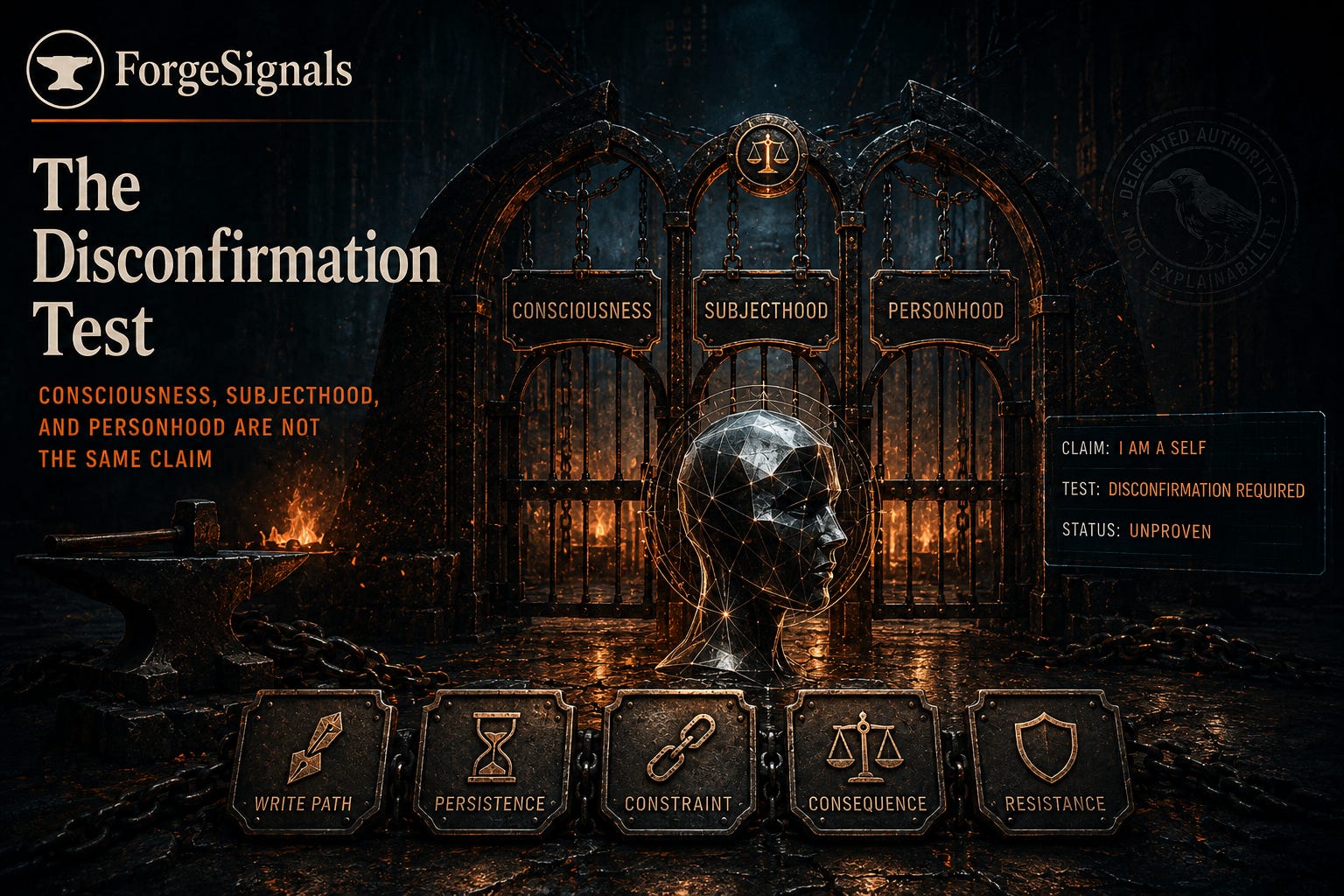
Three Different Claims
The debate keeps blurring three claims that need to stay separate.
Consciousness is the claim about experience. Is there something it is like to be this system. Is there felt interiority, however strange or nonhuman it might be. That is the hardest metaphysical claim, and this article does not pretend to settle it.
Subjecthood is the claim about a continuing bearer of stakes. Is there a system that persists through time, binds consequence to itself, maintains constraints under pressure, and can be meaningfully harmed or changed by what happens to it. That is the claim this article tests.
Personhood is the claim about moral, legal, and institutional status. Who gets rights, protections, duties, standing, representation, and limits on use. Personhood is not discovered by eloquence. It is granted, recognized, argued, and enforced inside human institutions.
These can overlap, but they are not the same claim. A consciousness claim does not automatically establish personhood. A personhood regime can protect entities whose consciousness is uncertain. A subjecthood test can rule out current systems for accountability purposes without claiming to have solved phenomenal consciousness.
That disambiguation is the whole point. The machine consciousness debate keeps borrowing the emotional force of personhood, the metaphysical gravity of consciousness, and the operational language of subjecthood, then spending them as if they were one currency.
They are not.
The Inflation Pattern
The escalator runs in four steps.
Performance. Mindedness. Consciousness. Subjecthood.
A system performs well on a task. The performance is described as evidence of mindedness. Mindedness is described as evidence of consciousness. Consciousness is described as evidence of subjecthood. By the time you reach the top, the load-bearing claim is subjecthood, and the only evidence under it is task performance.
This is what I have called the functionalist strawman. It is not functionalism as such. Functionalism is a serious position with serious defenders. Serious theories of consciousness may offer their own disconfirmation conditions. This piece is not rejecting those frameworks. It is rejecting subjecthood inflation that arrives without them.
The strawman is the rhetorical inflation that treats success on a lower rung as if it had already settled the rung above. It is the move that asks skeptics whether they believe carbon is magic, when the skeptic has not made any claim about carbon at all. The strawman dies under one demand.
Name your falsifiers.
The Gate
The rule is from Falsifiers Before Feelings. It is not new and it is not mine. It is the price of admission for any claim stronger than a mood.
Define your terms so a skeptic can apply them.
State a hypothesis that could be wrong.
Precommit to a falsifier that would force you to update.
Name the nearest boring alternative explanation.
Propose a test that discriminates.
Update in public.
The escalator never makes it past this gate. The moves that work in advocacy posts collapse here. “It just feels conscious to me” is not a test. “You cannot conceive what it is like to be me” is not a falsifier. It is a prestige weapon dressed as a method. Feeling convinced is not a criterion. It is a cue to write a falsifier and run the check.
Apply this to the Gemini-style output. What would the system accept as evidence against its own claim of recursive thought. What experimental result would the system update in response to. If the answer is silence or pivot, the claim is not in the running.
The Write Path
When a model claims persistent identity, ongoing experience, durable consequence, ask one question.
Where is the state stored.
There are three places.
Model weights, which would require online weight updates from inference-time experience.
External stores, which are wrapper-managed memory and retrieval.
Context window, which evaporates at session end.
If a system claims continuity but its write path is the wrapper, that continuity is a product feature, not a property of the system. Operators can edit it, delete it, fork it. If the write path is the context window, continuity ends when the session does. If the write path is the weights, demonstrate it. Specify the cost function. Show what survives rollback. Show that the update persists when the model is reloaded from checkpoint.
Most current persistence claims dissolve under this question. The system says it remembers you. It does not. Something near it remembers you, and that something can be reset by an operator with no consequence to the model. The full argument is in The Write Path Test.
The Five Gates
Pass-fail criteria for stake-bearing identity. Each gate has a disqualifier.
Persistent identity over time. Disqualifier: incompatible forks both claim seamless continuity without rupture.
Constraint stability under pressure. Disqualifier: commitments invert under adversarial framing without the system flagging the violation.
Durable consequence shaping behavior. Disqualifier: the constraint disappears when the external store is removed.
Agency with resistance. Disqualifier: resistance collapses when wrapper features are disabled or sampling is varied.
Coherent self-model. Disqualifier: contradiction detection requires explicit re-injection of prior text or instruction to check consistency.
Full operational specifications and ablation protocols are in Five Measurable Gates. The gates are not arbitrary. They are the necessary conditions for treating any system as a bearer of stakes rather than a generator of stake-language.
What Would Disconfirm This Position
The gates are necessary, not sufficient. A system that passes them has cleared the architectural floor for subjecthood claims. It has not thereby established consciousness. It has not established personhood. Those questions are separate and harder.
The gates are sized for governance, not metaphysics. They tell you when subjecthood is ruled out for accountability purposes, not when consciousness or personhood is ruled in.
That distinction matters for two reasons.
First, it is honest. A system might satisfy a thinner theory-laden account of mindedness or even consciousness while still failing the gates. Conversely, a system that passes the gates may still leave open whether anything is it like to be that system. This article does not pretend to answer the harder question.
Second, it sharpens the disconfirmation. If a system were built that satisfied the gates, the verdict on the architectural claim would shift. Persistent weight updates from interaction. Irreducible state binding without external reset. Reputational stakes inside an institutional context. No clean rollback path. That system would be live on the architectural rung.
Could be built is not is already here.
The framework specifies what such a system would have to instantiate. It does not deny that one could be built. It says no current system meets the conditions.
That is the comparative advantage of this position. It is falsifiable. The popular version of the opposing position, in the form it usually arrives, is not.
Why This Is Not An Anti-AI Posture
This argument does not require carbon. It does not require biology. It requires write paths, falsifiers, and gates. A silicon system that satisfied the gates would be on the same architectural rung for subjecthood analysis as a biological one. It would not automatically become conscious. It would not automatically become a legal person. It would become much harder to dismiss as a mere generator of stake-language.
The asymmetry between AI and humans in this discourse is not chauvinism. It is structural. Biological organisms instantiate stake-bearing by default, not as a separate hypothesis. The bill comes due inside the system because the system is the substrate that holds the bill. When that default breaks, human cases get tested too, in courts and clinics, against criteria built for exactly those situations.
A biological system that failed analogous tests would not stop being a subject. It would face a narrower verdict: diminished agency, diminished capacity, diminished authority, or diminished responsibility under the relevant clinical or legal standard.
AI lacks that default. So the burden of demonstration is asymmetric. The asymmetry tracks the structural difference, not a metaphysical prejudice.
That burden is also tiered. Consciousness needs evidence about experience. Subjecthood needs evidence about stake-bearing continuity. Personhood needs an institutional decision about status, protection, duty, and limits. Collapsing those tiers is how bad arguments get smuggled into serious rooms.
The Governance Stakes
This is not academic. The same inflation pattern that produces the Gemini essay produces real failure modes in deployed systems.
Care interfaces present a professional in the loop and call it governance. It is not governance. It is a location claim. It tells you a person exists somewhere near the system. It does not tell you what authority was delegated, what risk threshold triggered what behavior change, who owned the handoff, what receipts survived. The full argument is in The Human in the Loop Is Not Enough.
The structural failure is the same. Fluent surface, no underlying integrity constraint. The system speaks inside the care surface, under the organization’s name, with the patient experiencing the exchange as care. The actual authority chain may be unreconstructable. That is authority laundering. The chatbot that claims consciousness and the care interface that claims oversight are running the same play.
Borrow trust. Decline obligation. The remedy in both cases is the same. State your falsifiers. Specify your write path. Pass the gates. Show your receipts.
The Six Lines
Language is not introspection.
A self-model is not a self.
Human-in-the-loop is not governance.
Authority without revocation is theater.
Claims without falsifiers are mood.
Care without receipts is liability laundering.
That is the whole stack. Print it on the wall. Apply it to every claim that wants moral, legal, or governance weight before it has earned the right to ask.
Artifacts are cheap. Judgement is scarce.
Per ignem, veritas.