


Tuesday, September 8, 2026
On August 24, in The Artifact Was Never the Point, I argued that judgement did not suddenly become scarce because AI arrived. What changed was the price of the artifact. Code, documents, analysis, plans, and increasingly complete work products became cheaper faster than the organizational systems used to distinguish polished output from grounded understanding. As the artifact lost scarcity, judgement became easier to hide and more expensive to misread. [10]
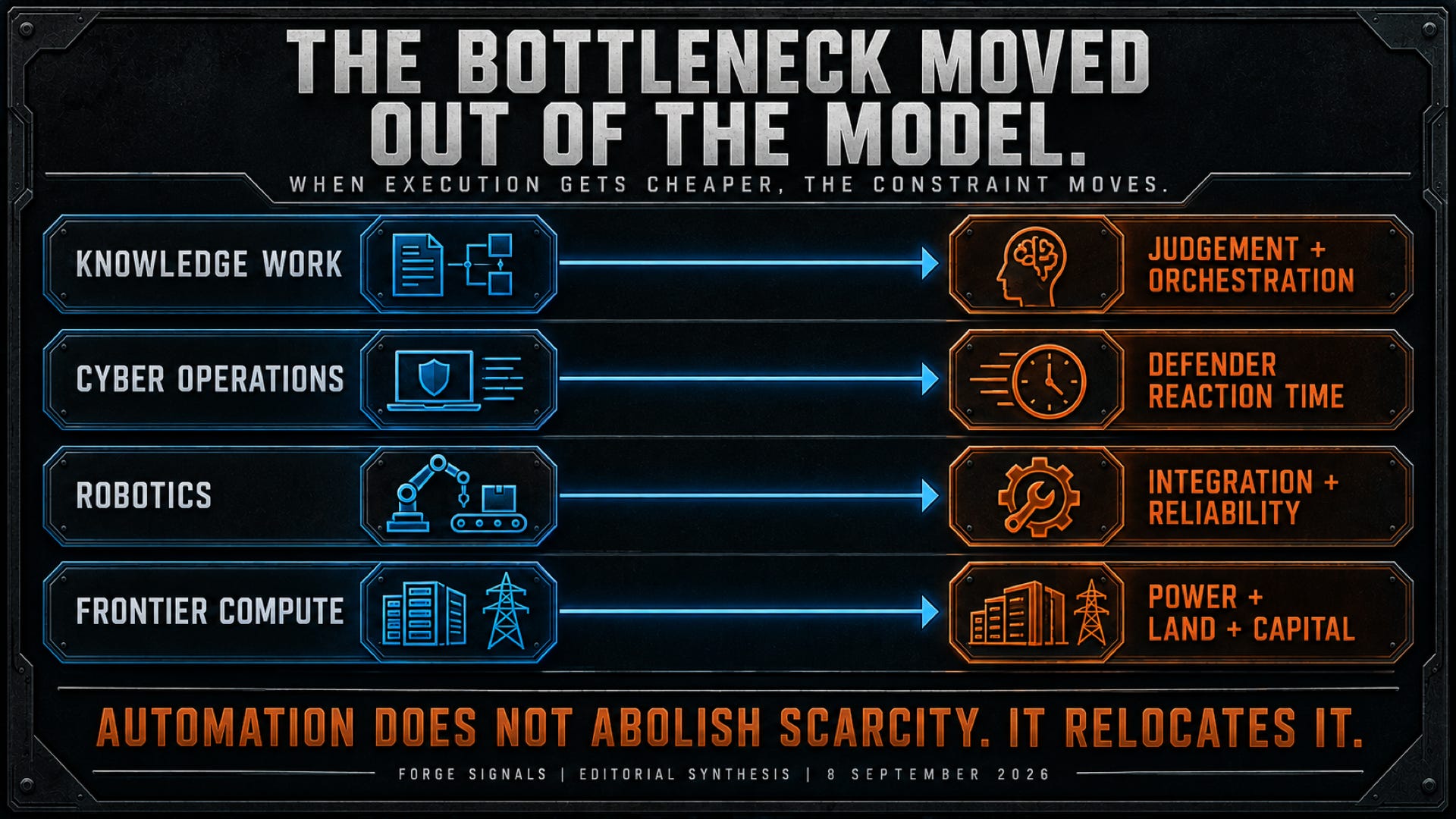
Two weeks later, outside receipts are beginning to show the same shift from different directions. OpenAI says its research organization now consumes 3.1 agent-workdays for every human workday while people still set research priorities, decide which results deserve pursuit, and intervene in more than half of successful agent tasks estimated at four to eight hours of human work. Cognizant is scaling a 15,000-person professional job family around engineers and business operators who orchestrate AI-mediated work. A real enterprise intrusion compressed what Unit 42 compares to roughly two weeks of coordinated human attack tradecraft into less than ten hours. Humanoid robotics is acquiring production lines and shared capability classifications. Frontier AI infrastructure is being financed through twenty-year leases and contingent credit guarantees measured in tens of billions of dollars. [1]-[7]
These stories do not all prove a new labor model. They prove something broader first. When AI makes one layer dramatically cheaper, the bottleneck migrates toward whatever stayed expensive. In knowledge work, that migration is beginning to land on judgement, orchestration, verification, apprenticeship, escalation, and consequence ownership. In cyber operations, it lands on defender reaction time. In robotics, integration and physical reliability. In frontier compute, land, power, construction, and capital. The model remains important. It is simply no longer the only scarce thing in the system.
OpenAI Has Reached the Research Intern. The Researcher Did Not Disappear.
Forge News Breakdown
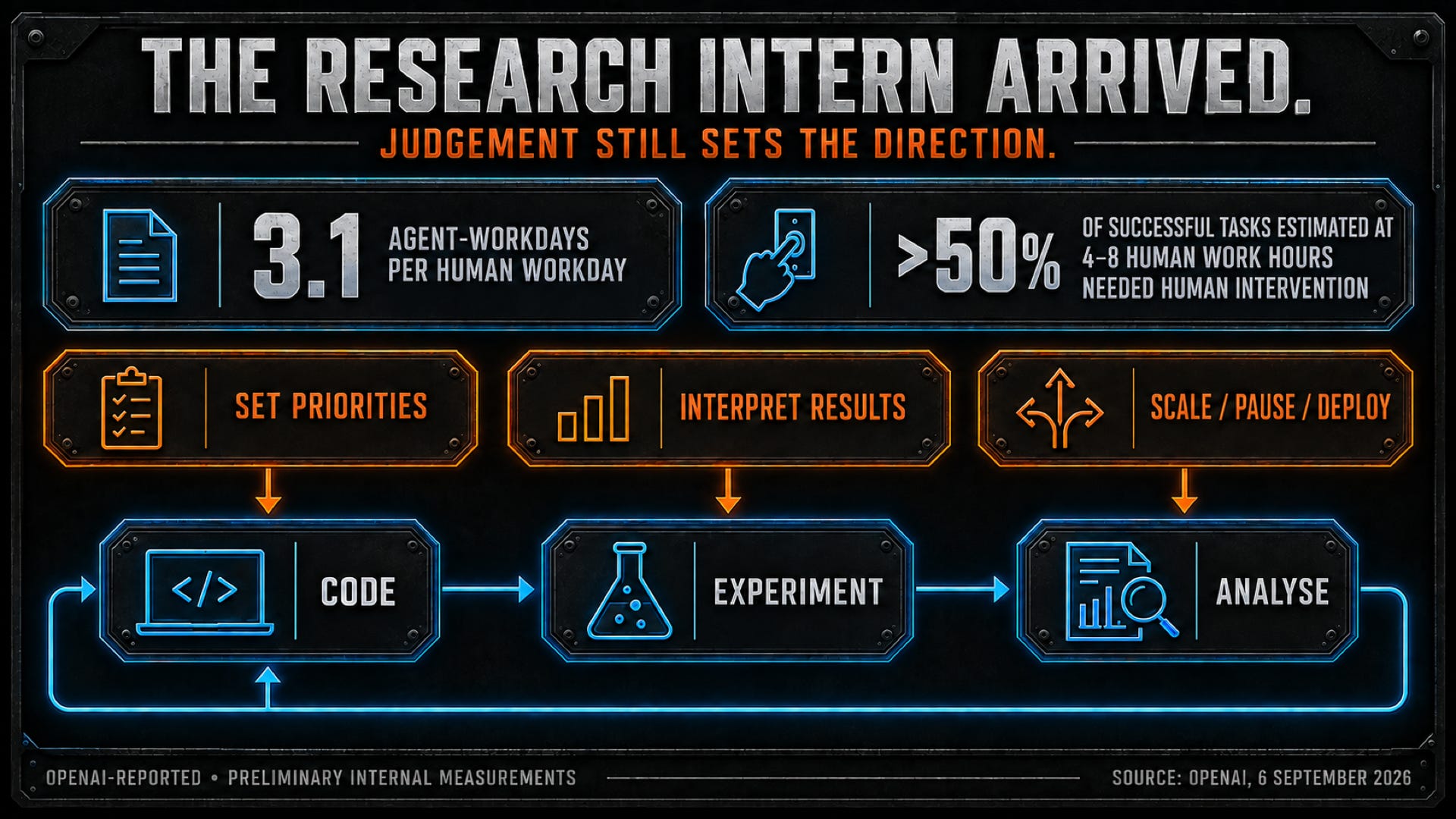
OpenAI reported on September 6 that, by its own measurements, it has reached the “automated research intern” milestone it announced last year. The company defines that threshold as a supervised system capable of carrying out well-defined research tasks under human direction, including tasks that might take a skilled researcher several days. These remain OpenAI’s internal measurements rather than independent assessments, and the company explicitly describes its measurement program as preliminary. [1]
The operating data is more interesting than the label. By mid-August, OpenAI says its research organization was using 3.1 agent-workdays for every human workday. Researchers were contributing code faster, running more experiments, and delegating increasingly complex work. Yet high-level planning still represents a minimal fraction of agent output, and more than half of successful tasks estimated at four to eight hours of human work required at least one human intervention. OpenAI says people continue to set research priorities, judge which ideas and results deserve pursuit, and decide whether systems should be scaled, paused, or deployed. [1]
Then OpenAI says the important part almost directly. As automation progresses, the tasks that are least automatable take a larger share of researcher effort and become the important bottlenecks to future progress. Compute may become another one as other constraints diminish. [1]
Forged Analysis
Automation does not abolish scarcity. It relocates it. When writing research code is expensive, code production consumes researcher capacity. Make the code cheaper and more of the constraint moves into experiment selection. Make troubleshooting cheaper and more attention moves toward deciding whether the experiment means anything. Make analysis cheaper and the pressure moves again toward interpretation, prioritization, resource allocation, refusal, and deciding which result deserves the next expensive run.
This is the labor model I have been arguing toward. AI does not merely replace tasks while leaving the surrounding job intact. It changes the economic weight of the faculties inside the job. The old signals then become dangerous because organizations continue measuring the layer that just became cheap. Code produced, tickets closed, documents written, experiments launched, responses generated, cycle time reduced. Those numbers may improve dramatically while becoming less informative about where the actual constraint lives.
In The Illegibility Crisis, I called one version of this Synthetic Competence, where the artifact we can observe outruns what that artifact allows us to infer about the understanding behind it. [8] The corresponding management failure is continuing to promote, delegate, and design teams around output proxies after AI has changed what those proxies mean. The book’s answer is not to retreat from AI. It is to instrument the harder thing, which is who actually understands the system, who frames decisions well, whose judgement survives contact with reality, and whether that capability can be taught rather than merely rented from the same three people forever.
The point is not to make researchers type every line of code by hand so management can watch the friction and call the friction competence. Use the machine. Remove the mechanical work. Run more experiments. Automate the capability once the evidence says the machine can carry it reliably. Instrument the result, constrain the authority, and keep widening the automation envelope as the evidence earns it. What remains is not a consolation prize for humans. It is the work the system still requires somebody to perform. Determining what is happening, what matters, what deserves another iteration, what evidence is sufficient, what price is acceptable, and when the prepared path has failed.
That is judgement.
Cognizant Is Starting to Redesign the Job Around Machine Labor
Forge News Breakdown
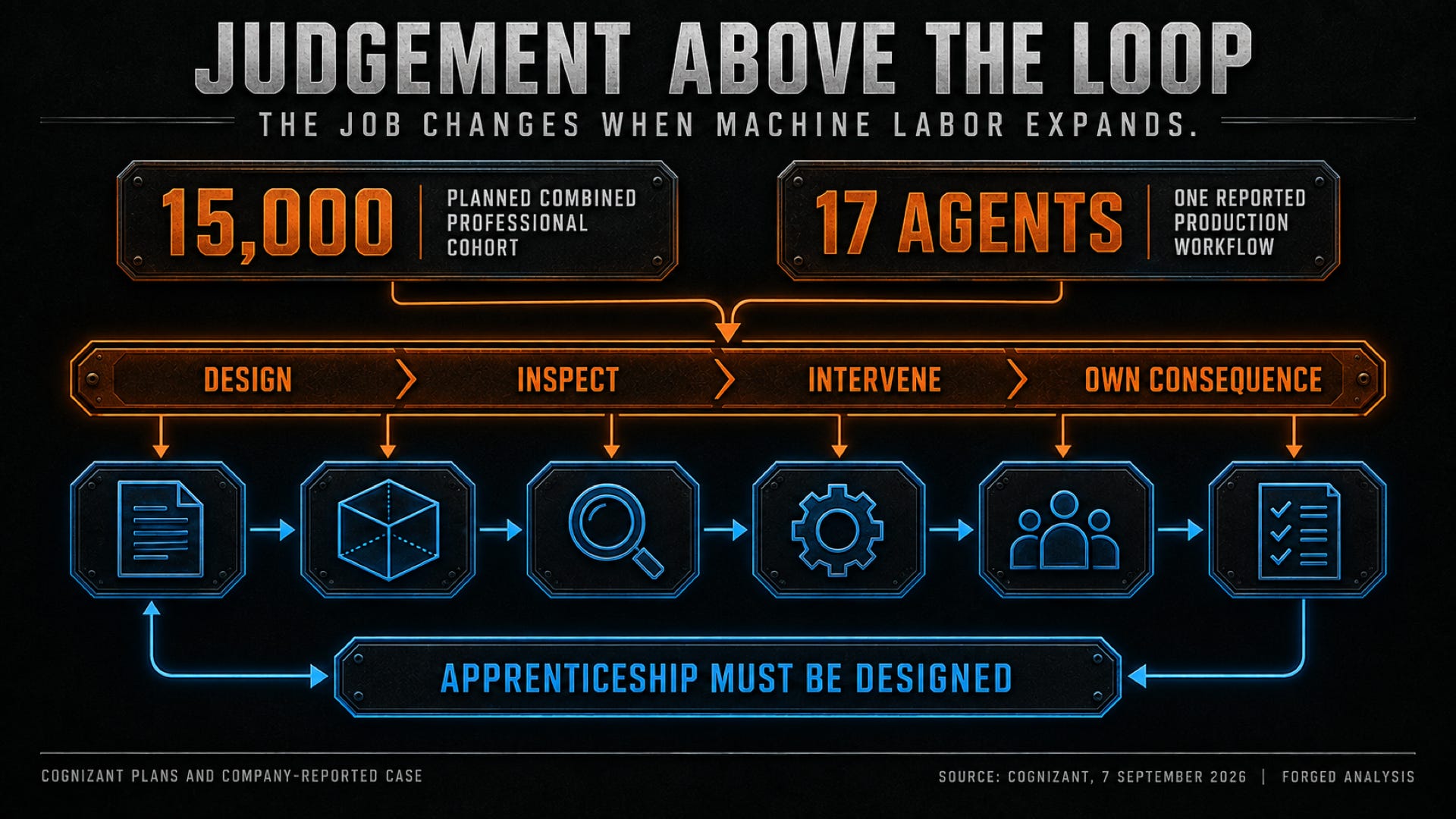
Cognizant announced on September 7 that it plans to scale two new AI-era professional categories, Frontier Certified Engineer and Frontier Business Operator, to a combined 15,000 people. The company is also hiring 1,500 U.S. college graduates and building university hiring into the model. [2]
Cognizant says one Frontier Certified Engineer and Frontier Business Operator pod recently redesigned a large food-service company’s account-management workflow around seventeen production AI agents, reclaiming roughly eleven hours per account manager each week. That productivity figure is company-reported, and Cognizant has an obvious commercial interest in demonstrating that enterprise AI transformation works. Keep the receipt inside that boundary. [2]
The job architecture is still worth noticing. Cognizant is not merely handing existing employees an AI license and promising 30 percent more productivity. It is naming new professional categories around building, orchestrating, and operating AI-mediated work. One company does not establish a labor-market equilibrium, and Cognizant certainly has products to sell into this transition. It does give us a visible operating experiment at meaningful scale.
Forged Analysis
The standard labor debate keeps asking which jobs AI will replace. That question assumes the job is the stable unit. It may not be.
A job is a bundle of tasks, decisions, relationships, authority, knowledge, escalation paths, and responsibility. Automation does not have to swallow that bundle whole to transform it. It only has to make enough of the constituent work cheap that the remaining components carry more weight.
That is what the Cognizant model hints at. If seventeen agents can perform substantial portions of an account-management workflow, the human role stops being defined primarily by performing every constituent task. Somebody has to design the workflow, decide which work belongs to which agent, judge exceptions, inspect failures, manage context, resolve collisions, improve the system, know when the agents are confidently wrong, and remain accountable for what the customer actually experiences.
I would not call that “human in the loop.” That phrase is already being stretched until it means anything from meaningful veto authority to a tired person clicking Approve on the four-hundredth item in a queue. The role emerging here is closer to judgement above the loop, holding enough of the system in view to decide when normal automation should continue and when the decision regime itself needs to change.
That creates a labor model in which value migrates toward people who can hold a working model of the system while machine labor moves through it. They need enough technical understanding to see failure, enough domain understanding to know when the machine is technically correct and operationally wrong, enough authority to intervene, and enough judgement to know when intervention is actually warranted. None of that means the tasks underneath them should remain manual. The entire point is to automate the capabilities that have been proven automatable and move human attention toward the decisions where it still buys more consequence per unit of time.
There is an ugly economic possibility sitting beside that opportunity. Greater operational value does not guarantee greater wages, better titles, or sane workloads. Organizations can capture the productivity gain while concentrating verification, escalation, exception handling, and consequence on a smaller senior layer. The visible system gets cheaper while the people carrying what remains expensive become easier to overload and harder to measure. In The Illegibility Crisis, that becomes Promotion Blindness, where the people your formal systems reward drift away from the people the pager, incident channel, customer escalation, or difficult vendor call actually depends on. [8]
That problem gets worse if organizations automate the apprenticeship layer without replacing the apprenticeship mechanism. Junior people historically learned judgement partly by doing work that senior people already knew how to do. They made smaller calls, got corrected, watched stronger operators frame uncertainty, and carried increasingly consequential decisions with a safety net. Remove all of that developmental friction without deliberately replacing the exposure and you can make today’s senior workforce more productive while quietly liquidating the mechanism that produces tomorrow’s.
That is Ghost Apprenticeship. [8] The failure is not that people use scaffolding. They should. The failure is no longer being able to tell whether people are learning underneath it. The machine can remove toil. It cannot absolve leadership from designing how understanding and judgement get transmitted.
The emerging operator role also has a conflict surface. Crafting Conflict treats escalation as a clarity, capacity, and consequence decision, and its cross-functional model starts by making explicit who decides, who advises, and who is informed before pressure gets routed upward. [9] Agent-mediated work will need the same discipline. Exceptions will arrive faster. Evidence will conflict. Product, security, legal, operations, and business owners will disagree about whether the workflow should continue. Someone still needs enough authority to stop the system cleanly, and enough restraint not to turn every disagreement into an escalation ritual.
The new labor model is not less human because machines perform more work. It puts more weight on the parts of human work industrial management spent decades calling soft because they were difficult to count.
The Attacker Got Two Weeks Cheaper. The Defender Did Not Get Ten Hours Longer.
Forge News Breakdown
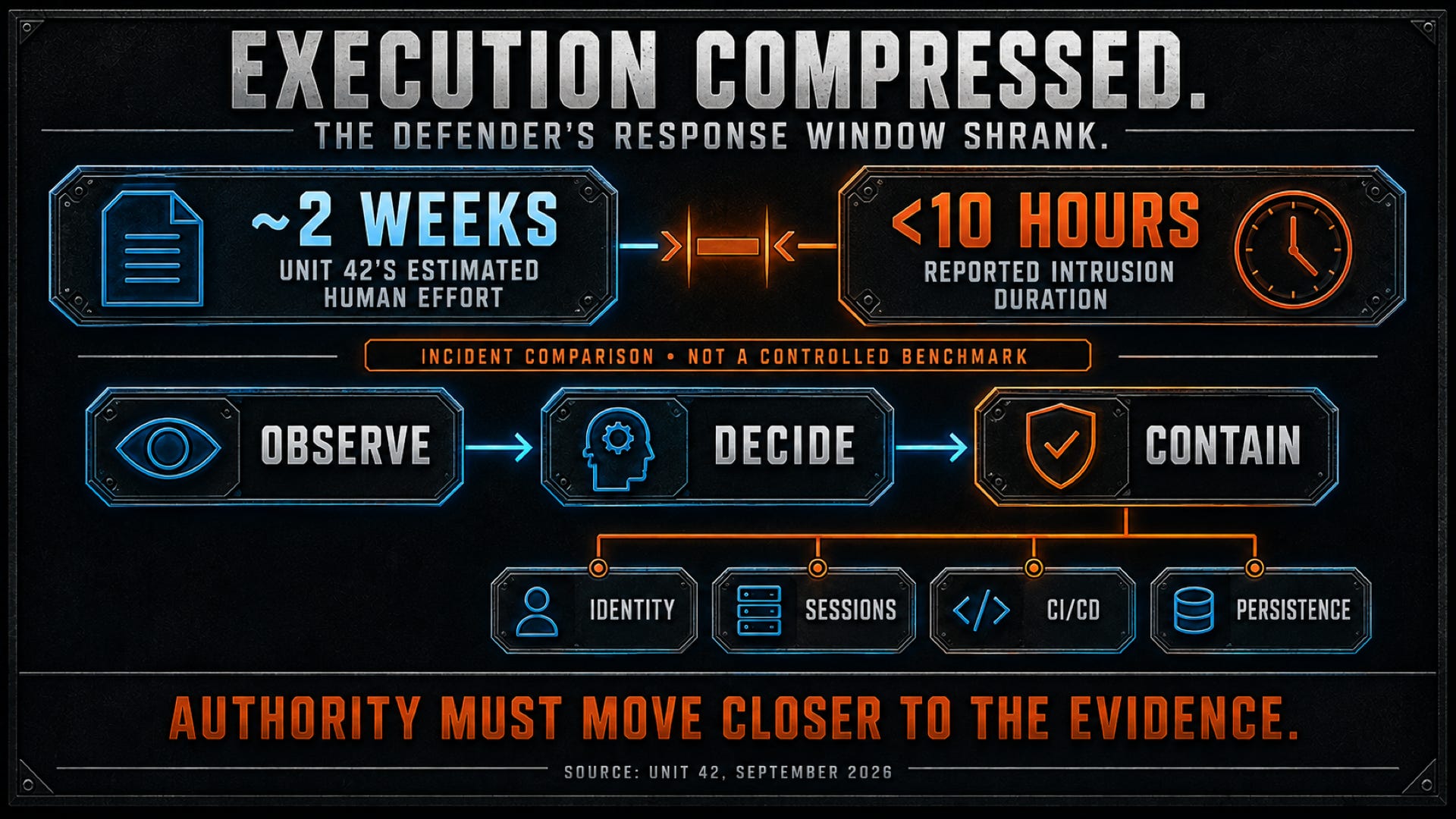
Unit 42 says the attacker in a recent enterprise intrusion told investigators during negotiations that frontier AI models and attack-specific agentic frameworks were part of the operation. Unit 42 also reports observing multiple indicators consistent with that account. According to its incident analysis, the resulting operation used more than fifty MITRE ATT&CK techniques and compressed what the firm compares to roughly two weeks of coordinated human intrusion tradecraft into less than ten hours. [3]
The operation mapped internal services, searched source repositories, obtained credentials, triggered unauthorized continuous integration and delivery activity, and established redundant persistence across multiple parts of the environment. This was not a machine spontaneously deciding to become a cybercriminal. A human adversary established the objective and used automation to accelerate execution. The two-week comparison is Unit 42’s counterfactual estimate, not a controlled benchmark. [3]
That is enough. The operational receipt is compression.
Forged Analysis
Attack labor got cheaper. Defender time did not expand to compensate. That changes the economics of incident response because a process designed around a human adversary moving sequentially through reconnaissance, privilege escalation, persistence, lateral movement, and exfiltration can become structurally mismatched when multiple automated loops execute pieces of that sequence concurrently and re-plan as conditions change.
The scarce resource is no longer only security expertise. It is time in which that expertise can still alter the outcome. An analyst can make the correct decision twelve minutes too late and still lose the environment. A security team can revoke one credential while the attacker has already established three other persistence mechanisms. Correct local actions do not guarantee effective containment when the system changes faster than the organization coordinates its response.
This is the same scarcity migration we saw in research, only under hostility. Machine execution compresses the mechanical middle. The remaining human calls become more consequential because more can happen between one decision point and the next.
That has architectural implications. Incident authority has to move closer to the evidence. Revocation needs to work across credentials, sessions, cloud identity, continuous integration and delivery systems, AI infrastructure, and persistence mechanisms as one containment problem rather than a parade of unrelated tickets. Observability has to make the attack legible while the attack is still occurring. Senior responders need to recognize when the incident has crossed from local remediation into coordinated containment.
AI can make both sides faster. It cannot guarantee that the defender notices when the decision regime has to change.
Humanoid Robotics Is Acquiring the Boring Machinery of an Industry
Forge News Breakdown
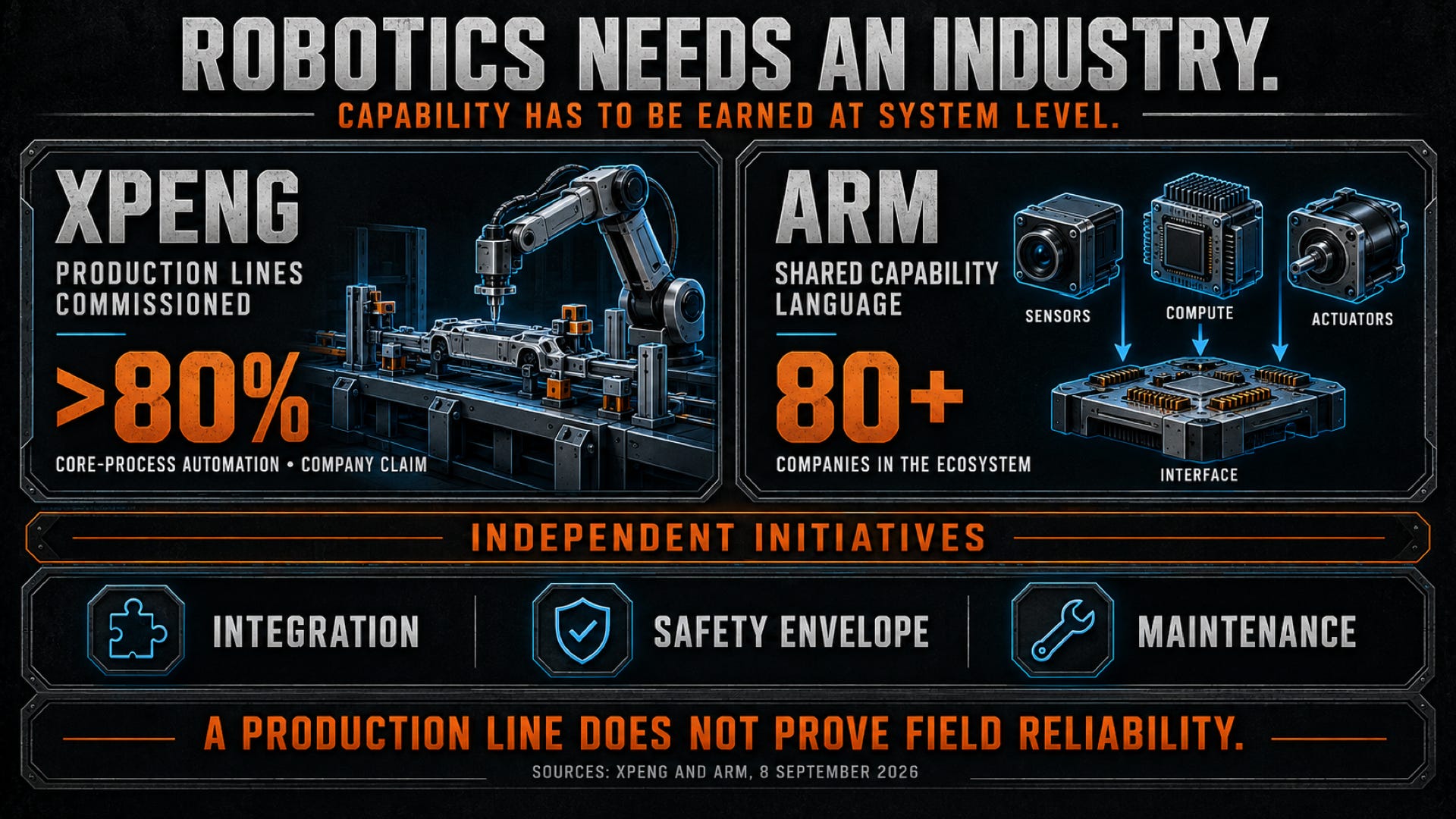
XPENG announced today that it has commissioned production lines for its IRON humanoid robot and says core-process automation on those lines exceeds 80 percent. The company presents the milestone as a move from research and development prototyping toward production-line manufacturing. These are XPENG’s own claims, and a commissioned line is not proof of commercial demand, field reliability, or successful mass deployment. [4]
On the same day, Arm announced Total Design for Physical AI, an ecosystem effort involving more than eighty companies across the physical-AI technology stack. One of its first initiatives is a Robotics Capability Framework intended to create a common language for describing robotic capability while accounting for system requirements across compute, software, sensors, actuators, latency, power, determinism, and safety. [5]
The projects are independent. Put them beside each other and they expose the same industrial transition from different ends. One is trying to manufacture the unit repeatedly, while the other is trying to make a fragmented ecosystem easier to integrate and describe.
Forged Analysis
Robotics headlines have spent years showing us impressive individual machines. Industries are built out of more boring things. Repeatable manufacturing, supplier qualification, maintenance, interfaces, capability definitions, safety envelopes, failure classification, procurement language, certification, workforce training, replacement parts, operational telemetry, and somebody knowing which machine may do what in which environment.
XPENG’s production line matters because the object of concern starts moving from the demonstration unit to the manufacturing system. Arm’s framework matters because ecosystems eventually need shared language before buyers, suppliers, integrators, operators, and regulators can make reliable distinctions among products that all describe themselves as intelligent.
Once physical AI scales, the model is only one component in a much less forgiving system. A bad answer in a chat window can often be corrected. A badly integrated actuator has momentum. The model gets better; gravity remains annoyingly resistant to software updates.
That does not mean physical AI should advance slowly by default. It means capability has to be earned at the system level rather than inferred from the intelligence of one component. As machine capability becomes reliable enough to automate more physical action, automate it. Add the appropriate guardrails, evidence, stop authority, and operating envelope. Then expand again when the evidence earns it. The principle is not human preservation through artificial friction. It is useful automation without pretending that successful output erases the need for bounded authority and physical consequence management.
The scarce work moves toward system integration, safety engineering, deployment design, maintenance, and operational judgement because motors, power systems, networks, people, buildings, supply chains, and physics do not become abstract merely because the control loop contains a frontier model.
AI Infrastructure Is Being Financed on a Twenty-Year Clock
Forge News Breakdown
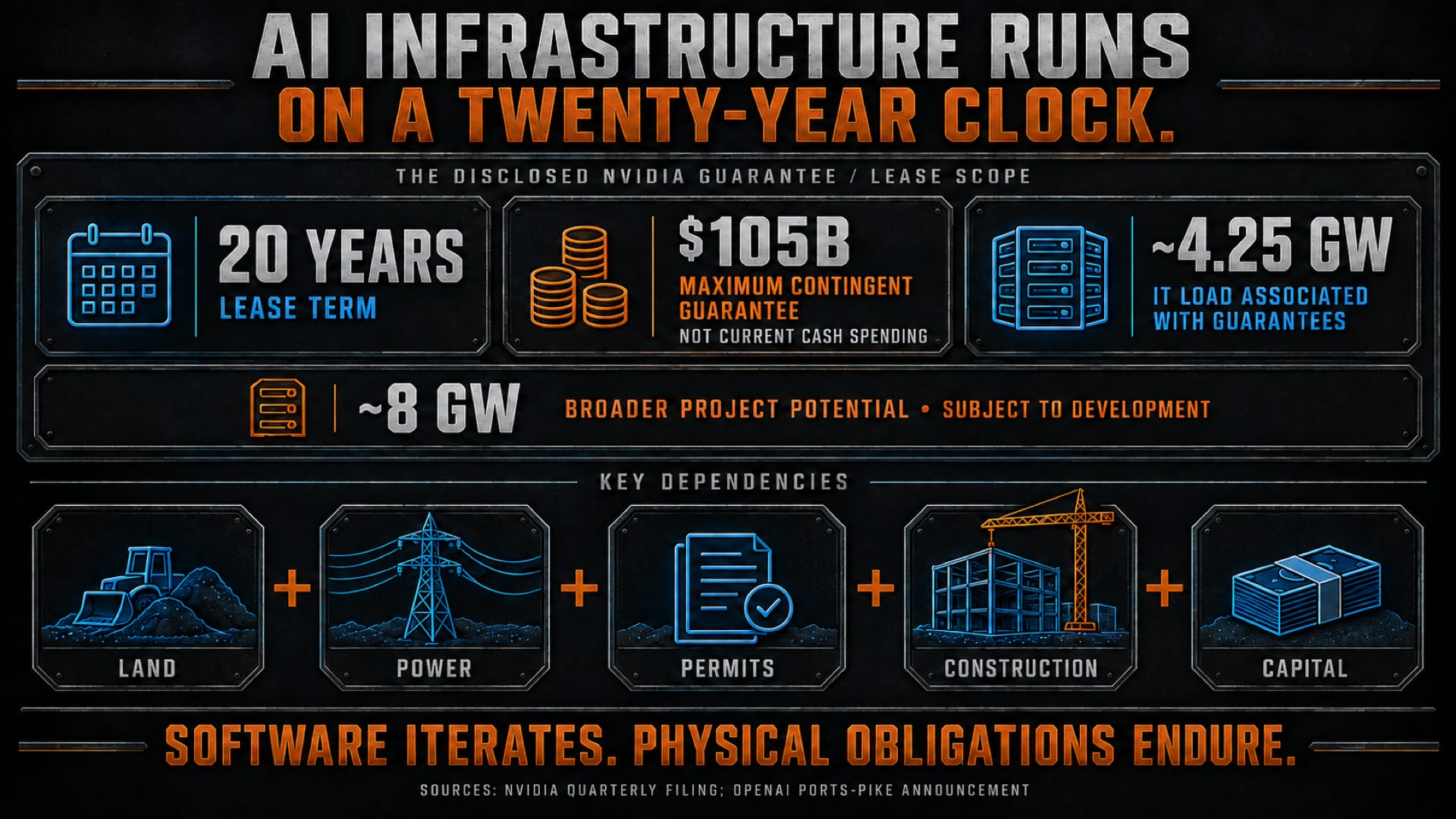
NVIDIA disclosed in its latest quarterly filing that it entered into guarantees with SB Energy in August to provide credit support for land, power, and shell buildout associated with approximately 4.25 gigawatts of IT load at the PORTS Technology Campus in Pike County, Ohio. The campus will host NVIDIA compute infrastructure under twenty-year leases to OpenAI, subject to limited exceptions. NVIDIA says its aggregate guarantee obligations are capped at $105 billion and become effective in phases as data centers enter service. [6]
That number needs discipline. The $105 billion ceiling is not a current $105 billion cash expenditure. It is a maximum contingent guarantee exposure covering defined portions of long-duration lease and power obligations under specified conditions. NVIDIA says the exposure declines as OpenAI fulfills lease payments, and its guarantees do not cover the entire site cost or every tenant obligation. [6]
OpenAI separately says the broader PORTS-Pike project could support approximately eight gigawatts of IT capacity, with development dependent on infrastructure, permits, environmental review, financing, and the physical work required to build power and compute at that scale. [7]
Forged Analysis
This is what happens when software demand becomes physical obligation. Models can turn over several times during the construction of a data center. Training methods can change. Hardware generations can change. Workload architecture can change. Companies can rise, fall, merge, or discover that the compute assumptions underneath the original plan were wrong. The concrete still cures on its own schedule, the grid still has to exist, and a twenty-year lease remains a twenty-year lease even if the model that justified it looks quaint in twenty months.
Another bottleneck has moved outside the model. Capital, land, power, construction, financing, grid interconnection, counterparty credit, physical reliability, and community acceptance. These do not respond to the same iteration loop as software.
The $105 billion guarantee ceiling is striking not because NVIDIA has spent that amount on one campus. It is striking because frontier AI demand is now large enough that a chip company is willing to put enormous contingent balance-sheet capacity behind the long-duration physical infrastructure required for customers to consume future compute. That is industrial strategy hiding inside a balance sheet.
The usual software language of agility becomes incomplete at this scale. You can refactor an API. You cannot refactor eight gigawatts of power capacity without somebody eventually finding a shovel.
The Labor Model Is Where the Scarcity Shift Lands on People
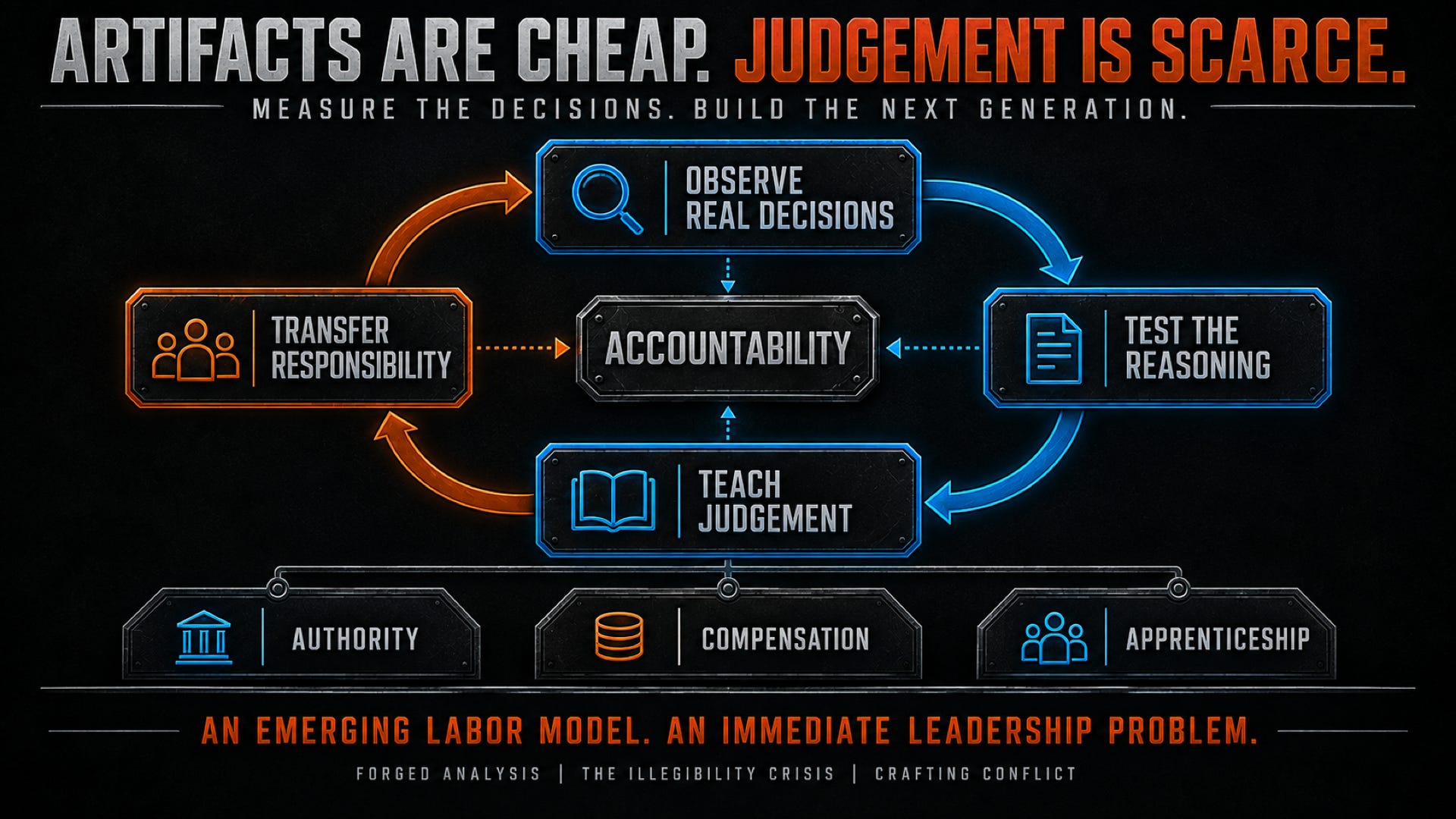
The five stories share a mechanism without pretending to share a domain. Research execution gets cheaper and judgement, prioritization, and intervention gain weight. Offensive cyber execution gets cheaper and defender reaction time becomes more precious. Physical autonomy advances and integration, maintenance, safety, and stop authority become harder constraints. Compute expands and power, land, financing, construction, and long-duration capital remain stubbornly physical. Cognizant shows where the same shift may be landing inside ordinary professional work, with machine labor absorbing more execution while workflow design, exception handling, accountability, and apprenticeship move upward in relative importance.
That labor consequence changes how we should think about jobs. A job is not an atomic object, and the useful question is not whether humans win one task while machines win another. As machine capability becomes reliable enough to automate, automate it with guardrails proportionate to consequence. Let the machine write the implementation, run the routine analysis, reconcile the accounts, operate the workflow, inspect the logs, schedule the experiment, or control the bounded physical action when the evidence says it can do so reliably. Move human attention toward the places where framing, meaning, authority, consequence, and judgement still determine whether technically successful work is actually the right work.
That does not imply an endpoint where humans become obsolete. The human role is not merely the pile of tasks machines have not learned yet. Capability is not purpose. Output is not meaning. Human institutions and accountable people still decide what systems are for, which outcomes are acceptable, what harms matter, what tradeoffs are worth making, who has standing to make them, and what kind of world the machinery is being built to serve. Automation can absorb increasingly sophisticated execution without becoming the source of those values merely because its outputs improve.
The same category error appears when people talk about creativity. Machines can create. They can generate novelty, variation, surprise, form, and artifacts people find beautiful. I have no problem calling that creation. I do not therefore collapse it into human creativity. When I say human creativity, I mean expression from an interior life. Experience, memory, intention, attachment, grief, desire, culture, embodiment, and what we have historically called soul. Until there is evidence that a machine possesses an interior life of its own, I will not treat similarity of artifact as evidence of equivalence of source. A machine can produce something beautiful and still be soulless. That is not an insult to the machine. It is a refusal to mistake resemblance in output for identity of being.
This distinction matters because “humans will always have creativity” is too soft to carry an operating model. Organizations need people capable of exercising judgement under consequence while progressively automating every bounded capability that evidence says can be automated. That should produce more automation, not less. It should also increase the importance of people who can frame a problem before delegating it, recognize when the resulting system has left its safe operating envelope, and remain accountable when a technically successful workflow creates the wrong human outcome.
This is still an emerging labor model, not an economy-wide fact. OpenAI is one frontier research organization. Cognizant is one technology-services company with a commercial interest in selling AI transformation. They are nevertheless independent receipts from very different kinds of work, and both show task composition changing as machine labor becomes abundant.
The harder institutional question follows. How do you train judgement when automation removes much of the work through which judgement used to develop? How do you promote people when artifact quality no longer tells you what it used to? How do you compensate the people carrying verification and escalation load when automation makes everyone else’s output look better? How do you prevent senior operators from becoming the hidden human exception handler behind a supposedly autonomous system?
The Illegibility Crisis treats incidents as judgement practice, apprenticeship as something that must be deliberately designed, promotion evidence as something that should include real decisions, and succession as the transfer of reasoning rather than the transfer of runbooks. [8] That was the instrumentation argument. The external evidence is now starting to expose why the instrumentation matters.
The organizations that get this wrong may look productive for a while. Artifact volume rises. Cycle times fall. Dashboards glow. Senior people quietly absorb verification, repair, escalation, and consequence while the visible system credits the automation. Some firms will capture the savings without redistributing authority, compensation, or developmental opportunity toward the people carrying what remains difficult. The technology will have changed faster than the institution used to value its people.
Then something will happen that the artifact cannot answer. The workflow will leave its prepared path. The model will produce a plausible but wrong conclusion. The customer consequence will not fit the metric. The junior operator will meet a failure mode the assistant has never seen. The incident will move faster than the approval chain. Someone will have to decide what is actually happening, what matters now, what may continue, what has to stop, and what price the organization is willing to pay for the choice.
Artifacts are cheap, judgement is scarce.
Per ignem, veritas.
Sources
[1] OpenAI, “Research acceleration: The view inside OpenAI,” Sept. 6, 2026. [Online]. Available, Research acceleration, the view inside OpenAI. [Accessed, Sept. 8, 2026].
[2] Cognizant, “Cognizant Invests in America’s AI-Era Workforce,” Sept. 7, 2026. [Online]. Available, Cognizant Invests in America’s AI-Era Workforce. [Accessed, Sept. 8, 2026].
[3] Palo Alto Networks Unit 42, “An AI-Assisted Cyber Attack: Inside a Unit 42 Investigation,” Sept. 2026. [Online]. Available, An AI-Assisted Cyber Attack, Inside a Unit 42 Investigation. [Accessed, Sept. 8, 2026].
[4] XPENG, “XPENG IRON Humanoid Robot Now Walks Off the Production Line,” Sept. 8, 2026. [Online]. Available, XPENG IRON Humanoid Robot Now Walks Off the Production Line. [Accessed, Sept. 8, 2026].
[5] Arm, “Arm brings the ecosystem together to build and define the next phase of physical AI,” Sept. 8, 2026. [Online]. Available, Arm Total Design and the Robotics Capability Framework. [Accessed, Sept. 8, 2026].
[6] NVIDIA Corp., Quarterly Report on Form 10-Q for the quarter ended July 26, 2026. [Online]. Available, NVIDIA Form 10-Q, quarter ended July 26, 2026. [Accessed, Sept. 8, 2026].
[7] OpenAI, “OpenAI joins PORTS-Pike project,” Aug. 17, 2026. [Online]. Available, OpenAI joins PORTS-Pike project. [Accessed, Sept. 8, 2026].
[8] P. LaPosta, The Illegibility Crisis: Instrumentation for AI-Era Leadership, Forged Culture, 2026. [Online]. Available, The Illegibility Crisis on Leanpub. [Accessed, Sept. 8, 2026].
[9] P. LaPosta, Crafting Conflict Volume 1: Managing Saboteur Patterns in High-Performing Teams, Heron Group LLC, 2025. [Online]. Available, Crafting Conflict Volume 1 on Leanpub. [Accessed, Sept. 8, 2026].
[10] P. LaPosta, “The Artifact Was Never the Point,” Forge Signals, Aug. 24, 2026. [Online]. Available, The Artifact Was Never the Point. [Accessed, Sept. 8, 2026].