


Monday, August 24, 2026
AI Is Changing Who Holds Power
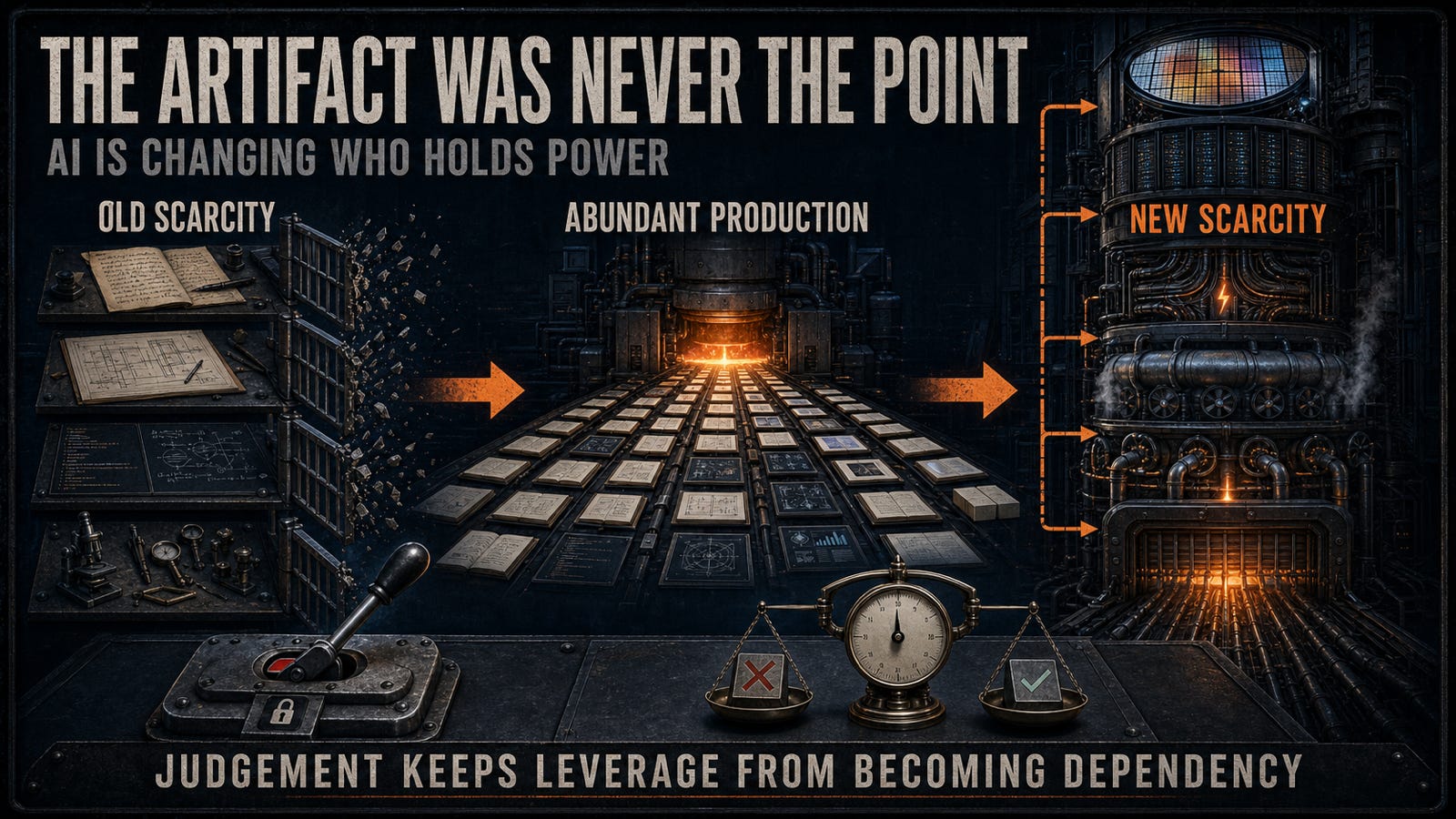
Everybody is fighting sideways. Writers are accusing other writers of cheating, artists are fighting users over legitimacy, professors are policing students, and engineers are arguing about who still counts as an engineer. Professionals who spent years earning access to difficult forms of production are watching people walk through doors that once required credentials, apprenticeship, institutional permission, or an expensive education. Some of those fights are legitimate. Copyright matters. Consent matters. Provenance matters. Compensation matters. Livelihoods matter. There are real questions about what was taken, what is owed, what must be disclosed, and what rights survive when machines can reproduce parts of work that once required a human specialist.
But while everyone fights over who deserves credit for the artifact, a remarkably small group of companies is spending extraordinary amounts of money to control enough of the machinery underneath it. They are acquiring compute, securing chip capacity, building data centers, assembling capital at extraordinary scale, integrating themselves into enterprise workflows, building developer platforms, and expanding distribution until their systems increasingly sit between an idea and the finished work. They do not have to settle the argument over whether an AI-assisted writer is a real writer or whether a programmer working through an agent is still a real programmer. If enough of the work eventually passes through their models, APIs, clouds, agents, and distribution channels, they gain leverage regardless of which faction wins the cultural argument.
That is the power transfer sitting underneath the authorship fight. AI is deliberately destroying old forms of scarcity while the companies building it position themselves around the scarce resources required to create, distribute, and govern what replaces them. The rest of us can fight over the shrinking value of the old scarcity while they build control over the infrastructure making that scarcity disappear. The power shift is intentional, and scarcity is the mechanism through which it moves.
The Strategy Is in the Infrastructure
Intent does not require psychoanalysis. I do not need to know what Sam Altman dreamed about as a teenager, what Dario Amodei thinks when nobody is listening, or which mixture of ambition, conviction, rivalry, fear, and ego drives any particular founder. Biography may eventually tell us interesting things, but it is unnecessary here. If you want to know what an institution intends, look at what it says it wants, where it puts its money, what it builds, what dependencies it creates, and which positions it works to control.
OpenAI is remarkably explicit about the first part. In June 2026, Sam Altman and Jakub Pachocki wrote that transformative technologies can concentrate power or broaden it, that the economy is already beginning to reshape around AI, and that the company’s next phase is about making advanced intelligence abundant, affordable, useful, and broadly accessible [2]. A month later, CFO Sarah Friar described how that abundance becomes an economic engine. Lower-cost intelligence makes more work economically worthwhile, broader adoption produces revenue, feedback, and demand, those support more research and infrastructure, and better systems drive another round of adoption. OpenAI calls this “the cycle we are building” [3].
The capital tells the same story. In March 2026, OpenAI announced $122 billion in committed capital at an $852 billion post-money valuation. It described itself as becoming “core infrastructure for AI,” called durable compute access a strategic advantage, and described ChatGPT’s consumer scale as a distribution channel into the workplace [4]. Its strategy spans infrastructure, models, agents, enterprise integration, and consumer products. OpenAI does not have to own every component to gain leverage across that system. It can own, partner, or buy where useful. What matters is controlling enough of the relationships, distribution, and infrastructure that growth in one layer strengthens the others.
Anthropic describes the stakes just as plainly. Dario Amodei has compared sufficiently advanced AI to a “country of geniuses in a datacenter,” with profound economic, societal, military, and security implications [5]. Anthropic’s work on global AI leadership treats compute, model intelligence, domestic adoption, and global distribution as strategic advantages and argues that leadership in those areas can create geopolitical leverage and the ability to shape the rules, norms, and infrastructure of an AI-enabled world [6].
None of this requires a secret political project shared by every frontier executive. The actors examined here already describe cheap intelligence, mass adoption, infrastructure scale, distribution, compute advantage, institutional dependence, and political power as connected problems, and they are allocating capital accordingly. If you deliberately make a previously scarce capability abundant, build the infrastructure through which that abundance is delivered, drive it into individual and institutional workflows, and position yourself around the scarce resources required to keep the system running, the redistribution of leverage is embedded in the strategy.
The Old Scarcity Was Power
For most of modern professional life, difficult production carried leverage because difficult production was scarce. A lawyer could do something most people could not. So could a programmer, designer, researcher, engineer, accountant, editor, or physician. The work required education, practice, institutional access, specialized tools, or enough accumulated experience that relatively few people could produce a credible result. That scarcity limited supply and supported compensation, but it also determined who could claim expertise, whose work received recognition, who sat in the meeting, whose recommendation became policy, and who remained outside asking for admission.
The artifact became both product and proof. A working program implied some ability to program. A legal brief implied legal competence. A research paper implied that somebody had found evidence, understood enough of it to construct an argument, and navigated the institutions required to publish it. The proxy was never clean. Ghostwriters existed, credentialism existed, senior people presented junior people’s work, and consultants produced decks executives later treated as revelation. Humans did not need artificial intelligence to invent synthetic competence. But meaningful friction still existed between wanting the artifact and producing it, and that friction gave the artifact scarcity value. The people controlling production inherited leverage from that scarcity.
AI attacks the friction. Stanford’s 2025 AI Index found that the cost of querying a model performing around GPT-3.5 level on MMLU fell from $20 per million tokens in November 2022 to seven cents by October 2024. Depending on the task, the report found inference prices falling between ninefold and nine hundredfold per year [1]. The important consequence is not simply that more people can make things. It is that the old producers lose part of the scarcity that gave them leverage. As the distance between wanting competent cognitive work and being able to produce it shrinks, the value attached merely to controlling production has to move somewhere else.
That is why the authorship argument feels existential. People are not only defending artifacts. They are defending the relationship between difficulty, expertise, livelihood, prestige, and authority that the artifact used to represent. The writer angry at another writer for using AI, the programmer sneering at somebody who built software with an agent, and the academic policing whether every sentence originated inside a student’s skull are all fighting over parts of a production scarcity that is already eroding.
The horizontal fight is extraordinarily convenient for the emerging infrastructure owners. While professionals fight over who still deserves access to the old sources of status, the companies making those sources less scarce are positioning themselves around compute, capital, models, distribution, cloud capacity, and institutional access. A company that controls the road does not need to win every argument among the drivers. It needs traffic. Every workflow built on its models, every organization that embeds its tools into daily operations, and every decision process that becomes dependent on its infrastructure creates another reason not to leave. What begins as convenience can become dependency, and dependency is where market leverage begins turning into control.
Abundance Can Still Concentrate Power
The common word for what AI is doing is democratization, and there is truth in it. Someone without years of programming experience can build software that once required hiring a developer. A small organization can perform analysis that once required specialist staff. A person uncomfortable with writing can produce competent business communication. Researchers can move through literature at speeds that would have sounded ridiculous a decade ago. That is real power moving outward, but the ability to use a capability and the ability to control the infrastructure producing it are not the same thing.
Stanford’s 2026 AI Index reports that industry produced more than 90 percent of notable AI models in 2025. It estimates global AI compute capacity at roughly 17.1 million H100-equivalents, growing about 3.3 times per year since 2022, with Nvidia chips accounting for more than 60 percent of that estimated compute base [7]. The OECD reaches the same problem from a competition perspective. Its 2025 analysis describes high barriers to entry, vertical integration, crossholdings, capacity constraints, and concentrated control across advanced lithography, leading-edge chip fabrication, GPUs, high-bandwidth memory, cloud infrastructure, and electronic design automation. In three critical segments, one provider reportedly holds more than 80 percent of the market. In three others, the three largest providers collectively exceed 60 percent. The three largest cloud providers also account for more than 60 percent of the global cloud market [8, pp. 18, 23].
The capital required to compete reinforces the structure. The IMF estimates that chip developers and hyperscalers collectively account for more than 70 percent of the AI stack’s revenue and outstanding debt, with hyperscaler capital expenditure projected around $3 trillion through 2029 [9]. Intelligence can become cheap at the point of use while remaining extraordinarily expensive to produce at the frontier. A person may be able to rent remarkable cognitive capability for a few dollars, and a startup may be able to build a product on top of it for a few million, while almost none of them can independently reproduce the infrastructure generating the capability on which they increasingly depend.
The Federal Trade Commission has already documented how relationships between model developers and cloud companies can deepen those dependencies. Its examination of Microsoft-OpenAI, Amazon-Anthropic, and Google-Anthropic identified equity and revenue-sharing rights, cloud-spending commitments, discounted compute, exclusivity provisions in some agreements, access to sensitive technical and commercial information, and contractual or technical switching costs that can make changing providers more difficult [10]. The FTC did not conclude that these arrangements are unlawful, nor does this argument require that conclusion. What matters here is that the relationships through which dependence can accumulate are already visible.
Once enough organizations build consequential workflows around a small number of models, clouds, APIs, and agent platforms, those companies gain influence over price, availability, capability, integration, and the conditions under which everyone else operates. A system can therefore distribute capability broadly while concentrating control over the conditions under which that capability exists. Millions of people can become more capable at the same time that a much smaller number of institutions become more powerful.
That is not a contradiction in the AI economy. It is one of its defining characteristics. The professions lose some leverage because production becomes less scarce, users gain leverage because powerful capabilities become accessible, and the infrastructure owners gain another kind of leverage because more people and organizations become dependent on systems they cannot reproduce or meaningfully replace.
Judgement Is What Keeps Leverage From Becoming Dependency
There is another power problem inside the professions themselves. Judgement was always scarce. The artifact was how we inferred that judgement existed. Software makes the fracture particularly easy to see because code is getting cheaper while understanding a production system is not. A pull request can be clean, the abstractions sensible, the tests green, and the documentation polished while the person presenting it still lacks a durable mental model of why the system is shaped that way, which assumptions carry the design, where it will fail under real load, or what happens when the prepared path stops working.
I developed this failure mode more fully in The Illegibility Crisis: Instrumentation for AI-Era Leadership [11]. I call one of its central fractures Synthetic Competence, senior-looking output without the grounded understanding the artifact used to imply. The deeper problem is illegibility. Once polished artifacts stop reliably signalling understanding, leaders lose one of the instruments they used to determine where real capability lives.
That is not merely a software-quality problem. It is a power and control problem inside the organization. If leadership cannot tell who understands a critical system, who actually made a consequential decision, what evidence informed it, which assumptions carry it, who can change course when those assumptions fail, and who owns the result, then the organization has lost visibility into its own capacity to act. AI can sharpen that failure precisely because it can improve every visible artifact. The implementation, tests, diagrams, documentation, architecture explanation, remediation plan, and postmortem can all look increasingly senior while the relationship between those signals and actual human understanding grows weaker.
This is why judgement becomes more consequential as production becomes cheap. Judgement did not suddenly become scarce, but the artifact becomes less reliable as evidence that judgement exists. The person who can use AI while retaining judgement becomes more capable because the machinery multiplies what that judgement can do. The person who refuses AI preserves autonomy but gives up leverage. The person who accepts machine output without preserving the ability to interrogate, reject, explain, and own it gains leverage while surrendering control.
That last arrangement is the dangerous one. A tool can extend capability without extending agency. If you cannot explain why an answer is right, recognize when it is wrong, reconstruct the reasoning when the system fails, or continue operating when access disappears, you have not merely adopted leverage. You have accepted dependency. The answer is not abstinence but legibility, making consequential judgement reconstructable through evidence, alternatives, uncertainty, decision ownership, and the ability to continue reasoning when the prepared path fails.
The same relationship scales upward. A professional gains leverage by using the tool and retains control by preserving judgement. An organization retains control only if it can still locate, inspect, and hold that judgement accountable. The company controlling the infrastructure gains leverage over both. That is where the personal argument and the political argument meet, because the question at every level is ultimately the same. Who can still act when the machinery disagrees, disappears, or changes the rules?
Rights Are Real, but Power Is the Larger Fight
None of this makes creators’ complaints imaginary. Copyright matters. Consent matters. Attribution matters. Provenance matters. Compensation matters. Workers have every reason to object when companies use productivity as a polite synonym for capturing the gains while externalizing the losses. Those rights should be fought for, but rights and scarcity are not the same thing. Saying that someone may not take protected work without permission is a rights claim. Requiring disclosure of how an artifact was produced is a provenance claim. Arguing that somebody should be compensated when protected work is commercially exploited is an economic claim.
Saying that someone should not be able to produce similar work without passing through the same scarcity barrier is different. That is a claim on preservation of the bottleneck itself. Years of training, tuition, apprenticeship, rejection, credentialing, and practice are real costs. Losing the leverage attached to them can be economically brutal, and calling that loss technological progress does not make the damage disappear. A person can be genuinely harmed by the collapse of a production bottleneck without acquiring a permanent moral right to that bottleneck.
The deeper problem is that legitimate fights over rights are becoming entangled with defense of the old power structure while a larger concentration of power develops above it. One writer attacks another writer, one artist attacks another creator, one engineer attacks another engineer, and one professor hunts for evidence that a student crossed an increasingly ambiguous line. The person standing beside us becomes the visible threat while the infrastructure through which all of us increasingly work becomes more powerful.
The old system distributed leverage across millions of professionals, firms, publishers, universities, guilds, credentialing bodies, and specialist workers. It was unequal, exclusionary, and often ridiculous, but power existed at many points because difficult production itself remained distributed. AI changes that arrangement. Some power moves outward because ordinary people gain capabilities they never had. Some moves toward professionals whose judgement becomes more valuable precisely because production is cheap. A substantial amount can also move upward toward the companies controlling the models, compute, distribution, interfaces, and institutional dependencies through which that abundance arrives.
OpenAI says it wants power broadly distributed [2]. That objective should be taken seriously enough to test against the architecture being built to deliver it. Broad access to capability is not the same thing as broad control over the conditions under which that capability exists. A system can empower millions of users while leaving pricing, access, capacity, rules, interfaces, and continuity in the hands of a few institutions. The question is therefore not whether AI gives people power. It plainly does. The harder question is whether the power it gives them remains theirs.
That is what gets lost when the conversation stays trapped at authorship. The writer is looking at the essay, the programmer at the code, the artist at the image, and the professor at the paper. Each is defending something real, but each is looking at the visible artifact while a deeper contest determines who controls the machinery producing more of the work, who retains the judgement needed to govern it, and who gains authority when everyone else becomes dependent on it.
If we spend this transition fighting sideways over the diminishing leverage of the old system, the people building the next one will not need to hide what happened. We will have handed them the leverage while arguing about who deserved the scraps. Scarcity explains how the transfer starts, but scarcity is not the prize. The prize is the ability to decide how intelligence is delivered, who depends on it, what it costs, what it may do, and who still has the judgement to say no when the machinery points somewhere it should not go.
The artifact was never the point. Power was.
Artifacts are cheap, judgement is scarce.
Per ignem, veritas.
Sources
[1] Stanford Institute for Human-Centered Artificial Intelligence, “Research and Development,” The 2025 AI Index Report, Stanford University, 2025
[2] S. Altman and J. Pachocki, “Built to benefit everyone: our plan,” OpenAI, Jun. 8, 2026
[3] S. Friar, “Building abundant intelligence,” OpenAI, Jul. 31, 2026
[4] OpenAI, “OpenAI raises $122 billion to accelerate the next phase of AI,” Mar. 31, 2026
[5] D. Amodei, “Statement from Dario Amodei on the Paris AI Action Summit,” Anthropic, Feb. 11, 2025
[6] Anthropic, “2028: Two scenarios for global AI leadership,” May 14, 2026
[7] Stanford Institute for Human-Centered Artificial Intelligence, “Research and Development,” The 2026 AI Index Report, Stanford University, 2026
[8] OECD, Competition in Artificial Intelligence Infrastructure, OECD Roundtables on Competition Policy Papers, no. 330, Nov. 2025, pp. 18, 23, doi: 10.1787/623d1874-en
[9] International Monetary Fund, “Artificial Intelligence Stack and Balance Sheet Vulnerabilities,” Global Financial Stability Report, Online Annex 1.6, Apr. 2026, p. 1
[10] Federal Trade Commission, Partnerships Between Cloud Service Providers and AI Developers, Jan. 2025
[11] P. LaPosta, The Illegibility Crisis: Instrumentation for AI-Era Leadership, 1st ed., A Forged Culture publication, distributed by Heron Group LLC, 2025