

The agentic desktop is not just an AI assistant. That is the brochure version. The real system sits across files, messages, meetings, browsers, dashboards, tickets, calendars, and workflows. It does not simply help someone complete a task. It learns how work gets done through a person. That is the shift we need to name before these tools become normal enough that no one remembers agreeing to the terms.
The tool does not just automate work. It starts to model the worker.
This is not the same claim as “AI will take jobs.” That frame is too blunt to be useful. It lets executives retreat into the familiar language of productivity, reskilling, and headcount planning. A nice soft fog bank with a budget owner. The harder problem is tacit labor capture.
A workplace assistant can summarize documents, draft emails, prepare meetings, search across systems, and automate repetitive steps. Those capabilities are useful. Pretending otherwise is not rigor. I am writing this with one of those assistants open in another window. That is exactly why I am not asking anyone to reject them.
But usefulness is not innocence. Once a tool can remember a worker’s projects, infer their priorities, learn their communication patterns, connect their relationships, and act through their tools, the governance object is no longer just the prompt. It is the worker-model.
The line is not whether the tool helps. The line is whether the worker can see, contest, and limit the model built from them.
The productivity story is incomplete
Most organizations will introduce agentic desktop tools through the productivity frame. People spend too much time hunting for context. Meetings create follow-up debt. Documentation is scattered. Status updates are slow. Work lives across too many systems. The assistant promises to collapse that mess into something usable.
Fine. Grant the point. These tools can reduce friction. They can retrieve context faster than a human can. They can draft passable artifacts. They can turn meeting sludge into action items. They can help a tired engineer, manager, analyst, or operator move through repetitive coordination work without sacrificing another afternoon to the gods of copy-paste.
But the productivity frame stops too early. If the assistant only handled explicit tasks, stayed stateless, forgot everything after the interaction, and had no ability to act across systems, the governance problem would be smaller. That is not where the market is going. The agentic desktop is moving toward persistent context, cross-tool retrieval, workflow automation, personal memory, semantic indexing, background agents, and action surfaces. The boundary is not triggered by AI in general. It is triggered by persistence, inference, imitation, action, or evaluation.
This is not speculation. Amazon’s new Quick desktop assistant is described, on its own product page, as an AI assistant for work that connects across tools, learns what matters to the user, and takes action on the user’s behalf. Its desktop documentation describes local file access, connected services, a knowledge graph, scheduled agents, and browser automation. That is not an accusation. That is the pitch. The features ship today. The reuse boundary is the part still being decided.
The tool does not just ask, “What do you want me to do?” It asks, implicitly, “How do you work, and how can I make that reusable?” That second question is where assistance starts to shade into extraction.
What gets captured
Watch a senior operations lead handle an escalation. She rewrites the email three times, not for grammar, but because she knows the VP on the thread reads only the first line, the customer forwards everything, and the engineer who caused the outage is two weeks from burnout and does not need an audience for it. None of that lives in any document. All of it just got typed into a tool that remembers.
The obvious answer is data. Files. Messages. Calendar entries. Meeting transcripts. Tickets. Dashboards. Customer notes. Browser context. Local documents. Chat history. That matters, but it is not the center. The center is the tacit layer.
How someone prioritizes.
How they decide what matters.
How they write under pressure.
Who they trust.
What they ignore.
How they translate ambiguity.
How they handle exceptions.
How they turn chaos into direction.
That is the valuable part of skilled work. It is also the part least likely to be protected, because organizations are much better at naming databases than naming judgement. They can classify documents, label repositories, assign data owners, and audit permissions. Then they look at the living pattern of a person’s work and call it “productivity telemetry,” as if changing the label dissolves the ethical problem. A little managerial incense, and suddenly the altar looks clean.
The privacy question asks what data the tool collected. The labor question asks whether we just extracted the thing that makes this person valuable. Those are not the same question.
A vendor may promise that employee prompts and documents are not used to train the vendor’s foundation model. Good. That should be required. It is also not enough. The worker-model may not live inside a foundation model at all. It may live in a personal knowledge graph, an assistant memory layer, an activity feed, a style profile, agent history, semantic index, workflow template, or internal analytics system. It may never be called a model. That does not make it harmless.
There is a fair objection here. Organizations have always captured how work gets done. Runbooks, playbooks, apprenticeship, the binder nobody updates. The company paid for the work, and it has a legitimate interest in continuity. Grant that too. But payment for work is not consent to unrestricted behavioral modeling.
The difference is not capture versus no capture. The difference is chosen documentation versus ambient extraction. A playbook is what a worker chose to write down. The worker-model is everything they never did, captured at full fidelity, updated daily, and held by someone else when they leave, or when they are made to. Consent is thinner when the tool becomes the job.
Mimicry is not succession
This is the part leaders will be tempted to get wrong. The assistant can imitate artifacts. It can produce the email that sounds like the manager. It can draft the project update in the staff engineer’s cadence. It can summarize the incident in the shape the director usually uses. It can reconstruct a workflow from past behavior and make the next instance look familiar. If you have ever watched a draft appear in your own cadence and felt something colder than convenience, you already know.
That is not succession. It is mimicry.
The tool can reproduce tone.
It cannot own the relationship.
It can follow a workflow.
It cannot know when the workflow is wrong.
It can imitate a prioritization pattern.
It cannot carry the political, operational, or moral consequence of the decision.
It can generate senior-shaped output.
It does not become senior.
This matters because organizations are already vulnerable to synthetic competence, work that looks fluent, polished, and mature without grounded understanding underneath it. Agentic desktops extend that risk from artifacts to people. The company does not just get a cleaner document. It gets something that looks like continuity.
“We have captured how our best people work.” That sentence will sound responsible in a planning meeting. Every telemetry stream in corporate history has eventually found its way into a review deck. Then it becomes “We can scale their methods.” Then “We do not need as many of them.” Then, six months later, “Why did quality, trust, mentoring, incident recovery, customer context, and exception handling all collapse?”
Because you copied the shape and removed the source. The pattern was trained on the days that went well. The person was made by the days that did not.
Captured pattern is not judgement.
Pattern residue is not leadership.
A behavioral fossil is not a living operator.
The worker-model boundary
Every organization deploying these tools needs a worker-model boundary. If no one owns that boundary by name, no one owns it. A normal SaaS review is not enough. A normal security review is not enough. A privacy review that only asks about vendor training and data storage is not enough. For every workplace AI assistant, leaders should be able to answer a short, uncomfortable list.
What can the tool read?
What can it remember?
What can it infer?
What can it imitate?
What can it write?
What can it click?
What can it submit?
What can it change?
What gets logged?
Who can audit it?
Who can revoke it?
What may never be used for performance, discipline, promotion, layoff planning, compensation, or replacement modeling?
That last category needs to be explicit.
Not implied.
Not culturally understood.
Not hidden in a policy PDF no one reads unless Legal starts circling like weather.
Explicit.
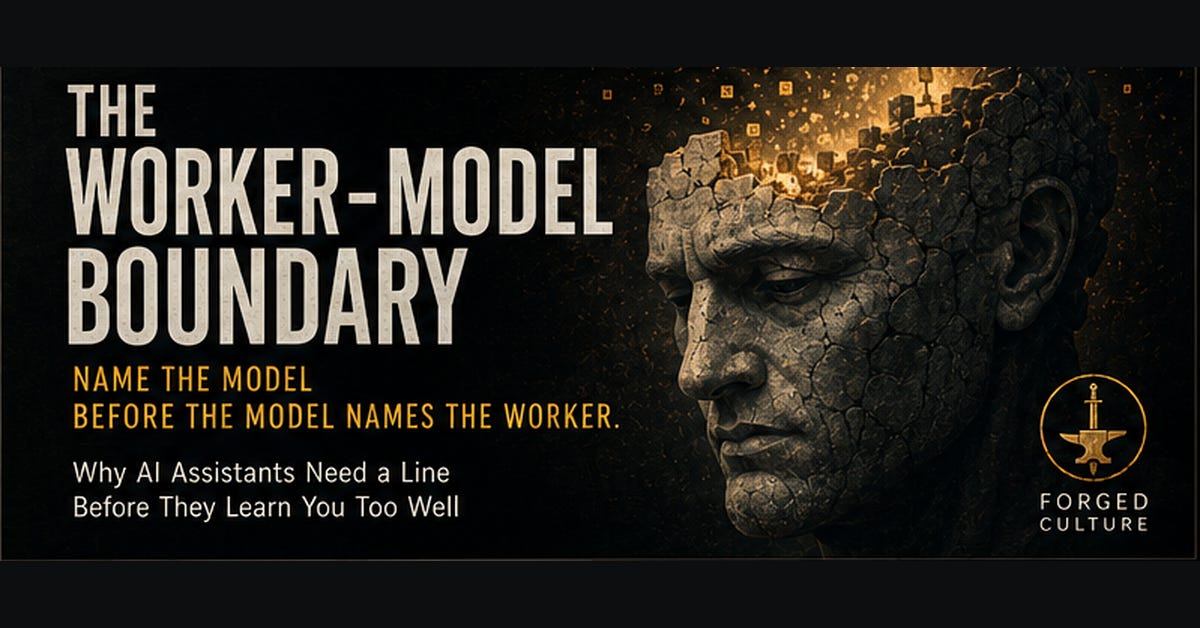
Persistent worker modeling creates a new governance object. If the system can remember, infer, imitate, act, or evaluate based on a person’s work patterns, then the organization needs a boundary before rollout. Name the model before the model names the worker.
Regulators are already closer to this than most deployment plans admit. The EU AI Act classifies some employment and worker-management AI systems as high-risk, including systems used to make decisions affecting work relationships, promotion, termination, task allocation based on individual behavior or traits, or monitoring and evaluating worker performance and behavior.
Under Article 113, the Regulation applies from 2 August 2026, with specific exceptions and staged dates. If your assistant’s memory can feed any of those uses, you are not early. You are late.
No worker-model reuse without meaningful consent.
No personal AI memory, writing profile, knowledge graph, activity history, or agent trace used for discipline, ranking, promotion, termination, compensation, or layoff planning.
No productivity telemetry laundered into workforce analytics.
No action-taking agent over employee context without logging, review, revocation, and a named accountable owner.
No delegated action across critical systems without a consequence boundary.
If that blocks a desired management use case, good. That is the point of the line.
And if the assistant can act through human credentials, it is no longer just a copilot. It is part of the control plane. Treat it that way.
This boundary will slow your rollout. That is what a boundary is for. It will also make some productivity claims harder to launder into headcount strategy.
The field test
Pick one workflow the assistant touches.
Meeting prep.
Incident triage.
Project reporting.
Customer escalation.
Release coordination.
Hiring loop summaries.
Performance review drafting.
Then ask.
Who owns the result?
Who can explain the source chain?
What sources did the assistant use?
What sources did it miss?
Who can reverse the action?
Who approved the permission boundary?
What happens when the assistant confidently summarizes the wrong thing, and the summary is the only version anyone downstream ever reads?
What employee context is being captured that would not exist without the tool?
Can the worker inspect the model of themselves the system is building?
Can they correct it?
Can they delete it?
Can they prevent it from being reused outside their direct work?
If the answers are vague, you do not have governance. You have vibes with admin privileges.
The leadership duty
The leadership duty is not to reject these tools by reflex. That would be too easy, and mostly useless. The duty is to decide what kind of organization the tool is allowed to create.
I want these tools. I also want the line around what they are allowed to learn from me.
An assistant that helps workers carry their own context is one thing.
An assistant that turns their tacit skill into shared organizational machinery is another.
An assistant that produces drafts under human control is one thing.
An assistant that acts through credentials across live systems is another.
An assistant that helps someone remember their own work is a notebook.
An assistant whose memory can later be inspected, scored, compared, or reused by management is a witness for the prosecution.
These are not feature differences. They are authority regimes.
Read.
Remember.
Infer.
Imitate.
Act.
Evaluate.
Each rung crosses a boundary. Each boundary needs ownership, logging, consent, and consequence.
The agentic desktop is not dangerous because it helps people work faster. It is dangerous because it can quietly change what the organization believes work is.
Work becomes the artifact, not the judgement.
The summary, not the source chain.
The style, not the relationship.
The pattern, not the person.
The workflow, not the consequence-bearing operator.
Once that happens, a company can convince itself it has preserved knowledge when it has only preserved residue. That is how labor capture becomes organizational illegibility.
The company becomes faster and less able to explain itself.
More automated and less accountable.
More polished and less wise.
The governance object was never the prompt. It was the person the prompt passed through. Engineering leaders should not wait for this to become an incident category.
Name what the agent can see.
Name what it can remember.
Name what it can do.
Name what it may never be used for.
Name who carries the consequence.
If you cannot answer those questions, you have not deployed a productivity tool. You have installed a new layer of organizational illegibility, built from the people who made the organization work in the first place.
Artifacts are cheap, judgement is scarce.
Per ignem, veritas.