


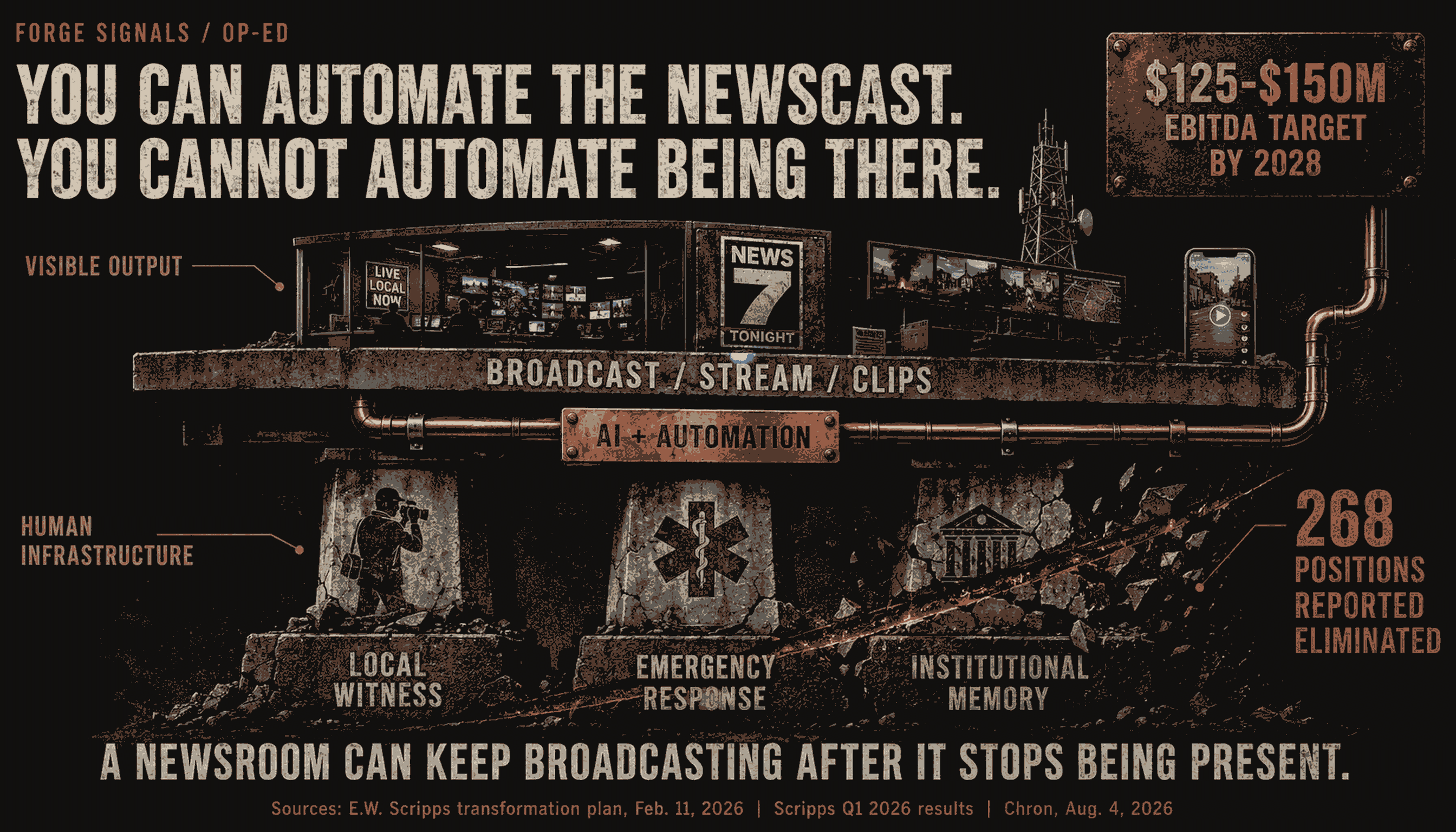
E.W. Scripps is eliminating 268 positions as it restructures its local television operations around digital publishing, automation, and artificial intelligence. The affected work reportedly includes producers, directors, technical employees, photographers, and some on-air positions associated with traditional newscast production. Scripps says the changes will reduce production friction and allow journalists to spend more time reporting. (Chron)
That is the promise. The question is whether the company is automating production around the journalism or removing so much of the institution that only the appearance of local news remains.
I spent about eight years at WBOC-TV, a small-market station serving communities across the Delmarva Peninsula. I was not a reporter, producer, or anchor. I was the network administrator. My responsibility was the technical system beneath the visible broadcast.
I managed the station’s networks, servers, backups, telecommunications, website infrastructure, digital program delivery, weather-alert system, school-closing system, and the logger that continuously recorded what went over the air. That vantage point taught me something that corporate transformation plans routinely misunderstand. A local station is not a program assembled from interchangeable parts. It is a standing operational presence built from people, systems, relationships, memory, and the obligation to remain available when the community needs it.
Some of the work was ordinary until the moment it was not. A school-closing system looked like another database until snow or ice covered several counties and families needed reliable information before dawn. A weather-alert system was routine infrastructure until a warning had to move quickly enough to matter. The on-air logger sat quietly in the background, but it preserved the record of what the station had actually told the public.
The website was not simply another place to repost stories. For a small-market station in the early 2000s, it extended the station’s public function beyond the broadcast schedule and gave the community another way to reach the information it depended upon. Each system existed to support the same obligation. The station had to be there, working, when the need arrived.
Local knowledge is part of the infrastructure
Local television is often evaluated by what appears on the screen. Executives count broadcasts, clips, page views, streaming hours, and stories published. Those measures capture output. They do not capture the institutional knowledge that makes the output useful.
A small-market station learns the geography of its community in practical terms. It knows which roads flood, which school districts make decisions early, which emergency offices communicate clearly, and which areas lose power first. It knows that a hospital closure, factory layoff, contaminated well, bridge repair, zoning dispute, or school-board vote can change the life of a town even though it will never attract national attention.
That knowledge is not stored neatly in one system. Some of it lives in contact lists, archived footage, old stories, technical procedures, and public records. Much of it lives in the accumulated judgement of people who have covered the same counties, answered the same phones, maintained the same systems, and learned which details matter locally.
Automation can process information already recognized as relevant. It is less capable of knowing what a community will need before the need becomes obvious. That requires presence, memory, and the ability to recognize when an apparently minor local development is not minor at all.
The people behind the broadcast are part of the reporting capacity
Corporate restructuring often divides a station into visible journalism and invisible support. Reporters are treated as the local presence. Producers, directors, photographers, editors, engineers, information-technology staff, and other operational employees become production cost that can be centralized or automated.
That division does not reflect how a station actually functions. Journalism depends on the capacity surrounding the reporter.
A producer decides what deserves attention, what still needs verification, and whether the official explanation answers the question. A photographer collects evidence that cannot be recovered from a press release. Directors and technical operators make live coverage possible when conditions change faster than a prepared format can accommodate. Engineers and technology staff keep the systems available, preserve the record, protect the information moving through the station, and restore service when something fails.
These functions can be redesigned. Some tasks should be automated. Repetitive switching, transcription, captioning, clip production, routine formatting, and distribution work should not consume human attention merely because an older operating model assigned people to them.
The danger begins when automation is used not to strengthen the station’s reporting capacity but to determine how little institutional capacity the company can retain while continuing to produce something that resembles local news.
A broadcast is not the same thing as a newsroom
Scripps says its transformation plan will generate between $125 million and $150 million in annualized earnings improvement by 2028 through cost reductions, revenue initiatives, and technology that includes artificial intelligence and automation. The company also says Americans depend on its programming to connect them with their communities. (E.W. Scripps)
Those two claims must be evaluated together. If connection to communities is part of the company’s purpose, then the success of the transformation cannot be measured only by earnings, output volume, or whether a scheduled newscast still reaches the air.
Scripps reported that its Local Media revenue increased 5 percent in the first quarter of 2026, while Local Media segment profit increased from $34.9 million to $46.7 million. Those results do not settle the company’s broader financial condition, but they do show that the local-station business was still generating substantial revenue and improved segment profit immediately before the announced cuts. (E.W. Scripps)
The company is therefore making a strategic choice about where local-media value will reside and who will bear the cost of producing it. That choice may prove necessary. It should not be disguised as technological inevitability.
A continuous stream can survive with fewer people. Graphics can remain polished. Stories can be reformatted automatically for television, mobile, websites, and social platforms. The familiar voices may still appear on screen. None of that proves that the community retains the same capacity for witness, scrutiny, emergency response, or institutional memory.
A newsroom can keep broadcasting after it stops being present.
Rural communities do not have spare institutions
In a large metropolitan area, several news organizations may cover the same government, hospital system, court, university, election, or emergency. Small and rural communities often have little redundancy.
When a local station loses capacity, another institution does not automatically take over the work. The county does not acquire an investigative desk. The school board does not become more transparent. The sheriff’s office does not begin independently scrutinizing its own actions. A neighborhood Facebook group may spread information quickly, but speed does not create verification, editorial independence, legal review, or an obligation to correct the record.
What fills the gap is usually a mixture of official messaging, rumor, national political content, and whatever an algorithm has learned will hold attention.
That weakens more than public knowledge. It weakens the community’s ability to maintain a shared account of itself. Residents may disagree sharply about a school budget, development proposal, election, police response, or hospital decision, but local reporting gives them institutions, documents, names, and consequences that belong to the same place.
Without that shared local record, national conflict moves into the opening. Every issue becomes evidence for a political story imported from somewhere else. The community becomes easier to provoke and harder to govern because fewer institutions remain capable of establishing what happened close enough for residents to verify.
The public function needs its own measures
The choice is not between preserving every old television workflow and allowing local broadcasting to collapse. That is a false frame. The legitimate question is whether automation increases the station’s capacity to perform its public function or merely reduces the cost of maintaining its visible shell.
A responsible transformation would identify what cannot be lost before deciding which jobs can be removed. It would protect field presence, emergency capacity, source development, local editorial judgement, institutional memory, technical resilience, and the ability to investigate officials rather than merely transmit their statements.
It would measure more than content volume. The relevant evidence would include how many public meetings receive coverage, how many counties retain regular reporting, how quickly the station can respond during an emergency, how much original reporting is produced, how many tips remain unresolved, and how much of the station’s output originates locally rather than being repackaged from elsewhere.
Scripps says automation will allow its journalists to produce deeper local reporting and engage audiences more effectively. The company should be expected to demonstrate that outcome. It should disclose what reporting capacity remains in each affected market, what work has been automated, how emergency operations will function, and what measures will show that the communities involved are receiving more than a continuous feed carrying a local brand.
I know from maintaining the systems beneath a small-market station that the visible broadcast is only the surface. The public value comes from the institution behind it, including the people who notice, verify, preserve, repair, remember, and respond.
A company can automate the newscast. It cannot automate being there.
Artifacts are cheap, judgement is scarce.
Per ignem, veritas.
Sources
E.W. Scripps transformation plan, February 11, 2026