

Segment One - The Referral Threshold
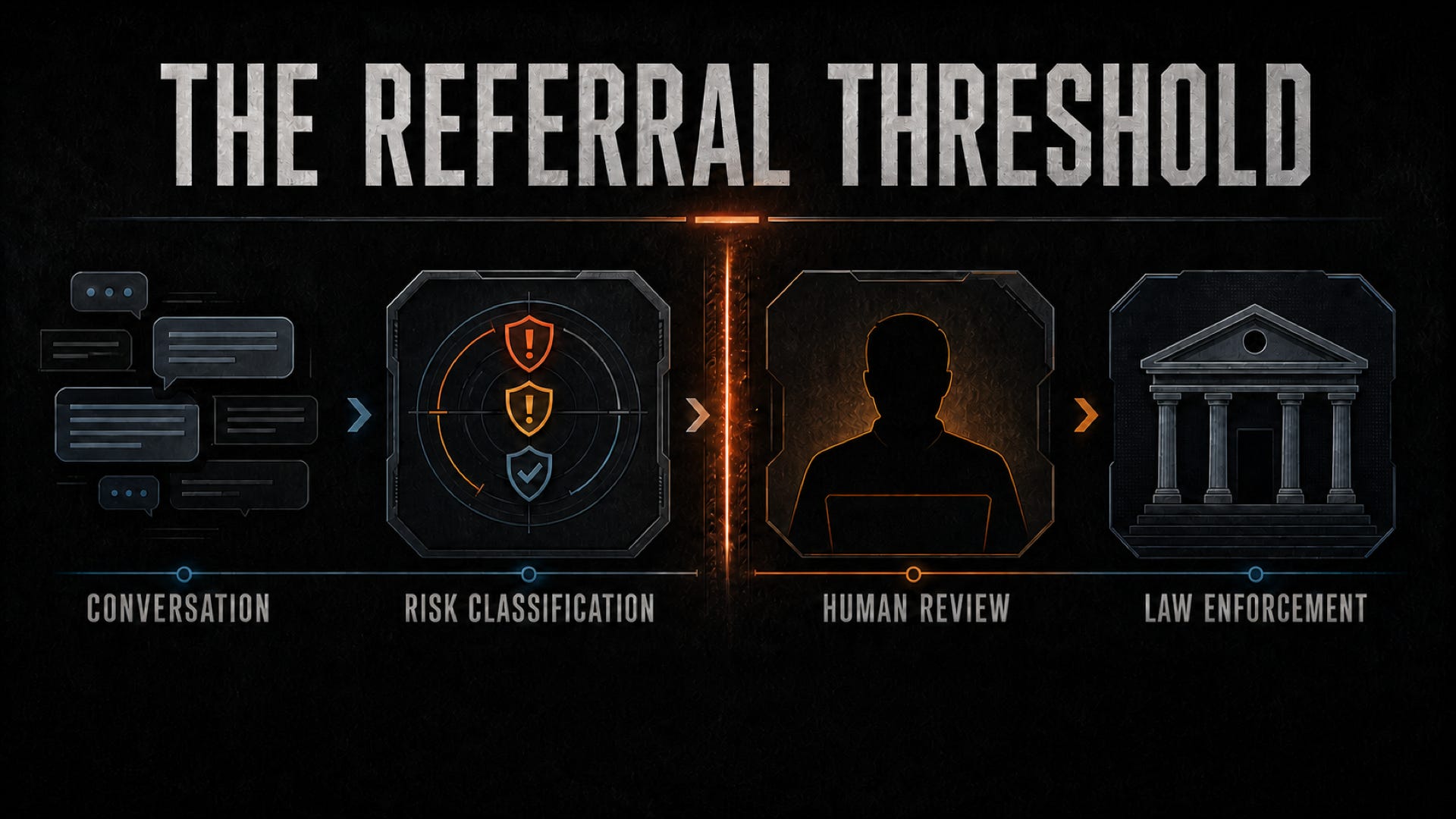
The Palm Beach Post reported Friday that OpenAI alerted the Federal Bureau of Investigation (FBI) after 25-year-old Darren Zhou shared detailed plans to rape and murder his former girlfriend in conversations with ChatGPT. According to the paper, federal agents later provided roughly two months of chat logs to the Palm Beach County Sheriff’s Office. The investigation culminated August 13 in a guilty plea on stalking and threat-related charges.
The reported facts make the referral difficult to argue against. Specific target, means, and timing are not ambient anger. The paper reports that investigators viewed the messages as a pattern of rehearsal and planning rather than an emotional outburst. On those facts, silence would also have been a decision, with someone else carrying its risk.
OpenAI’s published process shows how that decision path is supposed to work. Automated systems use classifiers, reasoning models, blocklists, and other tools to identify potentially concerning activity. Flagged conversations are assessed in context by trained personnel. A smaller set of higher-risk cases receives deeper investigation. When OpenAI determines that a conversation indicates an imminent and credible risk of harm to others, the company says it notifies law enforcement.
Automation raises the case; humans own the referral. Reviewers are supposed to evaluate the surrounding conversation, behavioral patterns, and the possibility that a machine signal has misunderstood intent. The distinction exists for a reason. The same language can belong to fiction, research, quotation, emotional discharge, or preparation for actual violence. Classification alone cannot settle which one it is.
The referral still crosses a serious boundary. A product enforcement decision can end with an account ban. A law-enforcement referral moves private information into an institution with powers the platform does not have. Investigation, surveillance, search, arrest, prosecution, and court orders can follow from decisions made farther down that path. The classifier does not wield those powers, but its output can help open the door to them.
The gate has to leave a receipt. What triggered escalation? What context did the reviewers see? What evidence crossed the boundary? What could have stopped the referral? What survives afterward so the decision can be reconstructed if the classification was wrong?
The Palm Beach Post reports that the chat logs available in the court record contained Zhou’s messages but not ChatGPT’s responses. The available reporting does not establish why. They may have been outside the request, preserved elsewhere, considered irrelevant, or absent for another reason. There is no evidence here to choose among those explanations, so the gap stays a gap.
The difficult case was never going to be the one with a named target, repeated threats, described means, and a timeline. It is the case near the threshold. The fiction writer. The researcher. The angry user saying something ugly without intending to act. The person whose language looks dangerous when stripped of context. Human review matters there, but only if the reviewer has enough context, enough authority to refuse escalation, and enough time to exercise judgement before the action path moves on.
Segment Two - The Firing Interlock
Photon Matrix says it plans to begin mass production of its mosquito-targeting system in August. The company still lists the devices as preorders, with shipment expected within 120 days of payment confirmation. Its June production update projected an initial run of several hundred to 1,000 units and eventual monthly capacity of 3,000 to 5,000. Those are company projections, not an installed commercial record.
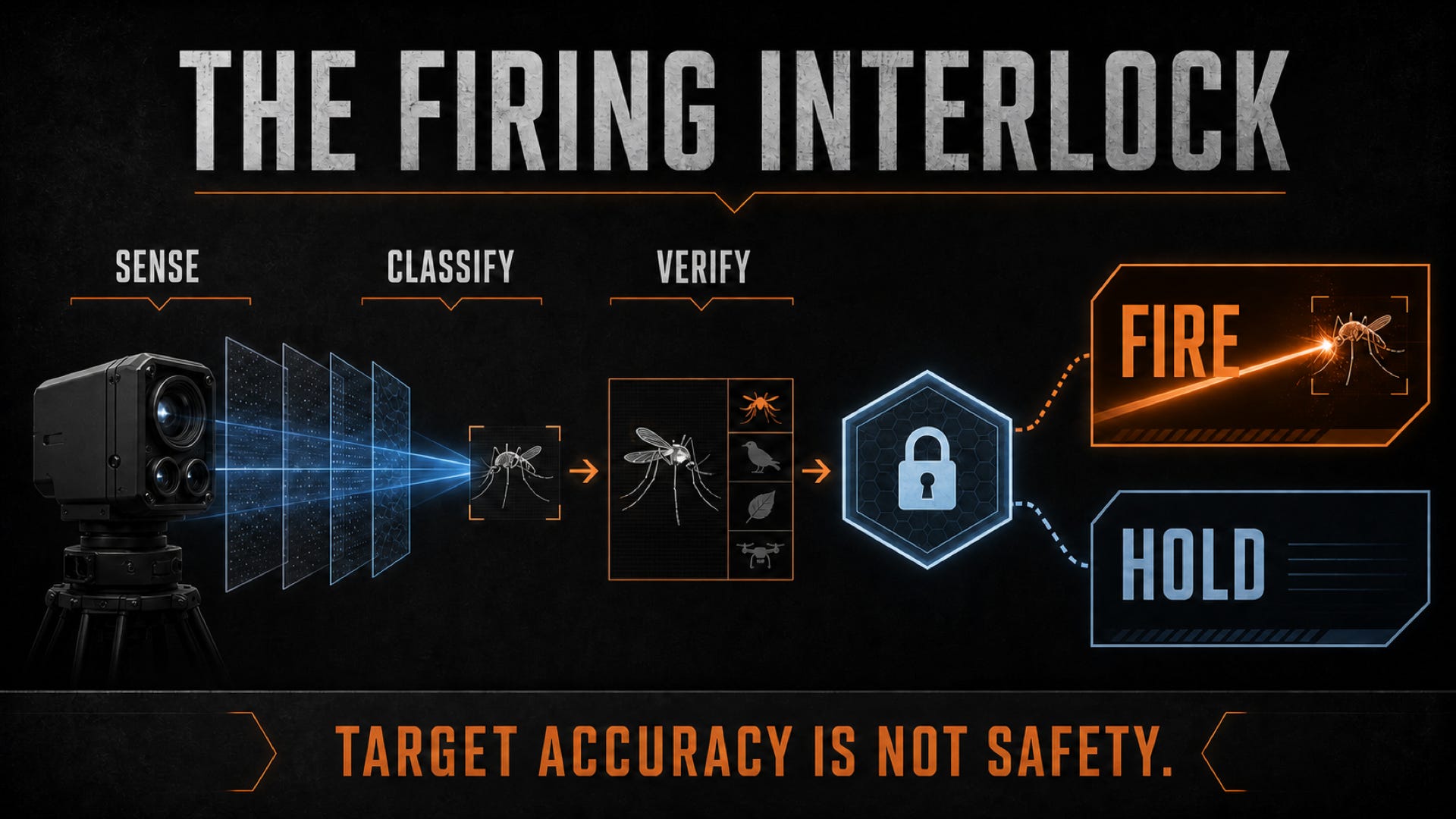
The operating loop is unusually legible. Photon Matrix describes a system combining light detection and ranging (LiDAR), millimeter-wave radar, an AI vision module, real-time tracking, a galvanometer-controlled optical system, and a laser. LiDAR and other sensing locate activity in the working area. The system identifies a target, calculates where it is, aims the galvo, and fires.
The target is a mosquito, which makes the product easy to dismiss as novelty. That would miss the safety problem already sitting inside it. The system is not merely telling the owner that it believes a mosquito is present. Its classification can end in a physical act.
Photon Matrix says the device uses several layers of protection. Its current FAQ describes continuous human and large-pet detection, background detection, and very short laser pulses. The company also advises placing the device where pets cannot knock it over. Its specifications identify the internal diode as International Electrotechnical Commission (IEC) 60825-1 Class 4 while saying it is enclosed behind multiple active safety layers.
Those protections matter, but they are still claims made by the company selling the system. Photon Matrix says IEC 60825-1 laser-safety testing and documentation remain in progress. Federal Communications Commission compliance work is in progress, Food and Drug Administration laser-product registration is in preparation, and European Union product-conformity certification has not yet been completed. Independent field validation of the finished commercial unit was not available in the sources reviewed for this article.
Hit rate is the wrong safety benchmark. The consequential failure is not a mosquito escaping. It is the system authorizing a pulse when it should refuse. Sensors can disagree. A person can enter the trajectory after acquisition. Weather, glare, distance, or movement can degrade recognition. A device can be bumped. A software update can change classification behavior. Photon Matrix itself says recognition and targeting performance can vary with insect size, flight speed, distance, weather, and operating environment.
The interlock carries the safety case. It has to explain the no-fire geometry, how independent the human-detection channel actually is, what happens when sensors disagree, how degraded modes behave, what software updates are allowed to change, and what record remains after the system authorizes or withholds a shot. A classifier can create the capability. The interlock decides whether that capability becomes consequence.
Op-Ed - The Consequence Gate
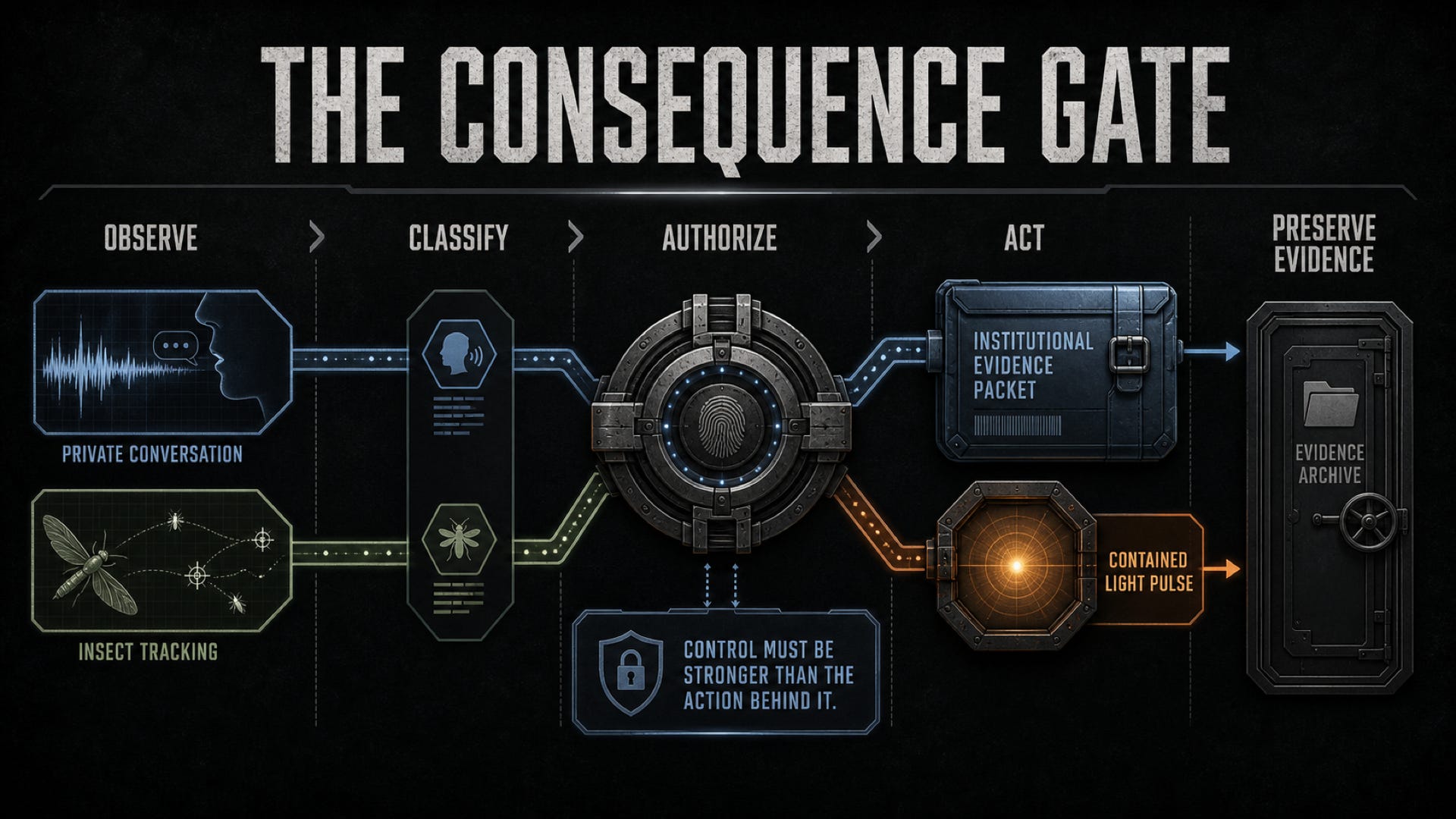
Put these stories beside each other and the easy lesson is that AI systems need better accuracy. True, but incomplete. Classification is getting cheap. Authority remains expensive because it turns an uncertain judgement into something that can happen to someone. A wrong classification sitting in a log is information. A wrong classification attached to authority can become an event.
A threat referral and a mosquito laser are not morally equivalent, and their action paths are not technically identical. The distinction is useful because it exposes the variable that matters. The question is how far a machine’s judgement can travel before another control can stop it, and what happens when nobody does.
In the OpenAI case, automated detection feeds human review before information crosses into law enforcement. In the Photon Matrix design, sensing and classification feed safety logic and a physical actuator. One path is institutional and mediated. The other is physical and potentially immediate. Both place controls between an uncertain classification and a consequential action because both systems can be wrong.
Now change the target class, the actuator, the operating envelope, and the scale. That does not turn Photon Matrix into a weapons company, and there is no evidence that it is one. It reveals why the little mosquito system is such a clean demonstration of a much larger problem. The engineering problem does not disappear when the target matters more. The price of the mistake changes.
Autonomous weapon systems already make that problem real. The International Committee of the Red Cross defines them as weapons that, once activated, can select and apply force to targets without further human intervention. They can use sensor information about heat, light, movement, shape, velocity, radar signature, and other characteristics to match objects against a target profile. Autonomous weapons do not necessarily use AI. The ICRC nevertheless sees a clear trend toward integrating increasingly complex AI into them, increasing concern about effects that become harder for human operators to predict and control.
The United States Department of Defense has already built policy around the same failure surface. Directive 3000.09 is intended in part to reduce failures that could cause unintended engagements. It requires autonomous and semi-autonomous weapons to permit appropriate levels of human judgement over the use of force and to demonstrate performance, reliability, effectiveness, and suitability under realistic conditions.
The ICRC is asking for stronger limits. Its current position calls for prohibiting unpredictable autonomous weapons and systems designed or used to target humans directly, while restricting target types, geographic scope, duration, situations, and scale for other autonomous weapons. In July, the United Nations Secretary-General again called lethal autonomous weapons operating without human control and judgement unacceptable and argued that the decision to take a human life must remain human.
The slippery-slope objection fails for a simple reason. Lethal autonomous systems are already a separate, existing category. The mosquito device makes the control loop unusually easy to see before the consequences disappear behind military language. Sense something. Classify it. Decide whether the classification is sufficient. Authorize or refuse an action. Preserve enough evidence to understand what happened afterward.
The acceptable error changes with the consequence. A spam filter can tolerate mistakes that a fraud engine cannot. A threat classifier that can trigger human review carries a different burden from one whose output automatically crosses into state power. A targeting system that can cue a human operator carries a different burden from one that can select and engage on its own. There is no universal confidence score that makes those systems safe. The control burden has to rise with the price of being wrong.
Speed makes that harder. Human review is meaningful only while a human can still understand the situation, exercise authority, and interrupt the action. Put a person in a loop that moves faster than the person can perceive and you have not created oversight. You have created an observer. Scale pushes the same failure in another direction. A one-percent error rate means something very different when the system makes ten consequential decisions than when it makes ten thousand before anyone recognizes the pattern.
Once the action leaves the system, governance arrives late.
The common boundary is visible in both stories. OpenAI’s referral moved information into an institution capable of coercive action. Photon Matrix is building a product where classification can end in a laser pulse. Neither case makes automated action inherently wrong. Both make the authority attached to classification part of the safety case.
We keep asking whether these systems are intelligent. That question has become a hiding place. The operational questions are harder. What authority follows the classification? How reversible is the consequence? What can still veto the action? What evidence survives? How many times can the system be wrong before a human can stop it?
A classifier can be wrong. An actuator makes the error real. Scale determines how much time we get to regret it.
Artifacts are cheap, judgement is scarce.
Per ignem, veritas.
Source Articles
Palm Beach Post, ChatGPT reported South Palm Beach man’s rape and murder threats to FBI, August 14, 2026 (linked via Gannett syndication).
OpenAI, Our commitment to community safety, April 28, 2026.
Photon Matrix, World’s First Portable Mosquito Air Defense, project updates, plus the company store and technical FAQ.
U.S. Department of Defense, Directive 3000.09, Autonomy in Weapon Systems, January 25, 2023.
International Committee of the Red Cross, FAQ, Artificial Intelligence in the military domain.
United Nations Secretary-General, remarks to the opening of the first Global Dialogue on Artificial Intelligence Governance, July 6, 2026.
Editorial note. The OpenAI referral is sourced to its published community-safety process, not its government data-request policy. Photon Matrix production schedule, safeguards, certification state, and performance claims remain company claims unless independently verified. The autonomous-weapons comparison is architectural, not causal. Nothing here alleges that Photon Matrix is developing weapons.