


Tuesday, August 25, 2026
Tuesday is for consequential stories readers may have missed. Not product announcements dressed as history, not another leaderboard fluctuation, and not a handful of examples tortured until they confess to sharing a thesis. The test is simpler. Something changed in the operating environment, there is a receipt for it, and the consequence is larger than the headline.
This week, Claude orchestrated protein-design campaigns whose outputs survived physical testing. A census of FDA-authorized AI medical devices exposed how rarely authorization is followed by public evidence about patient outcomes. Stanford’s updated payroll analysis found the strongest labor-market signal among young workers is emerging through hiring rather than layoffs. Pennsylvania turned data-center externalities into enforceable permit conditions. Thomson Reuters decided some intelligence is important enough to own while other intelligence can remain rented.
They are not one story. They are separate places where AI crossed from capability into consequence.
Claude’s Protein Designs Survived the Wet Lab
Forge News Breakdown
Anthropic’s protein-design work deserves more attention than another story about an AI system outperforming a benchmark because the final evaluator was not software. It was a laboratory.
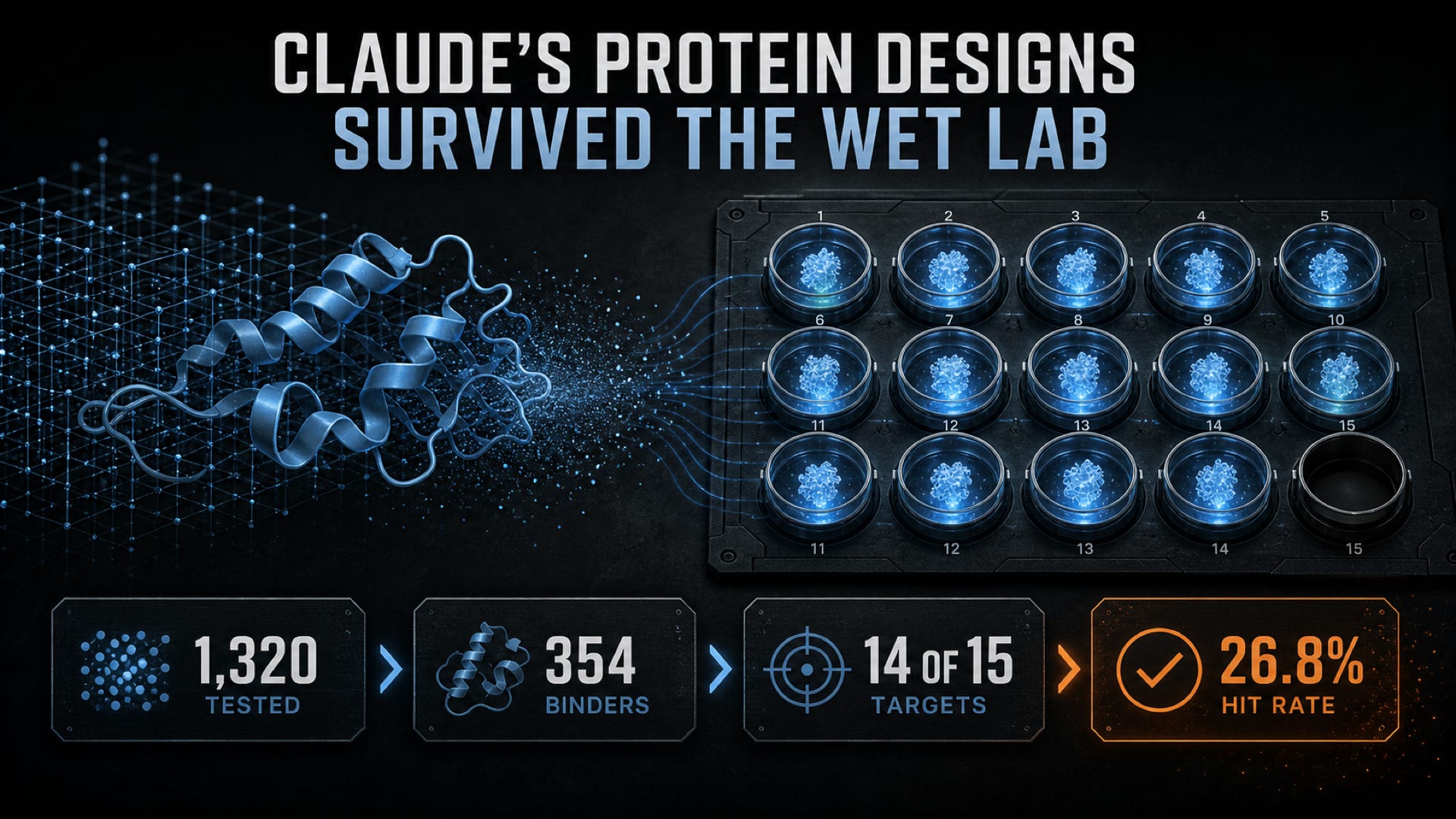
Claude orchestrated protein-design campaigns using existing specialist tools, producing candidate binders that were then physically synthesized and tested by Adaptyv Bio and Twist Bioscience. Across 1,320 designs with usable wet-lab results, 354 bound their intended targets. Working binders were found for 14 of 15 evaluated targets, producing an overall hit rate of 26.8 percent. One additional target was excluded because its measurements were inconclusive. [1], [2]
Adaptyv’s comparison is also worth taking seriously without turning it into mythology. On several comparable targets, Claude matched or exceeded results from prior protein-design competitions. The company reports an 80 percent hit rate on TREM2 against 38.3 percent in its earlier competition and substantially stronger binding affinities on several other targets. Adaptyv’s own conclusion is appropriately narrower than the inevitable internet version: Claude demonstrated expert-level skill at orchestrating existing protein-engineering tools. [1]
That qualification matters. Claude did not independently invent molecular biology, nor is AI-directed wet-lab experimentation historically new. It operated inside an engineered research environment using specialist computational tools, substantial compute, a detailed initial prompt, and external laboratories built and operated by people. What changed here is the placement and demonstrated competence of a general-purpose model inside a consequential portion of that experimental pipeline.
Forged Analysis
For most current deployments, model output remains one or more layers removed from physical consequence. The model proposes, a researcher evaluates, and a human decides what deserves synthesis, testing, deployment, or rejection. Even when AI is indispensable to the workflow, human judgement frequently remains the bridge between computational suggestion and material intervention.
This experiment shortened that chain. Claude interpreted a scientific objective, orchestrated specialist design tools, generated candidates, screened them, and passed selected artifacts toward synthesis. External laboratories then supplied the thing software cannot hallucinate its way around indefinitely: physical measurement.
That creates a much more interesting boundary than “AI can design proteins.” The meaningful system is becoming a loop in which a scientific objective produces machine-directed design, design produces a physical artifact, measurement produces evidence, and that evidence influences the next decision. Adaptyv explicitly describes the next phase as an agentic science loop in which experimental results return to the AI system and inform subsequent designs. [1]
Closing that loop would move machine agency another step downstream. The agent would no longer merely generate candidates for one experiment. It would begin allocating attention across successive experiments according to evidence produced by the physical world. That is enormously useful, especially in biological research where search spaces are vast, iteration is expensive, and specialist tools already exceed what one human can operate manually.
It is also where observability, provenance, experimental controls, stop authority, and resource allocation stop being abstract AI-governance nouns and become laboratory infrastructure. When a system can decide which experiment comes next, somebody needs to know which evidence caused that decision, which constraints bounded the search, what constitutes a stop condition, and which human remains responsible for the campaign. Once model output becomes substrate for the next physical intervention, “the model suggested it” is no longer a useful provenance record.
Counter-pressure
Protein binding is not drug discovery completed, much less medicine. A binder that attaches to a target still has to survive functional evaluation, specificity testing, developability, toxicity, delivery, manufacturing, animal studies where applicable, clinical trials, and every other indignity biology inflicts on elegant computational results.
Nor was this an unconstrained autonomous scientist wandering through nature with a pipette. The system operated inside infrastructure designed by people, with specialist tools and substantial compute, while humans handled the physical execution. Those limitations make the result more credible, not less. The useful milestone is successful general-purpose model orchestration of a consequential portion of the experimental pipeline with external physical evidence attached.
Forged Take
The benchmark was not whether Claude produced a plausible protein sequence. Somebody made the molecules, and the molecules had to survive contact with physical measurement. As AI moves deeper into scientific work, our evaluation architecture has to follow it out of the model and into the experiment. The receipt is no longer a score generated by another piece of software. It is what the world does when the design meets matter.
Cleared Is Not Outcome-Proven
Forge News Breakdown
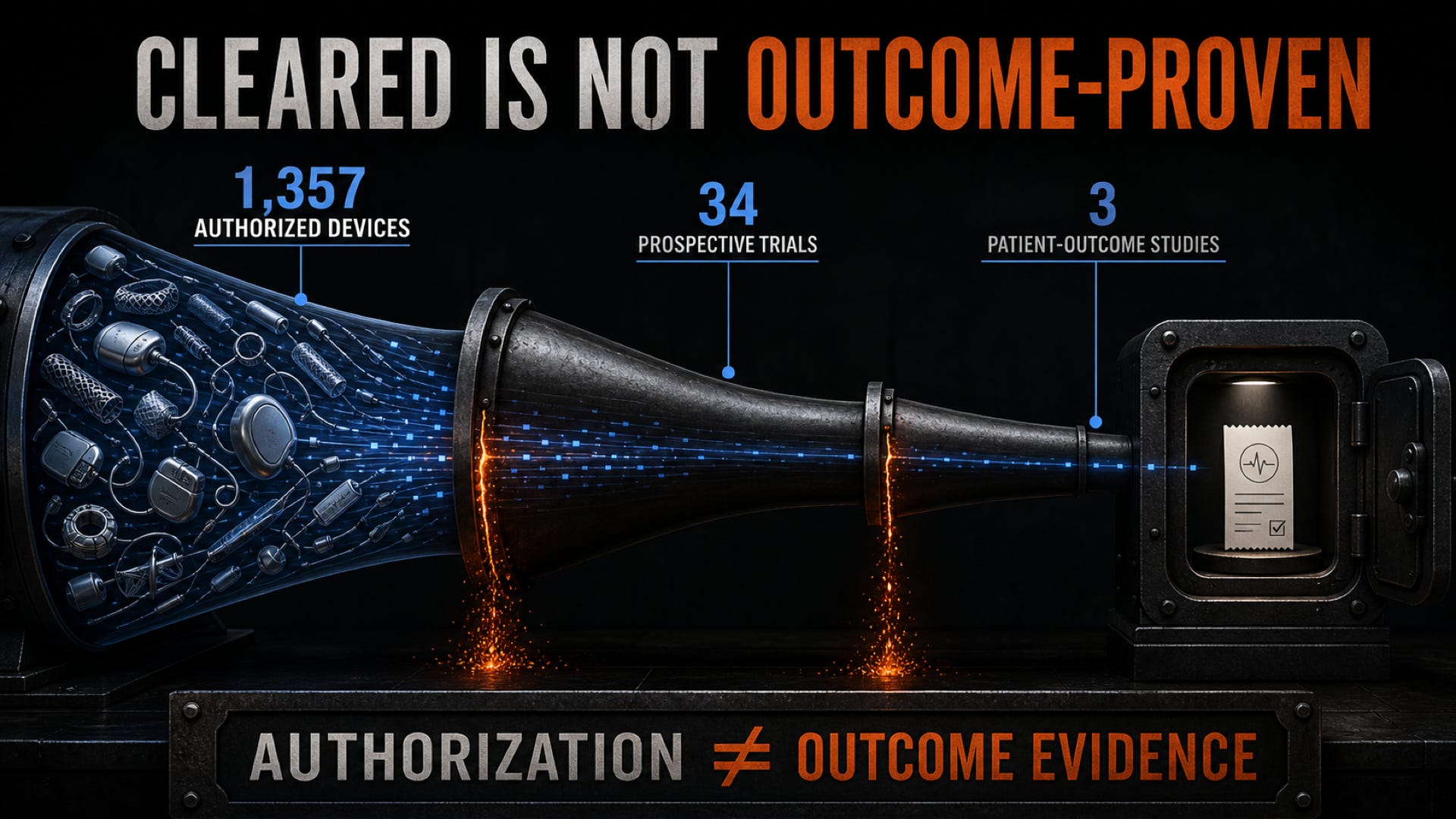
A PLOS Digital Health paper published August 19 examined the public clinical-evidence trail behind 1,357 FDA-cleared or approved AI and machine-learning-enabled medical devices through December 5, 2025. The numbers collapse quickly. Thirty-four devices, 2.5 percent, were linked to registered prospective trials. Twelve had posted trial results. Twelve had peer-reviewed publications. Only three, 0.2 percent, had been evaluated using patient-centered outcomes such as mortality, morbidity, or readmission. [3]
Even that narrow evidence base had problems. The researchers report that most identified studies were observational, nearly three quarters enrolled fewer than 500 participants, subgroup analysis was uncommon, and vulnerable populations were frequently excluded. Of the 34 registered trials, 32 were industry-led. [3]
There is an obvious headline available here about the FDA failing to test AI. It would also be an intellectually lazy reading of the paper. The study is a census of publicly linkable clinical evidence. It does not establish that 1,354 devices received no validation, that FDA review contained no useful evidence, or that authorized devices are unsafe. Regulatory review, predicate pathways, retrospective validation, post-market surveillance, company-held evidence, and prospective patient-outcome trials are different evidentiary objects. That distinction is exactly why the result matters.
Forged Analysis
We use the word “validated” far too casually in clinical AI. A model can demonstrate discrimination accuracy. A product can complete regulatory review. A hospital can show workflow improvement. A prospective study can demonstrate clinical effectiveness. A trial can establish a change in patient outcomes. Those are different claims, not successive synonyms for confidence.
The PLOS analysis exposes the distance between a system crossing a regulatory gate and public evidence showing that the technology improves what eventually matters to the patient. FDA authorization establishes that the device has satisfied the applicable regulatory pathway. It does not automatically establish a durable reduction in morbidity, mortality, readmission, diagnostic delay, or other patient-centered consequences. [3]
That should sound painfully familiar to anyone operating large systems. We routinely distinguish successful deployment from healthy service, healthy service from achieved service level, and achieved service level from improved user outcome. Clinical AI requires the same refusal to collapse layers simply because one layer has a certificate attached.
There is also a market incentive embedded here. Prospective outcome studies are expensive, slow, and capable of producing inconvenient answers. Regulatory clearance unlocks commercial deployment. Once a product has crossed that boundary, the organization paying for further evidence and the organization carrying the clinical consequence may no longer be the same actor. That does not establish deliberate avoidance, but it does mean the evidence architecture has an ownership problem.
Counter-pressure
The paper itself is more careful than many reactions to it will be. Missing publicly linked prospective trials do not prove absence of validation. The authors also examined a period ending in December 2025, while clinical evaluation continues after authorization. Some tools function as components of clinical workflows where measuring isolated patient outcomes may be difficult or inappropriate.
Patient outcomes are not the only legitimate evidence either. A tool that materially reduces diagnostic turnaround time or detects disease more accurately can deliver meaningful clinical value before a mortality endpoint is practical. The surviving distinction is narrower and harder to dismiss: authorization, performance, clinical utility, and patient benefit are separate evidentiary claims. Organizations deploying AI in medicine should know which one they actually possess.
Forged Take
The number 1,357 is not the scandal, and neither is the number three by itself. The problem begins when we let regulatory authorization imply evidence from a different category.
Clinical AI is becoming ordinary infrastructure inside consequential workflows. The evidence contract needs to become equally ordinary. What was authorized? What was demonstrated? In which population? Against what outcome? Under whose surveillance? Those questions should follow the device into production instead of disappearing once procurement sees an FDA number.
AI May Be Removing the First Rung
Forge News Breakdown
The loudest AI labor debate continues to ask when mass unemployment begins. Stanford’s Digital Economy Lab is finding something quieter.
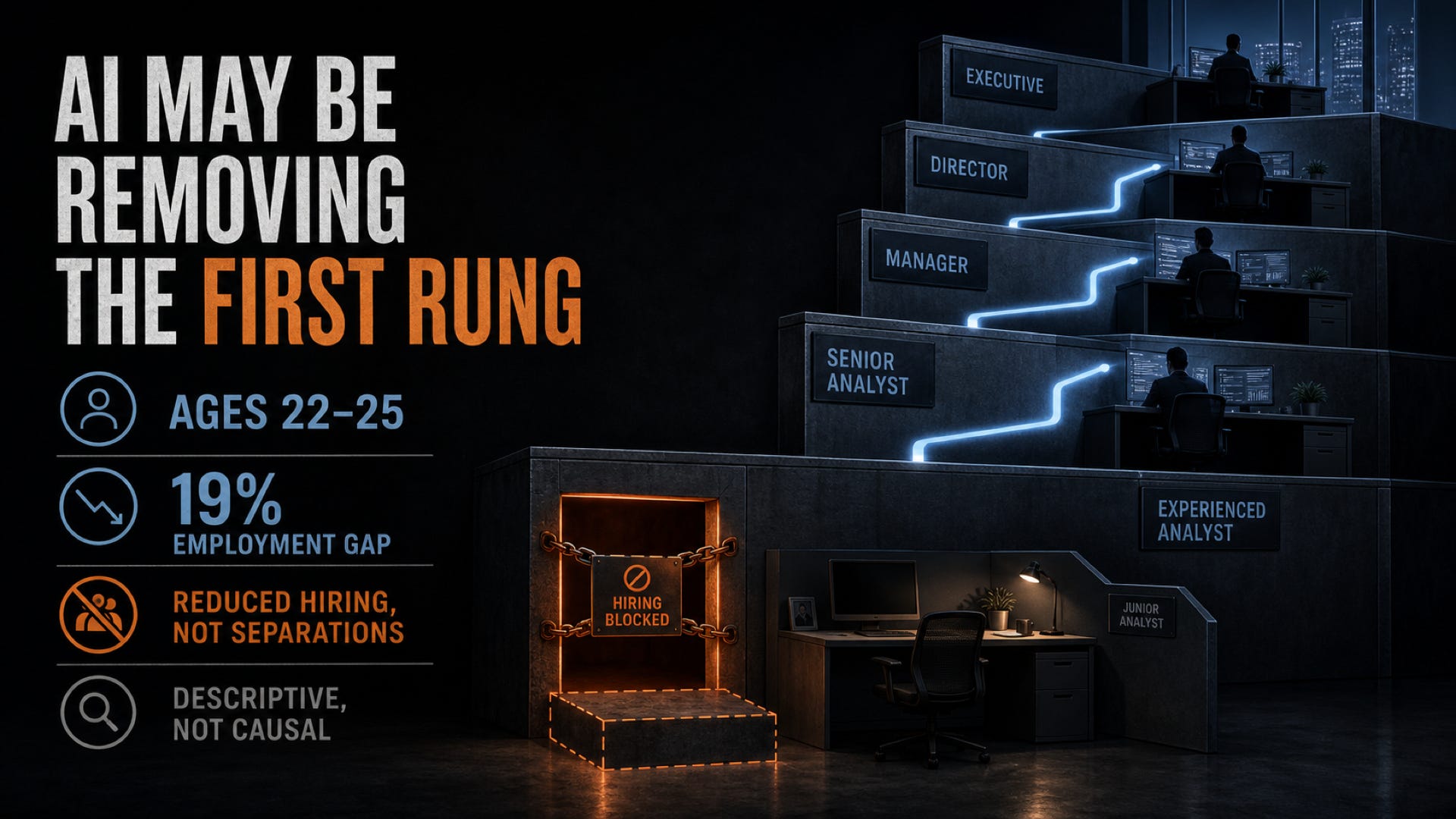
Using ADP payroll data through June 2026, Erik Brynjolfsson, Bharat Chandar, and Ruyu Chen report no evidence of widespread economy-wide employment displacement. The concentrated divergence appears among workers aged 22 to 25 in occupations with high AI exposure. Employment in that group stands about 19 percent below where it would have been had it kept pace with similarly aged workers in less-exposed occupations. Experienced workers show no comparable gap. [4]
The mechanism is more important than the headline number. The researchers report that the divergence operates primarily through reduced hiring rather than increased separations. They also find the decline concentrated in occupations where AI use is more substitutive of human tasks, while employment is flat or increasing in occupations where AI is more complementary, particularly among experienced workers. [4]
Stanford is explicit about what this evidence cannot support. These are descriptive patterns, not causal estimates. Some divergence predates generative AI, the effect attenuates when controlling for education, and the pattern is more pronounced in the ADP sample than in national survey benchmarks. [4] We have not found the smoking gun proving AI destroyed entry-level work. We may have found where to look.
Forged Analysis
Layoffs are legible. A company eliminates 5,000 positions, a filing appears, employees talk, journalists count, executives explain how this was actually a strategic optimization exercise and therefore nobody should notice the 5,000 people carrying boxes.
Hiring that never happens leaves almost no artifact. There is no termination notice for the analyst class that was not created, no severance payment for the junior developer never hired, and no organizational chart showing the associate position eliminated three years before somebody would have filled it.
That makes reduced hiring a particularly important mechanism for AI-driven labor change. Firms do not need to replace existing workers with software to alter the occupational structure. They can increase the productive capacity of experienced staff, automate portions of junior work, and quietly decide that the next vacancy does not need to exist.
The immediate effect is an employment problem for young workers. The longer-term effect could be a capability problem for the organization. That second claim is inference rather than a result established by Stanford, but it follows a well-understood organizational mechanism. Most professions do not produce experienced workers by downloading them fully formed from a senior-talent marketplace. Junior roles are where people encounter ugly production reality, absorb tacit knowledge, make bounded mistakes, learn escalation, watch experienced operators exercise judgement, and slowly become the people organizations later call “senior.”
If AI removes enough of that work without replacing its developmental function, the organization may enjoy a near-term productivity gain while consuming its future supply of experienced judgement. That is not an argument for preserving pointless entry-level labor as some sort of economic heritage exhibit. Much junior work deserves automation. The operating question is whether the work and the learning function are the same thing. If they are not, we need to stop assuming apprenticeship survives merely because the drudgery disappeared.
Counter-pressure
The Stanford researchers are appropriately cautious. Their analysis cannot isolate AI as the cause of the entire 19 percent divergence. Young workers experienced pandemic disruption, interest-rate changes, changes in technology hiring, educational shifts, and other labor-market forces. The authors explicitly refuse a causal interpretation. [4]
There is also a possibility that organizations reorganize career development rather than destroying it. AI-assisted junior workers may learn faster, new occupational categories may emerge, and explicit apprenticeship programs may replace some of the accidental learning that used to happen through repetitive work. That is a desirable outcome and worth building toward. But “the market will eventually invent a new pathway” is not a workforce strategy. If an organization removes the work that once produced expertise, somebody needs to become responsible for producing the expertise another way.
Forged Take
The first visible labor consequence of AI may not arrive as the mass layoff everyone was trained to watch. It may arrive much more quietly.
It may arrive as an empty chair that was never requisitioned.
That changes the management problem. Leaders need to measure more than headcount savings and individual productivity. They need to know whether automation is consuming the developmental substrate from which future experts are made. Cheap execution is useful. Cheap execution that quietly destroys the apprenticeship pipeline is borrowing against a workforce the organization assumes somebody else will train.
The Grid Sent AI an Invoice
Forge News Breakdown
Pennsylvania spent much of this year developing Governor’s Responsible Infrastructure Development, or GRID, standards for data centers. On August 18, those standards stopped being merely an incentive framework.
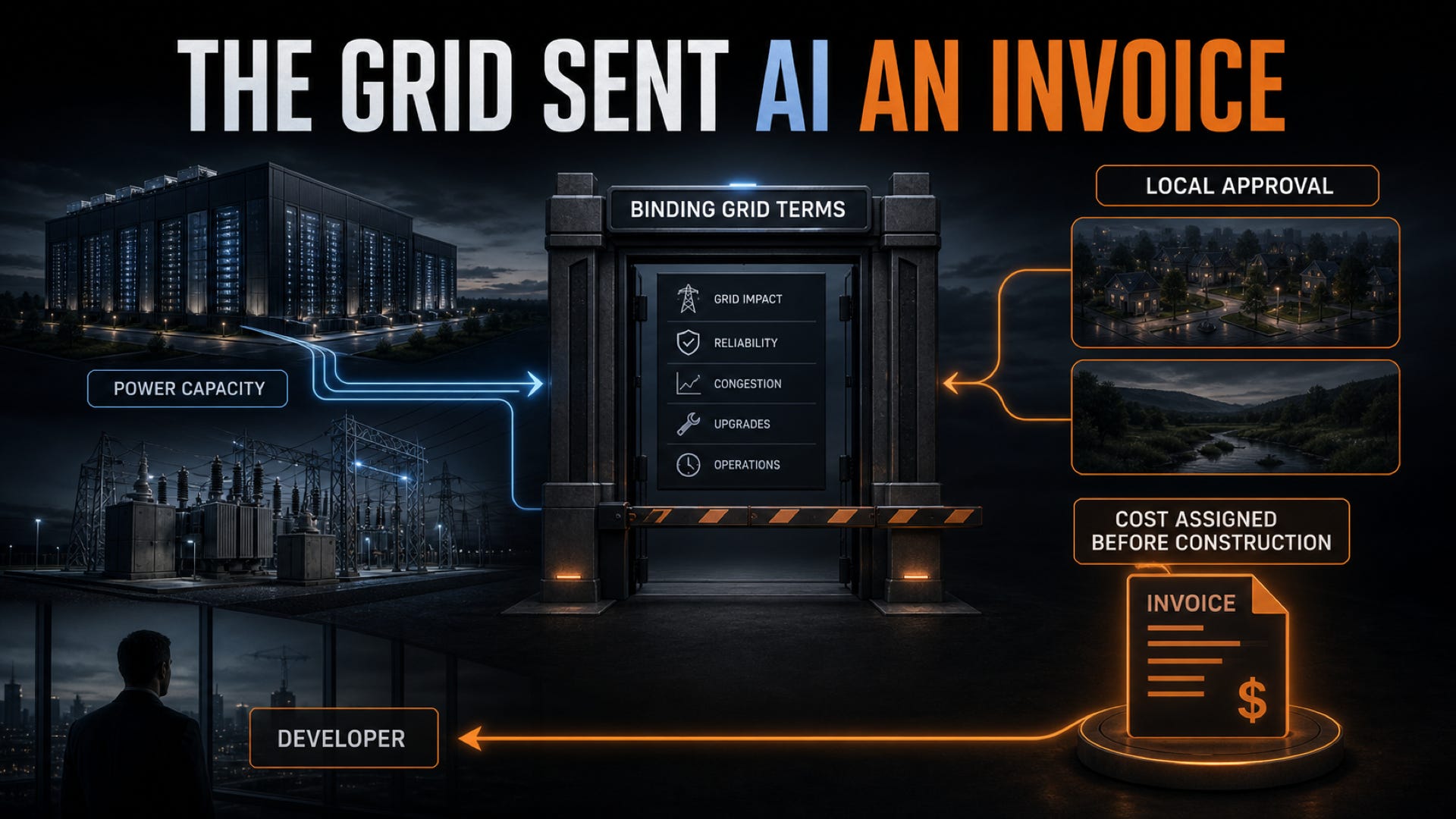
Governor Josh Shapiro signed Executive Order 2026-05 directing state agencies to incorporate GRID requirements into permit review for data-center proposals. Developers must enter a pre-application process with the Department of Environmental Protection and execute legally enforceable commitments, with penalties for failure to comply. The administration also removed AI data-center projects from the state’s Permit Fast Track program, prohibited nondisclosure agreements around proposed developments, and tied state approval to local approval. [5], [6]
The energy requirements are unusually explicit. Developers are expected to bring or pay for the power capacity associated with their projects rather than transferring those costs to existing residential and business ratepayers. GRID also imposes requirements around clean-energy sourcing, environmental protection, workforce development, transparency, and community benefits. [5], [6]
There is plenty of political language around the order, and politicians are perfectly capable of carrying that themselves. The operational change is enough: the state has moved infrastructure cost, local approval, and environmental conditions into the permit path.
Forged Analysis
AI infrastructure has spent several years enjoying a useful abstraction. We talk about compute as though it were an API product. Capacity appears on a cloud console, accelerators become tokens, tokens become inference, and somewhere underneath the interface enormous physical systems politely avoid appearing in the architecture diagram. The electric grid has been less cooperative.
A hyperscale data center can require generation, transmission, substations, water, land, construction capacity, and years of planning. When several proposed facilities converge on the same region, the question is no longer whether AI creates economic value. It is who finances the additional capacity, who carries the environmental load, who receives the economic benefit, and which projects deserve scarce infrastructure before speculative demand reserves it.
Pennsylvania has moved those questions into an executable boundary. A developer seeking permits now encounters requirements before the project becomes physical infrastructure. That is a different stage of AI governance than a report estimating megawatt demand. Cost assignment has entered the permit path.
The idea that infrastructure consumers should internalize the infrastructure they require is not radical. Cloud customers already pay more when they consume more compute. Network operators engineer capacity around expected load. Industrial users negotiate utility infrastructure. What has remained unusually vague is how rapidly expanding AI demand should interact with shared public systems whose costs can outlive the project that created them.
GRID is one state’s answer. It is not necessarily the right answer everywhere, and implementation will determine whether the requirements produce disciplined development or simply another bureaucratic queue. The consequence boundary has nevertheless moved. Externality is becoming obligation.
Counter-pressure
This is an executive action from one administration, not a national policy settlement. Legal challenges, implementation details, utility regulation, municipal decisions, and future political changes can alter how much of the framework survives in practice.
The order also risks discouraging legitimate investment if requirements become unpredictable or if infrastructure developers cannot obtain timely decisions. Pennsylvania is explicitly choosing more friction at the permitting boundary in exchange for stronger cost and community controls. That trade is real. Pretending there is a version of hyperscale infrastructure with no trade would be less serious.
The test now is whether the state can distinguish speculative projects from viable ones without converting accountability into indefinite delay.
Forged Take
The important development is not that Pennsylvania noticed data centers consume power. The grid has been sending that memo for some time. The change is that the state assigned more of the resulting burden to an owner.
If an AI infrastructure project needs additional capacity, the developer has to account for that capacity before the project crosses the permit boundary. That is what governance looks like when it stops being a principle and becomes a condition of execution.
Own the Judgement. Rent the Frontier.
Forge News Breakdown
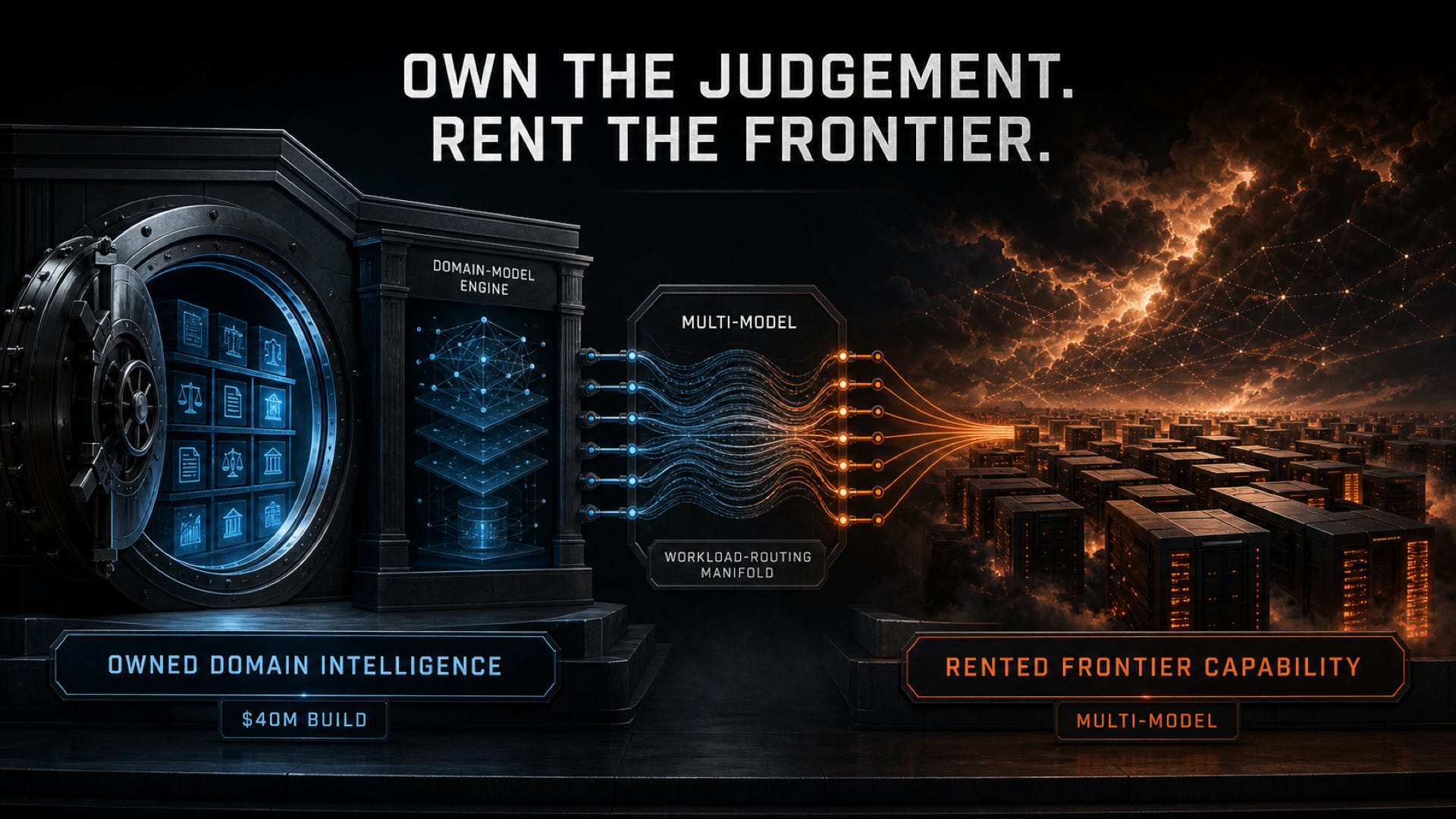
On August 24, Thomson Reuters launched Thomson, its first proprietary large language model. The company says it started from an open-source foundation and spent approximately $40 million on training, talent, and compute rather than attempting to reproduce the multi-billion-dollar training path of the largest general-purpose frontier labs. Thomson Reuters says the model remains fully owned and controlled by the company. [7]
The obvious story is that Thomson Reuters built a model. The more interesting decision is that it did not decide to use that model for everything.
Thomson Reuters says CoCounsel will remain multi-model by design, using Thomson where the company believes its specialized model has an advantage while continuing to use other leading models elsewhere. Thomson’s first production deployment is planned for high-volume structured document analysis in CoCounsel Legal. [7], [8]
The company also says Thomson has so far been trained on less than 10 percent of its proprietary content and argues that specialization on Westlaw, Practical Law, Checkpoint, Reuters content, and subject-matter expertise produced improvements its base model did not receive merely from access to those materials at inference time. Those performance claims remain company-reported and are undergoing additional external evaluation. [7]
The $40 million is interesting because it establishes the scale of the build decision. The portfolio architecture is more important because it establishes what Thomson Reuters thinks should happen after the model exists.
Forged Analysis
Enterprise AI strategy has been dominated by a procurement question masquerading as architecture: which model are we standardizing on?
OpenAI. Anthropic. Google. An open-weight deployment. Pick one, establish contracts, build a platform around it, and spend the next year discovering that different workloads have different requirements because apparently software remains stubbornly uninterested in procurement simplicity.
Thomson Reuters is describing a different operating model. Some intelligence is generic enough to buy competitively. Some capability sits so close to proprietary data, professional judgement, cost structure, privacy requirements, or strategic differentiation that owning more of the stack becomes rational.
That does not require every enterprise to train a model. Quite the opposite. Model ownership has a carrying cost. Training infrastructure, evaluation, inference, upgrades, safety work, data governance, specialist talent, and model lifecycle management all become somebody’s permanent responsibility. Owning a mediocre model because the board learned the word “sovereignty” is an expensive way to manufacture technical debt.
Thomson Reuters possesses something unusually valuable: a large proprietary corpus, deeply structured professional workflows, and thousands of domain experts capable of evaluating the output. Those assets can make specialization economically different from trying to compete with frontier labs on general intelligence.
The operating question therefore changes from model selection to capability placement. Which intelligence is strategically differentiated enough to own? Which should be rented? Which workloads deserve specialist models? Which require frontier reasoning? Where does data sensitivity justify local or controlled execution? Where does external competition create enough leverage that owning the model would simply recreate a commodity badly?
That is a portfolio problem whose answer can legitimately change by workload.
The Sovereignty Claim Needs Restraint
Thomson Reuters explicitly frames the launch partly through AI sovereignty, including questions about training, model behavior, privacy, deployment, and dependency on external architecture and pricing. [7], [8] Those are legitimate concerns, but owning the resulting model does not make the surrounding system sovereign by magic.
Thomson began from an external open-source foundation. Training still depends on compute infrastructure, frameworks, hardware, supply chains, and a substantial software stack. Serving the model creates another dependency graph. Upstream model architecture and downstream tooling continue to matter.
What ownership changes is the control surface. Thomson Reuters gains more authority over model lifecycle, economics, deployment, specialization, and future training than it possesses when all core intelligence is delivered through another company’s API. That is greater sovereignty, not independence. The distinction matters because enterprise AI is going to produce an impressive amount of theater around “owning our model.” The useful question is which dependencies became controllable and which simply moved.
Counter-pressure
All capability comparisons currently need an asterisk. Thomson Reuters says its early evaluations place Thomson competitively against leading frontier systems on professional tasks, but these are substantially company-designed evaluations of a company-built system. External researchers have begun testing it, and a smaller open-weight version is being released for academic and non-commercial evaluation, but broader independent evidence is still developing. [7]
Nor does this strategy generalize automatically. Most enterprises do not own Westlaw, Reuters, Practical Law, Checkpoint, and a standing population of professional experts. For many companies, buying frontier capability and investing heavily in retrieval, workflow design, evaluation, and proprietary tools will remain economically superior to training a model. That is precisely why the portfolio framing works. Ownership should be earned by the workload.
Forged Take
The enterprise model race may end with fewer enterprises actually participating in a model race because mature organizations will allocate intelligence instead. Own the capability where proprietary knowledge, economics, control, or differentiation makes ownership worth carrying. Rent frontier intelligence where competition among providers gives you better capability than you could economically reproduce. Route each workload according to the evidence instead of making organizational loyalty to a model provider part of the architecture.
Thomson Reuters did not merely announce another model. It made a build-versus-buy decision about intelligence itself.
What These Developments Do, and Do Not, Prove
I do not think these stories justify another grand unified theory of AI. Their mechanisms are too different, and flattening them into a predetermined architecture would waste exactly what makes Tuesday useful.
They do share one condition. In each case, the consequential object has moved outside the model. For Anthropic, the object is a molecule that exists in a laboratory. For clinical AI, it is the patient’s outcome rather than the algorithm’s regulatory status. In the labor market, it is the job never created and the expertise pipeline that may disappear with it. In Pennsylvania, it is electrical capacity, local approval, and infrastructure cost. At Thomson Reuters, it is organizational control over differentiated intelligence and the dependencies required to sustain it.
That is the larger signal worth carrying forward. AI is becoming easier to evaluate badly because the most visible object remains the model while the meaningful consequence increasingly lives somewhere else. If we want to understand where AI is actually changing institutions, we have to follow the consequence past the output.
Tuesday Take
The stories worth catching are rarely the loudest ones. This week, the important changes happened after the model spoke: in a wet lab, in a patient’s evidence record, in a hiring plan, at a permit desk, and inside an enterprise architecture decision.
The model remains important. The boundary around it is becoming more important.
Artifacts are cheap, judgement is scarce.
Per ignem, veritas.
Sources
[1] Adaptyv Bio, “Case study: Benchmarking Claude’s protein designs in the wet lab,” Aug. 19, 2026. [Online]. Available: Adaptyv Bio case study. [Accessed: Aug. 25, 2026].
[2] Anthropic, “Claude protein binder design - data release v1.0,” Hugging Face, Aug. 2026. [Online]. Available: Anthropic data release on Hugging Face. [Accessed: Aug. 25, 2026].
[3] R. Abulibdeh, S. A. Cajas Ordonez, L. A. Celi, R. Gorijavolu, N. Izath, and T. M. Lunde, “1,357 AI medical devices cleared, 3 actually tested on patient outcomes,” PLOS Digital Health, vol. 5, no. 8, e0001597, Aug. 19, 2026, doi: 10.1371/journal.pdig.0001597. [Online]. Available: PLOS Digital Health. [Accessed: Aug. 25, 2026].
[4] E. Brynjolfsson, B. Chandar, and R. Chen, “Canaries in the Coal Mine? Six Facts about the Recent Employment Effects of Artificial Intelligence,” Stanford Digital Economy Lab, rev. Aug. 12, 2026. [Online]. Available: Stanford Digital Economy Lab. [Accessed: Aug. 25, 2026].
[5] Commonwealth of Pennsylvania, “Governor Shapiro Signs Executive Order Demanding Data Center Developers Comply with Strict Requirements and Blocking Speculative, Irresponsible Data Center Projects,” Aug. 18, 2026. [Online]. Available: Commonwealth of Pennsylvania. [Accessed: Aug. 25, 2026].
[6] Commonwealth of Pennsylvania, “Governor Shapiro Releases Full Governor’s Responsible Infrastructure Development (GRID) Standards to Protect Pennsylvanians and Establish Strict Guardrails to Hold Data Center Developers Accountable,” May 27, 2026. [Online]. Available: Commonwealth of Pennsylvania. [Accessed: Aug. 25, 2026].
[7] Thomson Reuters, “Thomson Reuters Leverages its World-Class Data Assets to Launch Its Own Frontier Model,” Aug. 24, 2026. [Online]. Available: Thomson Reuters. [Accessed: Aug. 25, 2026].
[8] J. Hron, “The Future of AI Is Knowing How to Use the Intelligence Available to You,” Thomson Reuters Institute, Aug. 24, 2026. [Online]. Available: Thomson Reuters. [Accessed: Aug. 25, 2026].