


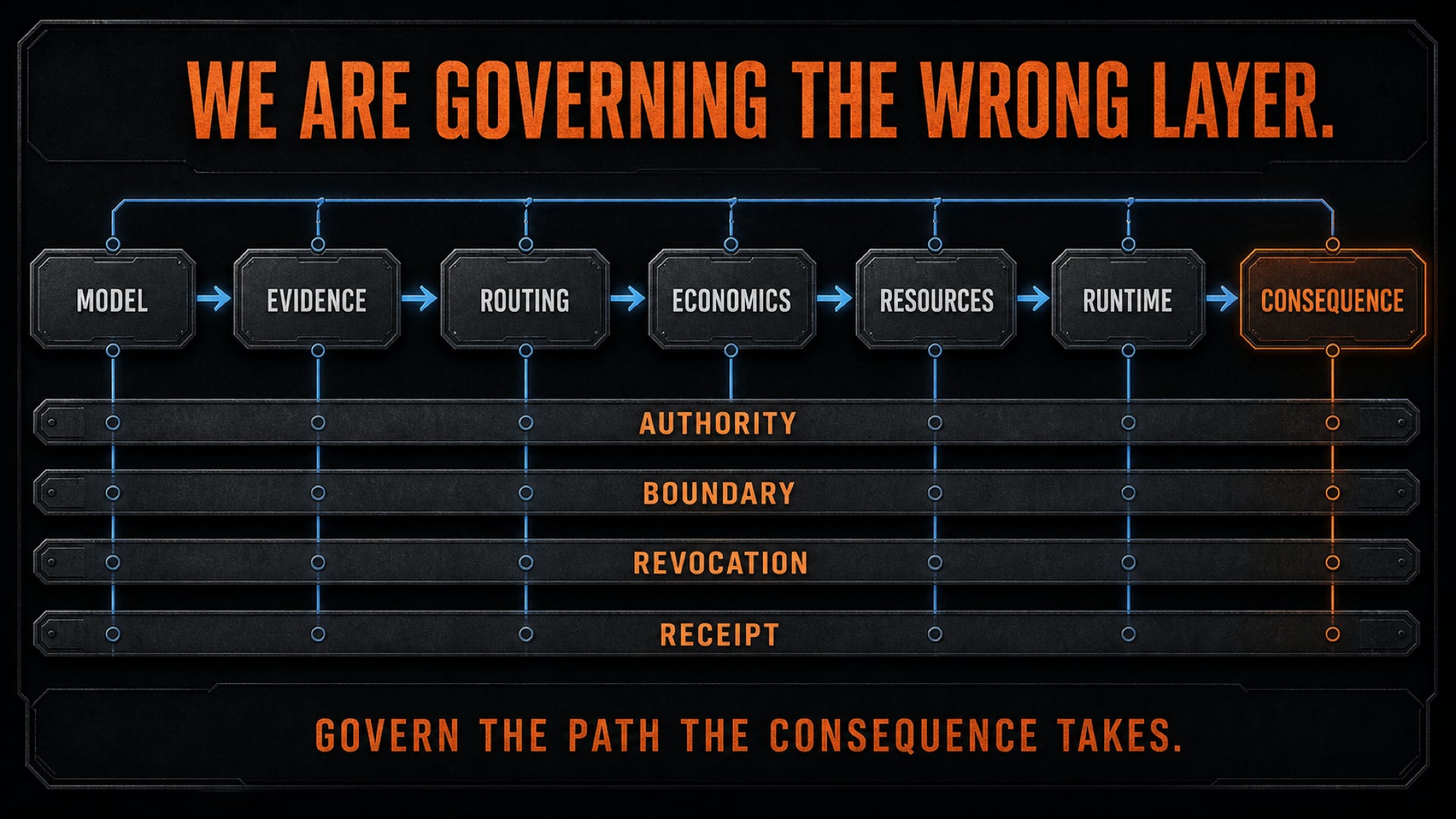
Four stories should not automatically become one argument merely because they all contain the letters AI. That is how trend pieces are manufactured and meaning goes to die. These four actually share an architecture. OpenAI is trying to create a safety signal without retaining the sensitive payload that generated it. Stripe is acquiring infrastructure that decides which model receives a request and sits beside systems that meter and monetize the resulting consumption. States are turning the external costs of data-center construction into permit conditions, transparency requirements, community obligations, and grid policy. Fortinet is buying security infrastructure intended to observe and constrain what agents do after deployment.
None of those stories is primarily about improving a model benchmark. For most of the modern artificial intelligence (AI) cycle, however, the model has been treated as the natural unit of analysis. We benchmark it, red-team it, align it, fine-tune it, measure hallucination, classify capability, test jailbreak resistance, publish model cards, debate open weights, and argue about what the model knows, what it can do, and what it might become. All of that remains necessary, but it is no longer sufficient once the model becomes part of a system capable of producing consequences outside itself.
A model that can call a tool, choose a route, spend money, enter a regulated workflow, consume physical infrastructure, access another system, or delegate work to another agent is one component in a larger action path. Capability still determines part of the risk, but authority, resources, routing, policy, and execution determine how that capability reaches the world.
Consider privacy first. Some sophisticated attacks reveal themselves only across multiple requests. Anthropic has therefore decided that certain high-capability models require temporary retention even when customers would otherwise use zero data retention. OpenAI is testing the competing architectural proposition that enough safety evidence can be derived without possessing the underlying customer payload.
The governance object is larger than whether the model emitted dangerous content. It includes what evidence the provider may collect, what information the provider is allowed to know, how long information survives, who controls encryption, what derived signal crosses the trust boundary, and whether the safety system can operate without quietly becoming a surveillance architecture. Those decisions belong to the evidence plane around the model rather than to model capability itself.
OpenRouter exposes another boundary. The relevant question is not simply which model is best because the answer may depend on the request. Stripe describes routing according to task complexity, price, speed, and reliability across hundreds of models. Other deployments may add jurisdiction, modality, policy, availability, privacy, or customer preference to the decision.
That turns model selection into policy expressed through execution. Was the cheapest model chosen, the fastest, the one approved for the customer’s jurisdiction, the provider allowed to see regulated information, or the model most likely to complete the task? What happens when those requirements conflict? Bring economic infrastructure beside that router and one system can influence where demand flows while another meters and monetizes the resulting consumption. The model still produces the answer, but the authority to choose the model has moved somewhere else.
The same expansion is happening below the software layer. Frontier AI is useless without compute, and compute requires land, electricity, water, transmission, cooling, fiber, permits, labor, capital, and political durability. The industry’s first instinct was understandably to treat those things as procurement and construction dependencies. Communities eventually noticed that they are part of the dependency graph too.
New York has paused new hyperscale data centers while it develops a regulatory framework around grid impact, ratepayer protection, environmental cost, and community investment. Pennsylvania has progressively tightened the relationship between permitting, transparency, community participation, resource disclosure, and developer obligations. Those controls can change whether infrastructure gets built, how quickly construction proceeds, who pays for the supporting systems, and whether the resulting capacity remains politically durable. Physical infrastructure has acquired a governance contract.
Runtime creates the fourth boundary. An agent can pass an evaluation on Monday and encounter an adversarial document on Thursday. A permission can change, a tool can change, an upstream application can change, or another agent can hand it a task that changes the meaning of its next action. The model can behave exactly as expected and still participate in a system failure because the context around it changed.
Fortinet’s acquisition of Virtue AI is a market acknowledgment of that problem. It does not prove the product category has solved runtime agent security. It does show that continuous validation, tool-call inspection, policy enforcement, and agent observability are moving toward ordinary enterprise-security concerns rather than remaining niche AI-safety experiments.
This is where purely model-centric governance begins to run out of road. A model evaluation can tell you something important about capability, but it cannot by itself tell you whether a provider retained too much customer data, whether a router optimized for the wrong economic objective, whether a community absorbed infrastructure costs created elsewhere, or whether an agent remained inside delegated authority three tool calls after the model produced an entirely reasonable response. Those are different control surfaces inside the same system.
The wrong response would be another enormous AI governance framework containing hundreds of controls, nineteen committees, and a yearly training module everyone clicks through while answering email. Civilization has manufactured enough of those. Start with the action path instead and ask who authorized the action, which boundary contains it, which system decides where it executes, what resources it may consume, who bears the cost, what evidence survives, which control can interrupt execution, who can override that control, whether the action can be reversed, and who owns the consequence when it cannot.
Those questions travel from safety telemetry to routing, from routing to payment, from payment to compute, from compute to land and power, and from model behavior to agent runtime. The answers do not have to live in one product, company, regulator, or framework, but they do have to join up if the overall system is supposed to remain legible.
There is a counterargument worth taking seriously. Models themselves are becoming more capable, and increasing capability can create hazards even inside well-designed surrounding systems. Moving governance outward cannot become an excuse to stop evaluating the intelligence itself. Cyber capability, biological capability, deception, autonomy, reliability, and other model properties determine how much consequence the surrounding architecture must be prepared to contain.
The model still matters because capability changes the load. The correction is that model safety and system safety are different layers of the same operating problem. OpenAI’s privacy architecture, if it works, demonstrates how one boundary might be decomposed more intelligently. Stripe and OpenRouter will have an opportunity to show whether routing neutrality remains legible under common ownership. New York and Pennsylvania are forcing physical AI infrastructure to account for costs that communities are no longer willing to leave implicit. Fortinet is betting that agent execution requires continuous enforcement because security cannot stop at the deployment gate.
Every one of those developments moves governance away from the artifact in isolation and toward the conditions under which the artifact acquires consequence. That raises the standard. The next generation of AI governance cannot be satisfied by proving that the model behaved during the test. It has to show that authority remained bounded through execution, sensitive data crossed only the boundaries it needed to cross, economic incentives did not silently rewrite policy, physical costs landed where they belonged, runtime controls could actually stop the action, and enough evidence survived to reconstruct what happened afterward.
That is a harder system to build, but it is also the system we are actually building.
Govern the path the consequence takes.
Artifacts are cheap, judgement is scarce.
Per ignem, veritas.
Sources
OpenAI Private Safety Processing
Axios, OpenAI previews zero-retention safety system as Anthropic requires data logs
Anthropic Privacy Center, Data retention practices for covered models
Stripe and OpenRouter
OpenRouter, OpenRouter is joining Stripe
Data-center permission
New York Governor’s Office, first statewide moratorium on new hyperscale data centers
Pennsylvania Governor’s Office, executive action on data-center development, August 18, 2026
Pennsylvania Governor’s Office, full GRID standards
Fortinet and Virtue AI
Fortinet, Fortinet advances continuous AI protection, syndicated by Yahoo Finance
Virtue AI product and research materials