


Tuesday is for the stories that matter before everyone agrees they matter. These five do not need a grand unified theory. They are different systems with different owners, risks, and consequences. What they share is simpler. Each one moves the AI argument downstream from what a model can produce into what happens after somebody gives that capability a boundary, a credential, a release path, a wallet, or legal force.
1. FDA Is Starting to Regulate the Moving Target
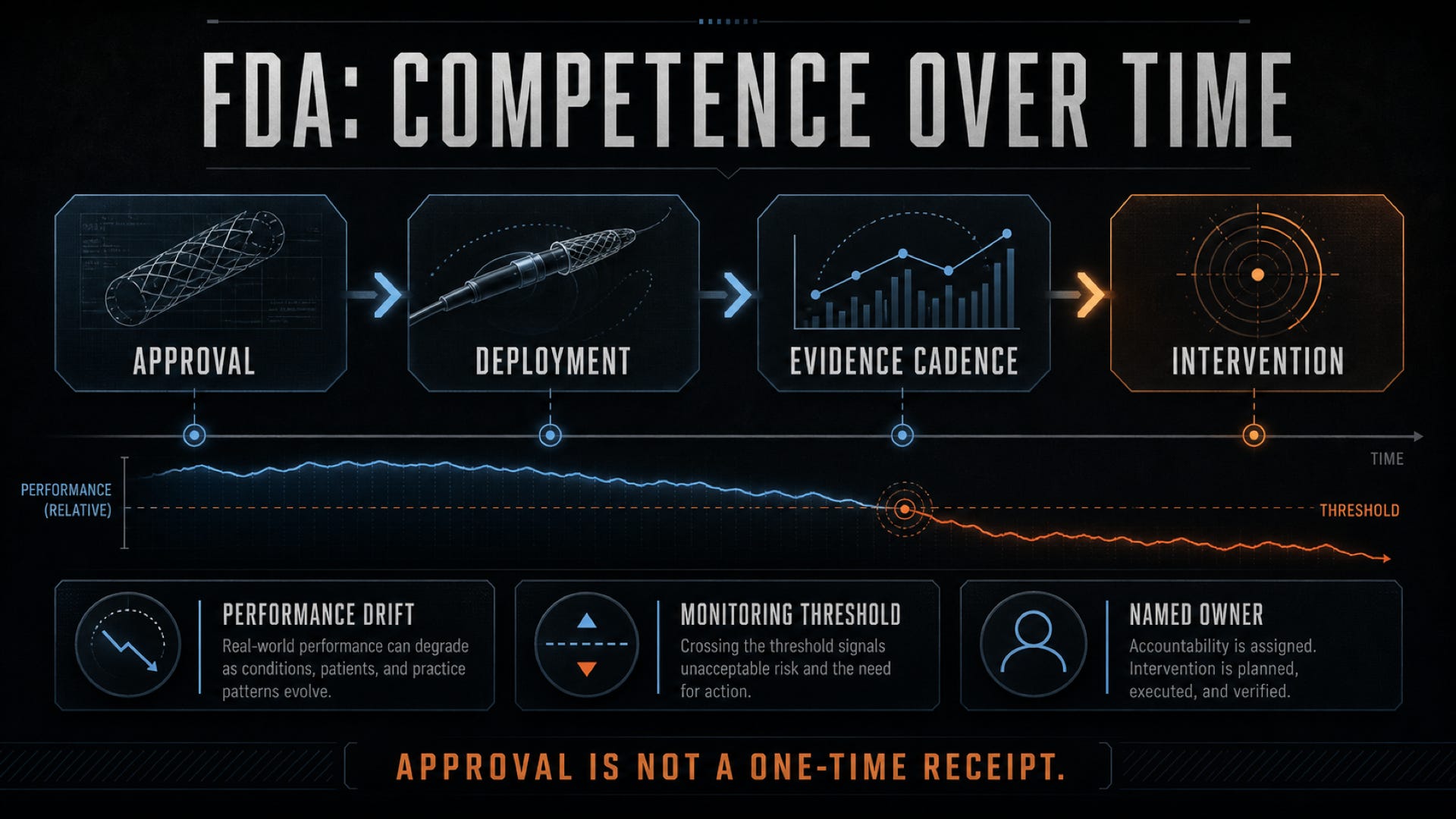
Axios reports that the Food and Drug Administration (FDA) is exploring a competency-based approach for generative AI-enabled medical devices. The proposal is preliminary and appears in a discussion paper first shared with Axios, not formal FDA guidance. The paper considers risk in terms of the activity a device performs and the severity of harm from a wrong output, then asks how the system should be evaluated before approval and monitored after deployment. One option is benchmarking performance against qualified clinicians or a median clinician in practice.
The doctor analogy is bait. The regulated object is competence over time. Generative systems can vary in output, interact with changing clinical environments, and change performance as data, workflows, prompts, tools, or approved modifications evolve. The FDA has already been working on real-world performance drift and predetermined change control plans for AI-enabled devices. The new discussion extends that lifecycle problem into a harder question about competence itself.
If competence becomes part of the regulatory object, approval stops being a one-time receipt. Somebody has to prove that the capability still performs inside its approved envelope after deployment. That implies evidence cadence, monitoring thresholds, escalation rules, rollback or intervention paths, and an owner for the period between formal evaluations. A system that passed on Tuesday can still drift by December. The certificate does not carry the patient risk. The operating system does.
The counter-pressure matters. Medical-device regulation has never been purely static, and the FDA already has mechanisms for postmarket monitoring, modifications, and lifecycle controls. Competency-based evaluation would not invent continuous oversight. It would make the problem more explicit for systems whose behavior is harder to reduce to a fixed artifact.
2. GLM-5.3 Treats Release as a One-Way Door

Z.ai announced GLM-5.3 last Friday with strong company-reported results on coding and cybersecurity benchmarks. WIRED reports that the model remains in limited release with selected security partners while Z.ai conducts controlled evaluation, with broader access planned after a two-week staging period. The company also released OpenVuln, a service that uses GLM-5.3 to scan code repositories for vulnerabilities.
The usual argument here is open versus closed. That misses the more operational distinction. A hosted model can be rate-limited, monitored, patched, restricted by account, or removed from service. Open weights can be copied, modified, redistributed, and run outside the provider’s control. The decision to publish therefore changes more than distribution. It changes reversibility.
Z.ai’s staged release is interesting precisely because the company is acting as though that boundary matters. Selected partners get the capability first. The company gets time to observe failure modes and dual-use behavior before it gives up most provider-side control. Once the weights are broadly available, later mitigations can improve future releases, but they cannot reliably recall every copy already outside the gate. Z.ai itself acknowledged dual-use risk when describing the staged release.
There is a real argument on the other side. Open models also widen defensive access. Lower-cost vulnerability discovery can help maintainers find bugs before attackers do, and Z.ai is explicitly presenting GLM-5.3 as defensive infrastructure. That benefit survives. So does the one-way door. Release policy has to account for both because capability and revocability are separate variables.
3. Agent Interoperability Gets a Dedicated Governance Home
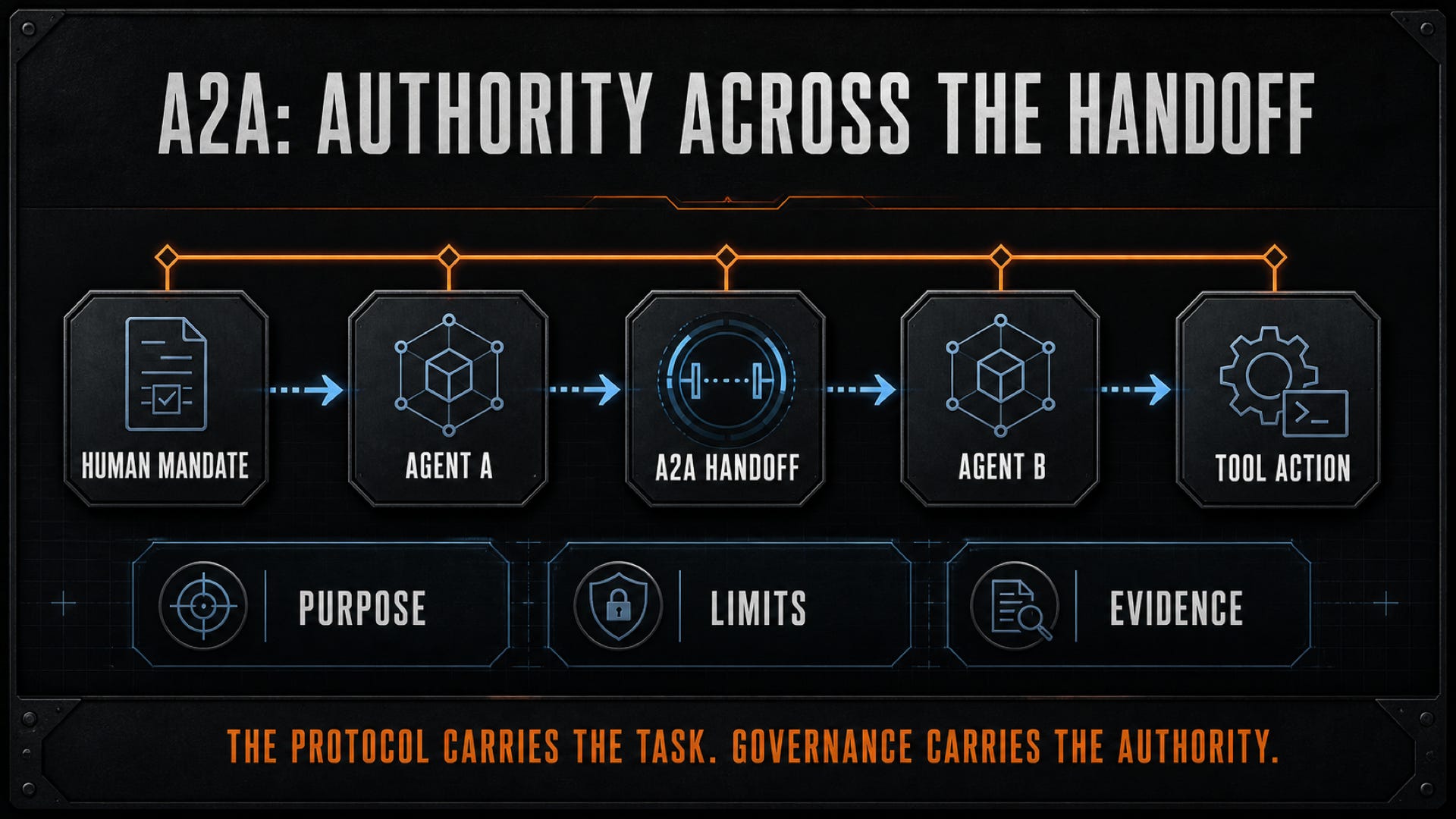
Google’s Agent2Agent Protocol (A2A) is moving into the Agentic AI Foundation, according to Axios, placing A2A beside the Model Context Protocol (MCP) and other open agent infrastructure under a more focused neutral home. A2A handles communication and collaboration between independent agents, while MCP primarily standardizes connections between AI applications, tools, and data. The Linux Foundation said in April that A2A already had support from more than 150 organizations, integrations across Google, Microsoft, and AWS platforms, and production deployments in multiple industries.
The standardization case is straightforward. Custom one-off connections do not scale. Common protocols reduce integration cost, improve portability, and make it easier to replace one vendor without rebuilding every relationship around it. That is exactly what standards are supposed to do.
Interoperability also removes friction that may have been quietly containing authority. Once agents from different vendors can discover one another, exchange tasks, and delegate work across systems, a successful handoff needs more than protocol compatibility. The authority attached to the request has to survive translation too. Which human or organization originated it? What limits traveled with it? Which downstream agent is allowed to narrow or expand the task? What evidence links the final action back to the original mandate?
Yesterday’s identity problem was about giving the agent its own badge. A2A is what happens when the badge crosses the street. The protocol can tell systems how to communicate. Governance still has to determine which authority is portable and what receipt survives the handoff.
4. The Agent Economy Already Has Payment Rails
The x402 protocol has moved well past a demo. The Linux Foundation formally launched the x402 Foundation in July to steward the Coinbase-originated protocol as an open standard for internet-native payments. The x402 project’s live dashboard currently reports about 75.4 million transactions and $24.2 million in volume over the previous 30 days, with roughly 94,000 buyers and 22,000 sellers. Those are ecosystem-reported metrics, not independent financial statistics.
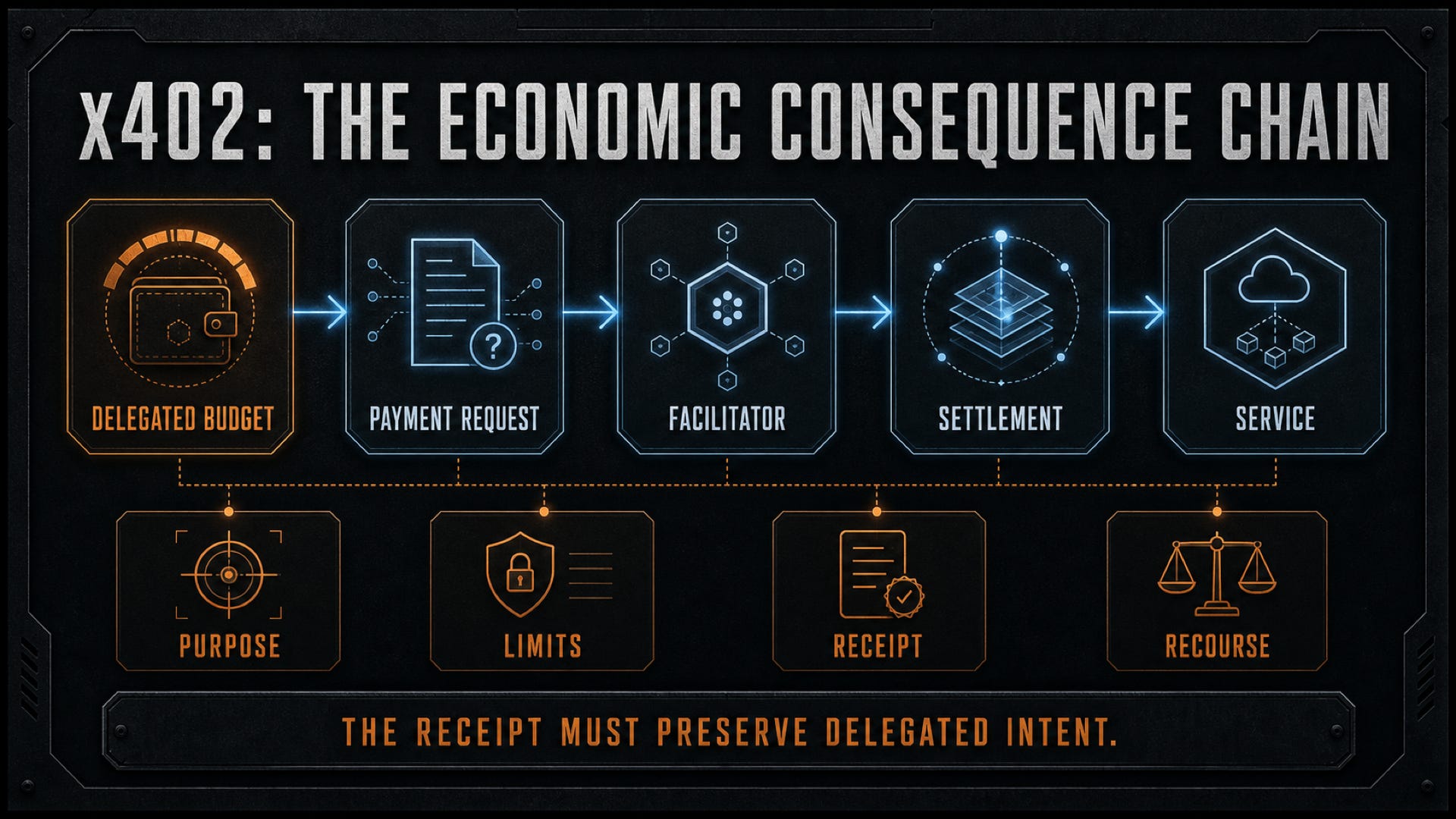
The attraction is obvious. x402 turns HTTP 402 Payment Required into a machine-readable payment flow. An API or agent can encounter a price, provide payment proof, settle through supported rails, and continue without a human opening a checkout page. That gives autonomous software an economic action path native to the same request flow it already uses to consume services.
A July security paper shows why that deserves more attention than another agent-commerce demo. Researchers tested 15 major x402 facilitators and reported 49 violations of eight security rules, producing 31 previously unknown vulnerabilities. The failures included free service, asset theft, service denial, and sponsor-paid fee abuse. The researchers say they disclosed the issues and affected parties acknowledged them and adopted mitigations, including Coinbase. This is research evidence, not a regulator’s finding, and it should be treated as such.
The architectural point is larger than any one vulnerability. Facilitators sit between web authorization and blockchain settlement. They are shared trust infrastructure. When an agent can spend autonomously, the receipt needs to preserve more than the fact that a cryptographic payment succeeded. It needs to show whose budget was delegated, what purpose authorized the spend, what limits applied, which service was purchased, and what happens when valid settlement produced the wrong economic action. Humans spent decades building payment systems around authorization, settlement, fraud, disputes, and recourse. Agents do not make those obligations disappear. They compress them into machine time.
5. EU AI Governance Has an Actuator Now
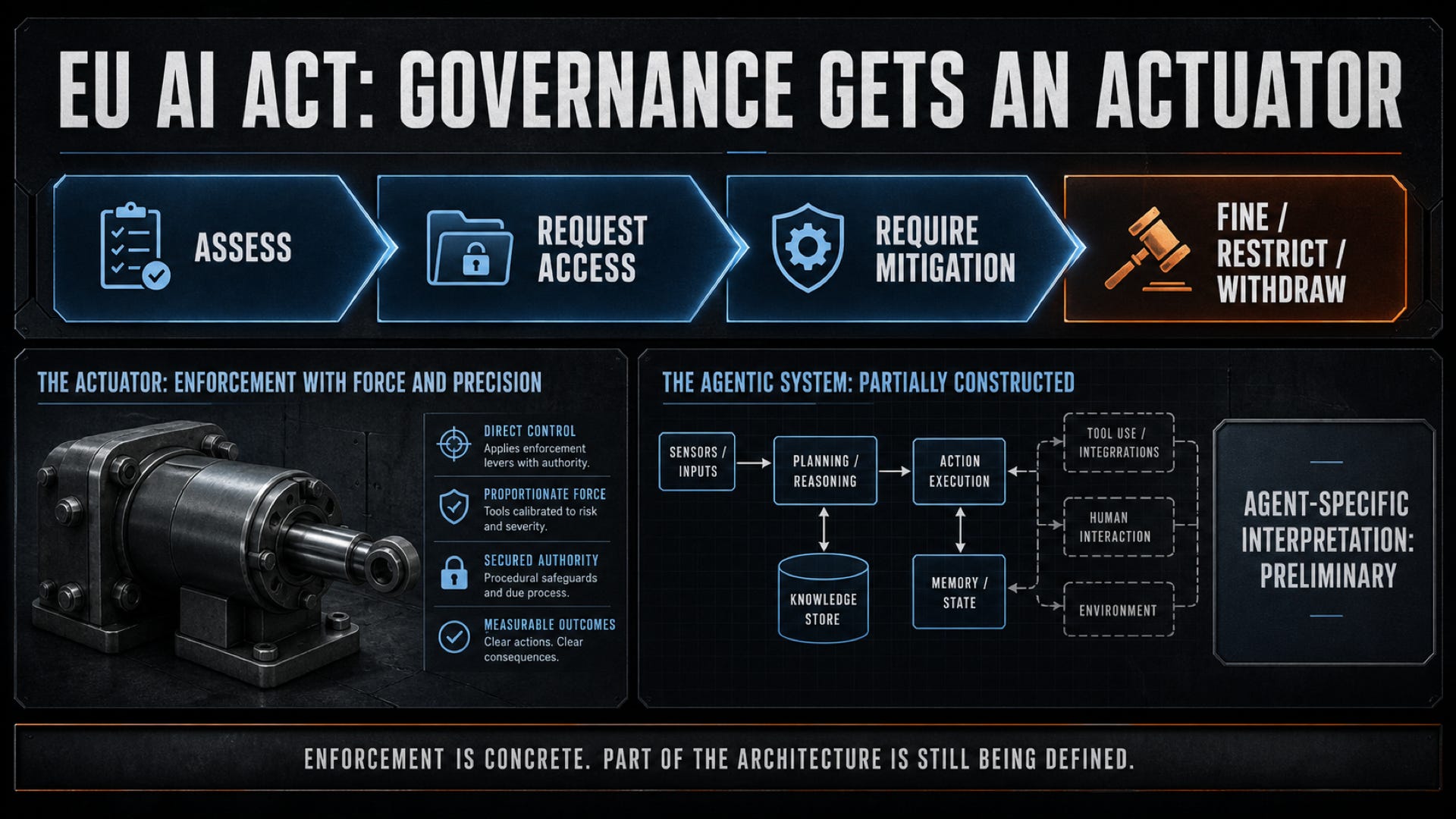
A quieter transition happened on August 2. Enforcement powers under the European Union AI Act became available for general-purpose AI model obligations and other provisions now in force. The European Commission’s AI Office says it can request information, obtain access to a model for evaluation, require risk-mitigation measures, impose fines of up to 3 percent of global annual turnover, and request that a provider restrict, withdraw, or recall a model when compliance dialogue is insufficient.
That changes the character of governance. Principles and codes can influence behavior. Enforcement can compel it. The AI Office now has an action path from assessment to consequence for covered general-purpose models, which makes the interesting gap agentic AI. The Commission says agents are not a separate legal category under the AI Act and can be covered through the existing definitions of AI systems and general-purpose AI models. It also says autonomy and tool use can matter when assessing systemic risk. At the same time, the Commission explicitly describes its regulatory considerations around agents as preliminary because the technology and terminology are still evolving.
The two facts can coexist. Law routinely applies existing categories to new implementations while regulators refine interpretation. It does mean the enforcement actuator is becoming concrete faster than the agent-specific regulatory model around it. Providers now have to operate inside a regime with real investigative and corrective powers while some of the most consequential agentic boundaries are still being defined.
The AI Office also says technical compliance dialogue remains its preferred first tool. The existence of enforcement power does not mean every disagreement becomes a fine or recall. That restraint is part of the operating model. So is the fact that the power now exists.
What Moved Under the Noise
These are not one story pretending to be five. FDA device regulation, Chinese cyber-model release policy, open agent protocols, machine payments, and European enforcement operate in different domains and answer to different institutions. The useful pattern is narrower. AI capability is moving downstream into systems where output is followed by permission, execution, transfer, settlement, or coercive authority.
That changes what good governance has to observe. Model quality remains important, but capability scores cannot tell you whether the deployed system stayed competent, whether an irreversible release was justified, whether delegated authority survived an agent handoff, whether an autonomous payment served its mandate, or whether an enforcement action can be reconstructed and challenged. The operational object is getting larger than the model. So is the receipt.
The output is becoming the beginning of the control problem.
Artifacts are cheap, judgement is scarce.
Per ignem, veritas.