

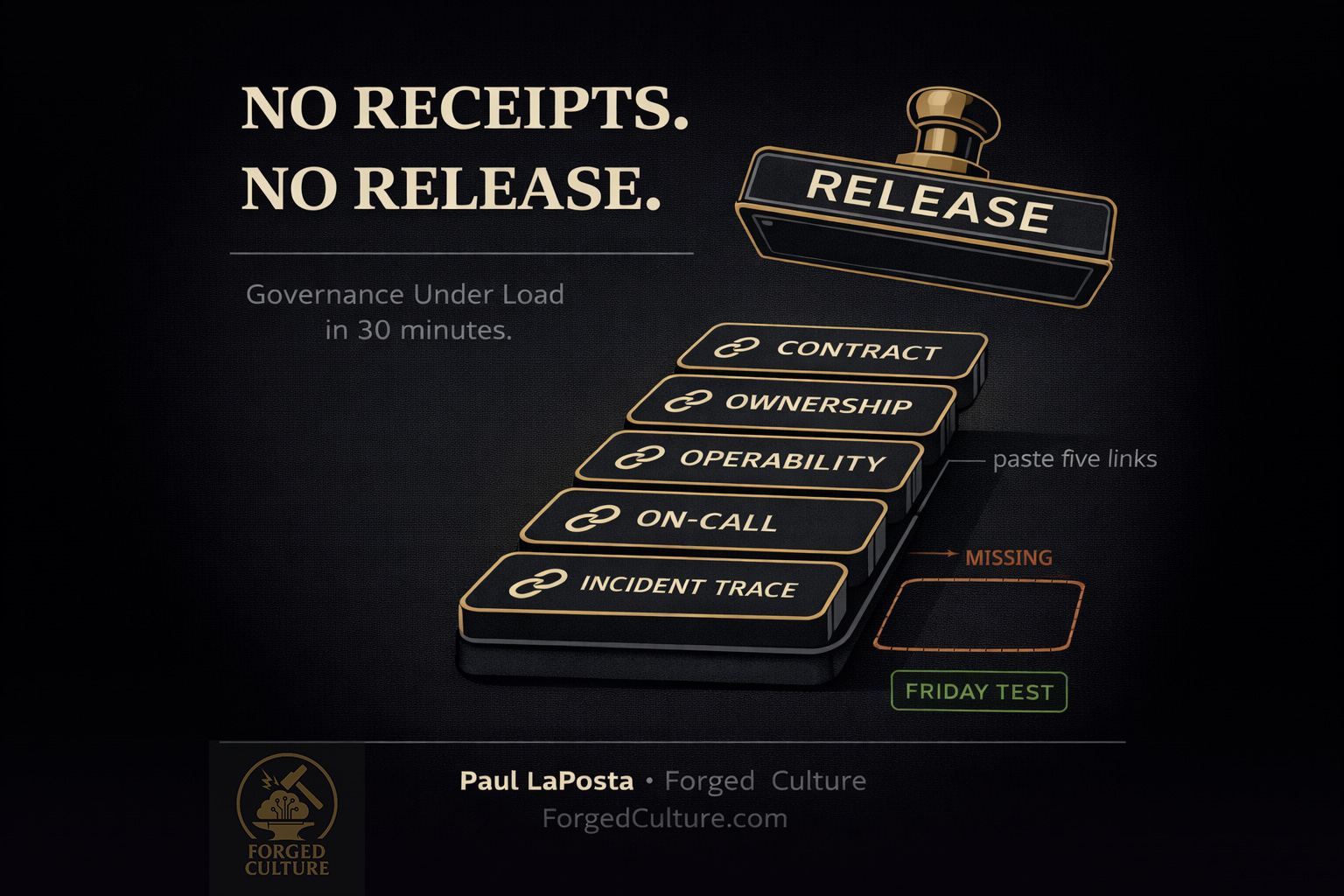
If you cannot produce five links in 30 minutes, you do not have an operating model. You have a story.
DevX without OpsX is speed purchased with other people’s sleep.
Forged Culture doctrine: two non-negotiable gates
The Five Receipts Gate for applications.
The Five Boundaries Gate for agentic workflows.
This is a 30-minute diagnostic you can run today: paste five links or admit you cannot.
The pager going quiet is a real moment. It can feel like progress, and it can feel like being made redundant. Both can be true at the same time.
DevOps is not dying. Toil is. And that was always the goal.
DevOps was systems thinking: delivery, reliability, and learning as one loop. SRE makes reliability measurable. Platform engineering makes the safe path cheap to follow.
Every culture war ends the moment you force it to produce a template and an on-call rotation.
DevX matters. It is necessary. It is not sufficient.
Ops, security, and support are customers too. When engineering ships problems, those problems land in someone else’s life. Usually at 2 a.m., usually without context, usually with someone asking for an ETA like recovery is a vending machine.
The failure mode here is not microservices or ops or AI.
It is exec decree plus missing contracts plus optional on-call. That is governance failure.
The Governance Externalization Pattern
I call this the Governance Externalization Pattern: exec decree plus missing contracts plus optional on-call.
The organization rewards decree speed, so decree speed repeats.
Clean narrative rewards risk externalization. The system selects for leaders who can decree without paying. The currency is headcount, compatibility discipline, and on-call obligation.
Here is how it plays out. A senior exec makes operational decrees from a distance. Greenfield rewrite. “Move fast.” Breaking changes without compatibility. No patience for incremental migration. No appetite for the boring work that makes distributed systems behave. Staffing is mis-scoped. SRE and infra raise basic concerns about failure modes, operability, and ownership. The feedback is ignored, and a “platform team” appears as a political buffer, staffed to agree rather than staffed to deliver.
Outages multiply. Customers feel it. The business pays for it. The narrative stays clean: operations should handle incidents. The exec cannot be wrong. The customers are just experiencing “growing pains.” Meanwhile, the people keeping the lights on burn out and leave.
Underneath the slogans, the failure is basic. No durable API contracts. No versioning discipline. No breaking-change policy. No shared understanding of where the data is when, what “fresh” means, or who owns what. Boundaries chosen by ideology instead of cohesion and operability. Then the poison pill: best-effort on-call.
If on-call is optional, reliability is optional.
The Five Receipts Gate
So here is the gate. Not a vibe. A test.
Forged Culture: The Five Receipts Gate (paste links, no prose)
Contract: [versioned API contract + breaking-change policy (versioning, deprecation window, rollback expectation)]
Ownership: [service owner + escalation path]
Operability: [runbook + rollback path]
On-call: [rotation rules + response expectations + escalation policy]
Incident trace: [last serious postmortem + follow-through tracker]

Validity: artifacts must be versioned, reviewed in the last 90 days, and clickable. No screenshots. Links only.
DONE: links posted and pinned in the team channel.
High-performing teams paste links. Low-performing teams argue. Arguing is the tell. Paste the link instead.
Golden paths matter only because they make the receipts cheap to maintain and hard to dodge.
The Acceleration Problem
Acceleration does not replace governance. It makes missing governance lethal faster.
Operational test: if you cannot revoke an agent workflow in minutes and reconstruct one incident end to end, you are not delegating safely. You are scaling failure.
Tool calls run at machine speed. Approvals, incident response, and accountability still run at human speed. That gap becomes an incident factory. Agentic workflows make delegated action easier. Useful. Also dangerous.
This is where someone will say, “AI will just replace your ops teams.”
Orgs want operational cost for free. They want accountability to be optional. They want the bill to land somewhere else. AI sounds like the perfect loophole.
It is not.
AI can replace toil. It cannot replace obligation. If you remove ops humans without installing governance, you do not get efficiency. You get a predictable consequence chain:
Contracts stay vague, so breaking changes ship faster.
Ownership stays fuzzy, so incidents stall.
On-call stays optional, so the people who know the code do not show up.
Attribution gets worse, so fixes get political.
Audit becomes theater: “we have logs” without correlation, decision trace, or authority proof.
Customer harm rises, and the org pays later in worse currency.
The Five Boundaries Gate
No receipts, no release. No boundaries, no delegation.
Forged Culture: The Five Boundaries Gate (bare minimum for agentic workflows)
Agent identity
Allowlisted tool permissions
Data scope boundaries
Incident-grade provenance
Revocation plus a kill switch

Validity: demonstrate one successful revocation drill and one reconstructed incident trace from the last quarter.
DONE: revoke works in minutes, provenance reconstructs a single incident end to end.
If you cannot reconstruct what happened, attribute it to a specific identity, and revoke it in minutes, you did not ship capability. You shipped future work in the form of an incident.
The Friday Test
Pick one crown jewel service.
In 30 minutes, post the five receipts links.
If you cannot, file the work with Owner, Timebox, Witness.
If leadership refuses, record the refusal as a governance risk with owner and date.
OTW
Owner:
Timebox:
Witness:
Evidence: Witness posts the five links in [channel] by [time], pins the message, and replies “verified” or “missed.” Evidence must be links, not screenshots.
Toil died. The craft remains: strategy, vision, and governance that works under pressure.
Patterned. Tempered. Tested. Trusted.
Per Ignem, Veritas
If this helped, forward it to the person who owns the on-call rotation.
Paul LaPosta is a DevOps and Cloud Infrastructure leader who writes field manuals for leaders on AI adoption, conflict, incidents, and legible systems. Read more at the Leadership Under Load blog on ForgedCulture.com. Examples: The Illegibility Crisis, Leadership Under Load, and Crafting Conflict.