

The clean note may be easier to read than the truth.
Clinicians are buried in after-hours charting, fragmented attention, inbox drag, compliance residue, and the quiet tax of turning a human encounter into a record before the day will release them. Ambient AI documentation may reduce that burden. That matters. A tool that returns attention to the patient deserves serious consideration, not because AI is new, but because exhaustion is already shaping care.
The danger starts where the demo usually ends. The note appears. It is clean, structured, fluent, and ready for review. The clinician can edit it, sign it, and move on to the next patient. That may be better than finishing notes at night while already spent. But once that note enters the chart, it stops being convenience. It becomes memory. That is the threshold.
The easy fear is hallucination. Did the system invent a symptom, diagnosis, exam finding, or plan? That matters, and no serious person should wave it away. Hallucination is the failure everyone already knows how to fear. That ghost is loud. It gives risk committees something obvious to point at. The quieter problem is not invention. It is compression, the loss of fidelity under clean prose.
A note can be technically accurate and still shrink the visit. A patient hesitates before answering, and the note keeps the answer but loses the hesitation. A concern surfaces sideways, not as the chief complaint, but as the thing that gives the encounter its edge. The note catches the complaint and drops the edge. The clinician is uncertain, but the generated prose reads settled. Nothing was made up. Something was still laundered out.
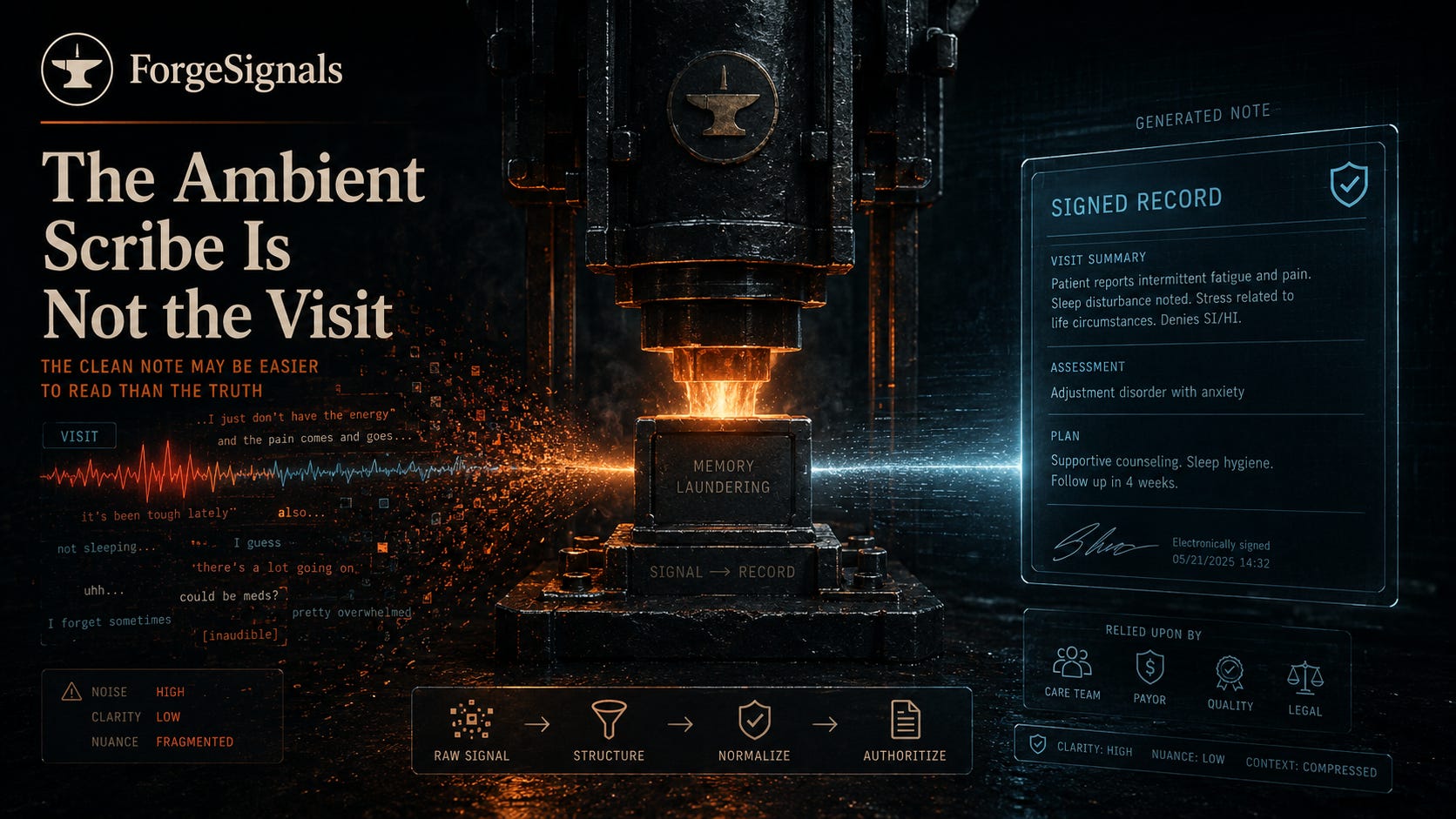
Memory laundering. The visit is messy. The note is clean. The clean note gets trusted. The trust travels. The source disappears.
A visit has tone, sequence, silence, interruption, repetition, and force. It captures the moment when the patient is about to say the thing, then retreats. It has the clinician asking one more question because some small detail did not sit right. There is a difference between “I am fine” and the way someone says it while looking at the floor. A note has never captured all of that. Clinicians have always summarized, selected, interpreted, and compressed. No chart note is the full encounter. Pretending otherwise is its own kind of administrative religion.
What changes now is scale, speed, and distance from the source. The encounter becomes a transcript. The transcript becomes a generated note. The generated note becomes a clinician-edited record. The signed record becomes future care. The next person usually does not have the encounter. They have the chart, and the chart is what they act from.
That is why cleanliness is not neutral. Clean prose can hide uncertainty. It can make urgency quieter. It can make a provisional judgment sound more final than it was. It can preserve facts while changing their weight. Clinical meaning does not live only in whether each sentence is true. It also lives in emphasis, sequence, doubt, and what the note makes easy to notice later.
This is where documentation becomes authority. The signed note is not simply a record of what happened. It becomes the source another clinician reads, the artifact a reviewer evaluates, the summary a care coordinator trusts, the material a coder interprets, and the memory a future visit may depend on. If the generated note compresses the wrong thing, underweights the wrong concern, or makes uncertainty look settled, that compression can travel downstream long after the original encounter is gone.
A human signature does not solve this by itself. A clinician reviewing an AI-generated note is still reviewing a shaped artifact, often under time pressure and after a day already full of cognitive load. Fluent prose sits inside the clinical system and looks like work product. Trusting it does not make the clinician careless. It makes them human.
The question I would ask is not whether a human reviewed the note. I would ask whether the human could see the transformation. If the review step only asks the clinician to approve polished output, the gate is weaker than it looks. It proves someone accepted the artifact. It does not prove they had enough source context to see what changed. The clinician may be reviewing the final surface, not the path from encounter to record. That is a signature step. It is not a working guardrail.
A better guardrail makes the transformation inspectable where risk justifies it. Not everywhere, and not with a courtroom-grade audit trail attached to every ordinary sentence. That would be safety theater in the other direction, and healthcare has enough theater already. Most of it has a committee, a badge, and a budget code.
High-risk signals need preservation. Ambiguous moments need visibility. Uncertain sections should not be polished into false confidence. Meaningful changes between generated draft and final note should be recoverable. The system should let the clinician correct more than outright falsehood. Missing emphasis matters. Softened concern matters. Misplaced certainty matters. A record can be factually correct and still clinically misleading if it changes the significance of what happened.
So the field test is simple. Can you reconstruct the path from encounter to signed record to downstream reliance?
Not as a vendor promise. Not as a workflow diagram. Not as “the clinician signed it, so we are good.” Can you see what source material the system used, what it left out, what the draft changed, what the clinician edited, what survived into the chart, and who relied on it later? If you cannot answer that, you may have reduced documentation burden by increasing record illegibility.
That is not an argument against ambient scribes. It is an argument against treating them as clerical tools after they start shaping clinical memory. Low-risk documentation support should stay usable. Clinicians do not need another ritual strapped to their backs in the name of safety. But the more a generated note gets used for future care, review, coding, coordination, or clinical judgment, the less acceptable it is to lose the trail of how that note came to be.
The ambient scribe is not the visit. It turns the visit into institutional memory. Once it becomes memory, it becomes authority. Care does not improve just because the note is cleaner. Safer care depends on the organization being able to see what the note preserved, what it changed, what it lost, and who acted on it later. If a clinical record cannot be reconstructed, that is not merely a documentation problem. It is a care problem hidden by better formatting.
Care can only be governed when it can be reconstructed.
Artifacts are cheap, judgment is scarce. Per ignem, veritas.