


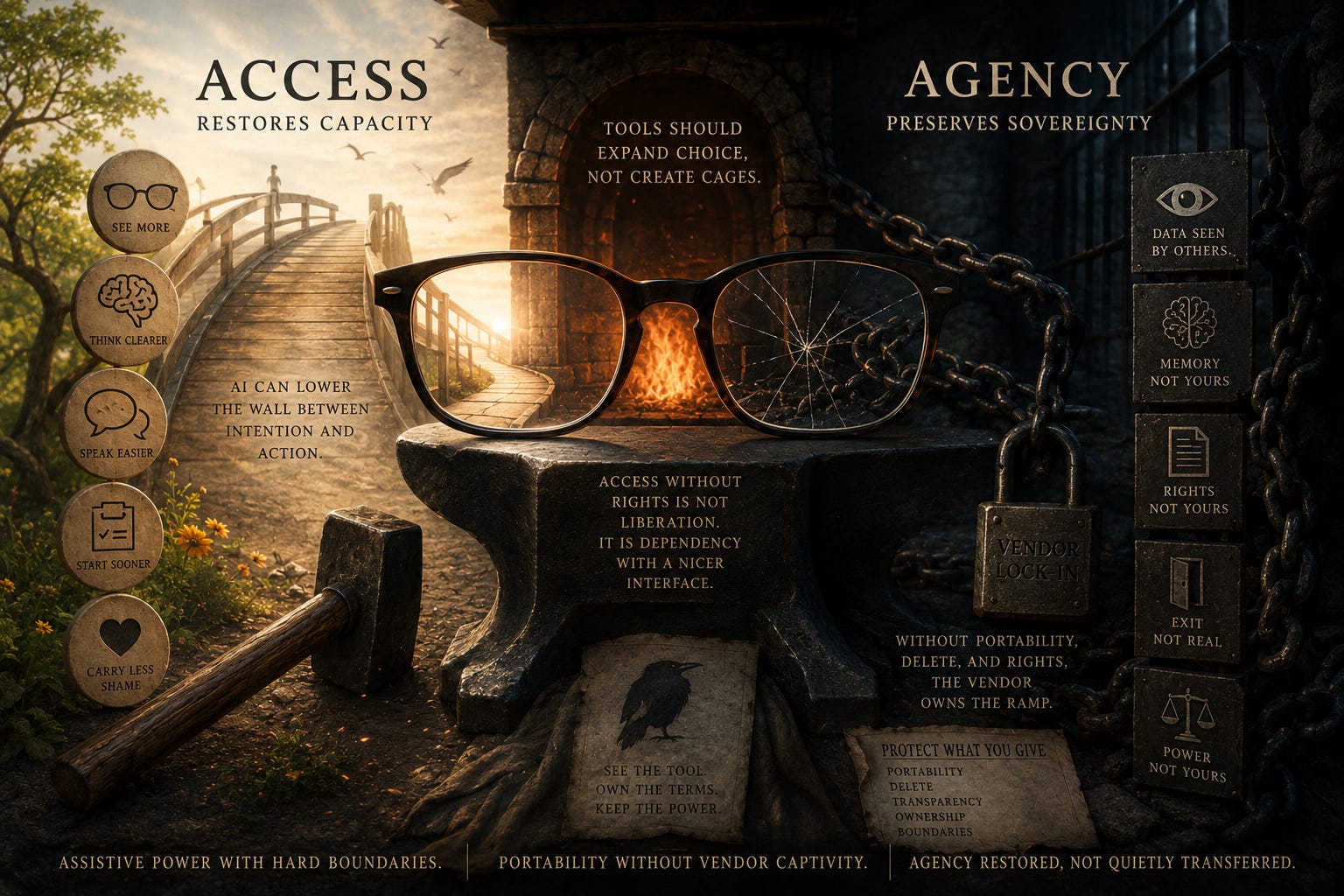
The real question is whether the tool restores agency or quietly takes it away.
“You are becoming dependent on AI.”
Maybe. I am also dependent on glasses, running water, refrigeration, roads, calendars, maps, medication, electricity, spellcheck, language, and the accumulated prosthetic stack we insist on calling civilization. Nobody tells a nearsighted person to squint harder to build character, and nobody tells someone with a cane that stairs are an important growth opportunity. But the moment a tool helps with memory, initiation, sequencing, communication, tone, social translation, or emotional load, suspicion arrives dressed as concern.
That suspicion is not neutral. It tells us which kinds of limitation we respect, and which ones we still treat as moral failure. For neurodivergent people, especially people with ADHD, autism, or both, the problem is often not intelligence, desire, care, or discipline. It is the threshold between intention and action. The email is visible. The stakes are known. The person wants to send it. The body still will not move. Calling that laziness is not insight. It is bad instrumentation.
AI agents matter because they can externalize parts of executive function that standard productivity systems assume are already present. They can remember context, break sequence, draft the first pass, lower activation cost, hold the thread when working memory drops it, translate directness without erasing the person, and pick the task back up after three days without adding another layer of shame. That is not the same thing as surrendering judgment. It is closer to access.
The question is not whether the user is dependent. Everyone is dependent. The question is what the dependency does. Does it restore agency, or does it capture it?
Civilization is dependency
Humans are not independent creatures. We are scaffolded creatures. We offload memory into writing, orientation into maps, arithmetic into calculators, vision into lenses, movement into vehicles, and survival into supply chains no individual could reproduce alone. The myth of the independent person is mostly marketing copy written by people who forgot who paved the road under them.
So when someone says AI creates dependence, the first response should be plain. Compared to what. Compared to the planner someone abandoned because every reminder felt like an accusation. Compared to the productivity app that assumed task initiation was a solved problem. Compared to the workplace norm that treats one unanswered email as a character defect. Compared to a school, job, or family system that demanded output while refusing to see the hidden cost of producing it.
Dependence is not the scandal. Dependence is the human condition with better or worse design. The useful distinction is not dependence versus independence. That is fantasy. The useful distinction is access versus capture.
A tool supports access when it helps a person do more of what they mean to do. It supports capture when it begins deciding what they mean, narrowing their options, extracting their data, or making exit too costly. Without that distinction, the AI debate collapses into two bad scripts. One side treats AI as liberation with a product roadmap. The other treats it as moral decay with better branding. Neither frame is good enough.
Cognitive assistance gets moralized
Physical assistance is legible. A ramp makes sense. Glasses make sense. A hearing aid makes sense. A wheelchair makes sense. You can see the missing access path and the tool that restores it. Cognitive assistance is harder for people to respect because the injury is not always visible and the cost is not always measurable from the outside.
A person with ADHD may know exactly what needs doing and still be unable to start. A person with autism may understand the content of an email but burn enormous energy modeling how the recipient might interpret tone, directness, timing, subtext, and expectation. A person with both may carry the whole task in mind, lose the thread halfway through, recover it, lose the emotional regulation, and then spend two days ashamed of the delay. From the outside, this can look like avoidance. From the inside, it is a tax.
AI agents can reduce that tax. Not because they are magic, wise, conscious, or your friend, therapist, doctor, mentor, priest, or tiny glowing executive assistant sent from the benevolent cloud kingdom. We have suffered enough product mythology. They can help because they externalize load. They can hold memory, break sequence, turn the first step into something small enough to touch, draft the awkward message, sort the pile, and track what fell off without adding the disappointed-human face that makes shame worse.
For some people, that is not convenience. That is the difference between participating and disappearing.
This is access, not cheating
The accusation of cheating depends on a strange assumption. It assumes the unaided version of a task is morally purer than the aided version. That assumption falls apart fast. Writing with a pen is not more moral than writing with a keyboard. Remembering an appointment from pure internal memory is not more virtuous than using a calendar. Navigating by stress and vibes is not nobler than using GPS, despite what every man over fifty in a hardware store would like history to believe.
The point of a tool is not to preserve suffering. The point is to preserve agency. If an AI agent helps someone move from paralysis to action, from shame to repair, from overwhelm to sequence, then the right first question is not whether they used assistance. The right first question is whether the action remains theirs.
Did the tool help them say what they meant. Did it help them keep a promise they wanted to keep. Did it reduce the hidden cost of participating. Did it make their life more livable without making them less sovereign. That is the access argument, and it is strong. But it cannot be the whole argument, because AI agents are not glasses all the way down.
The access case is real. That is exactly why the governance case matters.
The glasses metaphor has limits
Glasses are a decent metaphor for function. They are a bad metaphor for governance. Glasses correct vision. They do not log your fear patterns, infer your attachments, store your unfinished custody email, remember your medical worries, summarize your shame spiral, or route your private life through an operator whose incentives may not match yours.
AI can be like glasses in what it restores. It is not like glasses in what it collects. That difference is not a footnote. It is the whole ethical problem.
If an agent works well, it becomes intimate. It sees abandoned tasks, repeated stalls, emotional loops, financial fear, workplace conflict, family fracture, health anxiety, and the draft message written at 1:17 a.m. and deleted before morning. That intimacy is part of why it can help. It is also why it can become dangerous.
A tool that helps you function can become infrastructure. Infrastructure can become leverage. Leverage can become control. The more useful the agent becomes, the more costly it is to leave. That is exactly when operator incentives matter most.
Who owns the memory. Who can read it. Who can train on it. Who can sell it. Who can subpoena it. Who can revoke access. Can the user export their context. Can they delete it. Can they move it from one vendor to another without losing the functional self they built inside the tool.
That last question matters because portability is not a convenience feature. It is an agency requirement. If the agent becomes part of how a person remembers, plans, sequences, writes, regulates, and maintains commitments, then locking that memory inside one vendor creates dependency without sovereignty. It turns accommodation into platform capture.
A rights-preserving agent must make exit real. The user should be able to export memory, preferences, task history, relationship context, prompt scaffolds, routines, and working patterns in a usable format. Not as a decorative data dump no human can parse. Not as a PDF tombstone. As portable context another system can ingest, inspect, and rebuild from. If the user cannot leave without losing the accommodation, the vendor does not merely provide the tool. The vendor owns the ramp.
That is not acceptable. Access that cannot be moved becomes leverage. Memory that cannot be exported becomes custody. Personal context that cannot be deleted becomes a quiet form of possession. Yes, that sounds dramatic. So does building a cognitive prosthetic and then pretending vendor lock-in is just normal software economics. Here we are, ankle-deep in the future and somehow still arguing with the landlord.
The same test applies across domains. Can the user separate work memory from legal memory, medical memory, therapy-adjacent memory, and personal life. Can they use the tool without feeding an employer, vendor, insurer, platform, or data broker a behavioral profile of their inner life. Those are not edge questions. They are access questions, because access without rights is not liberation. It is dependency with a nicer interface.
The rights problem
There is another layer beneath privacy. Rights.
If an AI agent becomes the place where you draft the email to your lawyer, process your custody fear, summarize the facts of a workplace complaint, prepare for an HR investigation, rehearse a deposition answer, or work through whether you were discriminated against, you may not just be sharing sensitive information. You may be changing what protections attach to that information.
Attorney-client privilege does not exist because something feels legal. It exists because a communication is made inside a protected relationship, in confidence, for the purpose of legal advice. An AI agent is not a licensed attorney. It does not owe fiduciary duties. It is not disciplined by a bar association. It is not automatically your lawyer’s agent. It may be operated by a company whose terms permit retention, review, training, disclosure, or compelled production.
That matters. This is not theoretical anymore. In United States v. Heppner, a federal court in the Southern District of New York held that a securities fraud defendant’s written exchanges with Claude, used to generate legal analysis and potential defense strategy, were not protected by attorney-client privilege or the work product doctrine. The court pointed to the obvious but often ignored facts. Claude was not an attorney. The exchanges were not communications with counsel. The platform did not create a protected legal relationship. The court also examined confidentiality concerns tied to the platform’s data practices.
Lawyers can argue over how broad the ruling should be, and they are already doing that, because lawyers, given oxygen and ambiguity, will build a cathedral of billable nuance. But the practical warning is clear enough for ordinary users. A person can sit alone at night, scared and overloaded, trying to make sense of a legal situation, and feed the most sensitive facts of their life into a tool that feels safe because it feels responsive. Responsiveness is not privilege. Helpfulness is not confidentiality. A calm tone is not a protected relationship.
The same boundary applies to health and therapy-adjacent use. An AI agent can help you prepare questions for your doctor. It is not your doctor. It can help you track patterns to bring to your therapist. It is not your therapist. It can help you organize facts to discuss with your lawyer. It is not your lawyer.
This distinction has to stay clean, not because the tool is useless, but because the user is vulnerable precisely where the tool is most useful. Neurodivergent users are not just asking for convenience. Many are bringing the parts of life already loaded with shame, exhaustion, disability, trauma, financial pressure, social cost, and professional risk. If the tool becomes a cognitive prosthetic, the operator sits very close to the nervous system of the user.
That requires more than a good interface. It requires rights-preserving design. Local-first options where possible. Clear deletion. Exportable memory. Portable context. No training on sensitive content by default. Protected modes for legal, medical, employment, and therapy-adjacent material. Strong warnings when users enter categories where privilege, confidentiality, or statutory protections may matter. Enterprise controls that serve the worker, not just the employer.
Most of all, it requires refusal. No clinical cosplay. No legal cosplay. No employer surveillance dressed as accommodation. No soft-voiced extraction sold as support.
The institutional version is different
There is a reason this gets tangled. For an individual, an AI agent can be assistive technology. For an institution, the same pattern can become accountability laundering.
A person using an agent to draft an email they could not start is not the same thing as a company using AI to decide who gets access to care, credit, employment, housing, legal status, or internal opportunity. One restores a user’s capacity to act. The other can obscure who acted at all. That distinction is where a lot of AI discourse goes to die, probably under a slide that says transformation in a font chosen by committee.
Individual assistive use asks whether the tool helps the person express intent. Institutional use asks who has authority, who can explain the decision, who can override it, who is harmed, and who carries liability when the system gets weird. Those are not the same governance problem.
Treating them as the same is how you get bad policy from both directions. You either ban tools that help people function, or you permit systems that quietly move decisions beyond human accountability. The answer is not blanket permission. The answer is not blanket panic. The answer is role, risk, power, and rights.
The agency test
So stop asking only whether AI creates dependency. Ask better questions.
Does the tool help the person do more of what they mean to do, or does it quietly decide what they mean. Does it restore access, or does it replace judgment. Does it reduce shame, or does it create a new failure loop. Does it make the user more capable in the world, or more governable by the system.
Does the user own the memory. Can they leave without losing themselves. Can they delete what they gave it. Can they see what it knows. Can they move their context to another vendor. Can they separate personal support from employer oversight. Can they bring legal, medical, or therapeutic material without giving away rights they do not understand they are giving away.
Who benefits from the dependency. Who pays if it breaks. Who has the power to change the terms later.
Those are the questions that matter. Dependency is not one thing. It has a shape. Some dependencies are liberating because they return function. Some dependencies are dangerous because they transfer power. A good agent should make the user more capable, not more owned.
That is the line.
Squint harder
Nobody should have to squint harder to prove they deserve to see. Nobody should have to perform cognitive suffering to prove their thoughts are real. And nobody should have to hand over a map of their mind to get through a Tuesday.
AI agents may become one of the most important assistive technologies of this era for neurodivergent people. Not because they are conscious. Not because they understand us. Not because they are replacements for doctors, therapists, lawyers, managers, friends, or actual human care. Because they can reduce the cost of action in a world built by people who keep mistaking invisible friction for weakness.
That is worth defending. But defense without boundaries is just sales. The work now is to protect the access without surrendering the person.
Assistive power with hard boundaries. Portability without vendor captivity. Agency restored, not quietly transferred.
Artifacts are cheap, judgement is scarce. Per ignem, veritas.