


Operations, DevOps, SRE, Platform, Infrastructure. Most organizations speak about these as if they are fundamentally different disciplines, separated by doctrine, maturity, and some sacred distinction only the initiated can perceive. Usually they are not. Usually they are variations on the same underlying craft, shaped by different tooling, business constraints, and reporting structures, then inflated by org-chart vanity into something grander than it is.
At the center, the work is not especially mysterious. The job is to reduce chaos, increase reliability, make complexity more legible, and keep fragile systems from becoming normalized simply because the organization has learned to function inside their instability. More bluntly, the job is to make reality easier to survive. That applies to systems, teams, processes, and the plans people keep handing each other with far more confidence than the evidence warrants.
That last part is where this starts, because there is a failure mode in technical organizations that almost never gets named cleanly, in part because it often arrives dressed as professionalism. It looks calm. It sounds respectful. It feels measured. Nobody is openly grandstanding. Nobody appears negligent. If you only look at the surface, it can pass for maturity. But the closer you get to the mechanics, the more obvious it becomes that what is being protected is not the work, not the outcome, and not the standard. What is being protected is comfort.
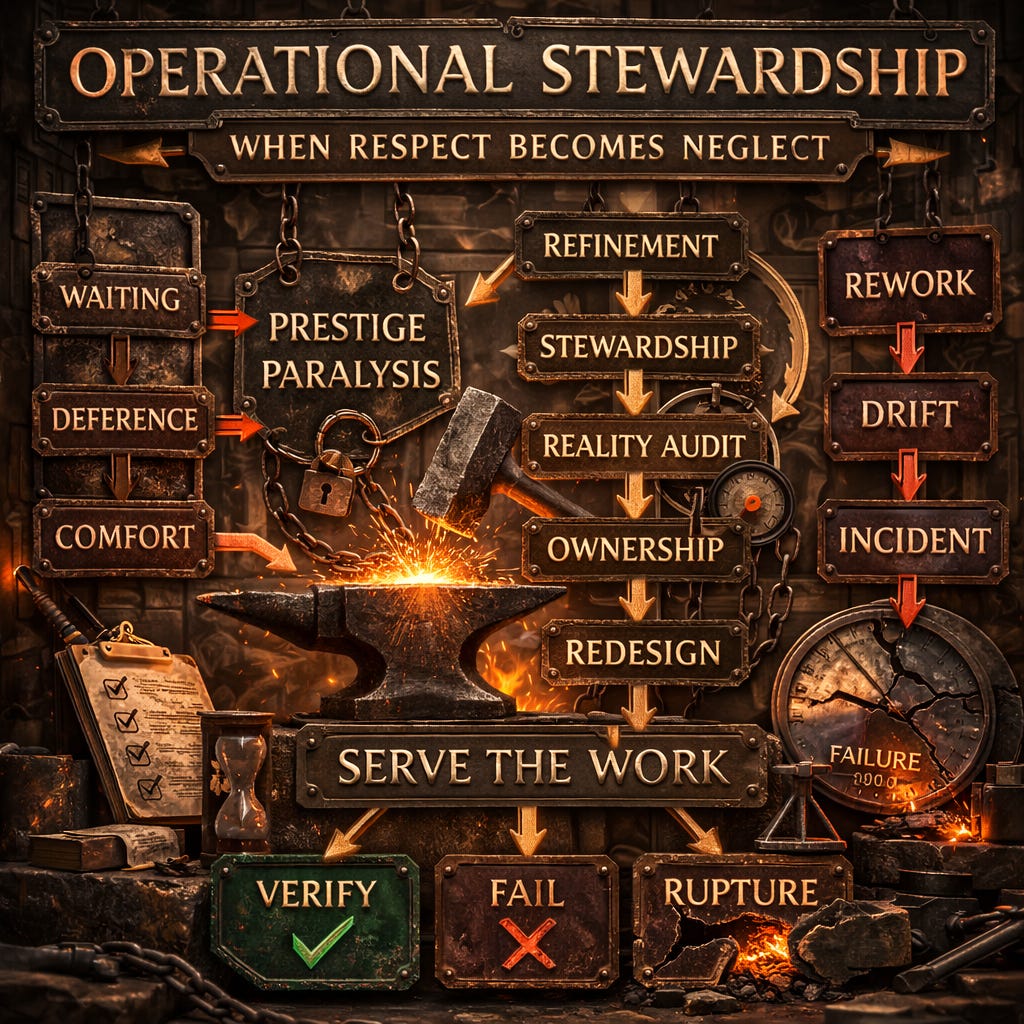
You can see it when engineers wait for work to be perfectly refined before they move. You can see it when a broad initiative comes down from someone respected and nobody wants to challenge it. You can see it when teams push forward with implementation without doing the refinement the work actually requires, as if forward motion by itself is proof of seriousness. These look like separate problems if you treat them as isolated incidents. They are not. They are different surface behaviors organized around the same deeper refusal.
That refusal is simple to describe, though people will spend an extraordinary amount of energy avoiding the description. It is a refusal to absorb ambiguity and convert it into judgment. One team waits for someone else to refine the task before acting. Another refuses to challenge a respected author’s draft and calls that restraint. Another moves the work forward without doing the difficult thinking that would make the work more true. The outward posture changes. The underlying move does not. In each case, the burden of uncertainty is displaced rather than metabolized. It is pushed upward toward the author, downward toward implementers, or forward into execution, where reality will eventually collect payment with its usual lack of patience and complete indifference to anyone’s title.
That is the first thing worth saying plainly. What gets called respect in these situations is often something far less honorable. Non-interference gets framed as professionalism. Passivity gets framed as restraint. Deference gets framed as trust. Reverence gets framed as maturity. Because the behavior is low-friction, organizations confuse smoothness with competence. Human beings are very fond of social arrangements that let them avoid tension while still sounding virtuous. It saves them the trouble of thinking hard and the discomfort of saying what the situation actually requires.
The second thing worth saying is more specific. A healthy technical culture understands that high-level design is not the finished artifact. It is starting material. A leader, architect, or initiative owner may define the broader direction, sketch the design, break out epics, and even produce a detailed first-pass ticket set. That work may be thoughtful. It may be strong. It may even be strong enough to create the illusion that the hard thinking is mostly complete. But that does not mean the work is done. It means the work has reached its next stage, which is refinement under contact with reality.
That stage matters because reality is where abstraction goes to get audited. The receiving team is not there to admire the design. They are there to refine it until it can survive implementation. That means adding lower-level detail, tracing dependencies, tightening sequencing, surfacing ownership gaps, testing assumptions against actual operating conditions, and identifying the points where the plan, elegant in theory, starts to deform under the weight of the environment it has to inhabit. Sometimes that means a modest adjustment. Sometimes it means deeper rewrites. Sometimes it means discovering that the broad shape was right but several key assumptions underneath it were not. And sometimes it means a total redesign, because the original design does not hold once it encounters reality. That is not disloyalty. That is not disrespect. That is the work doing what it is supposed to do.
This is where many organizations quietly betray their own standards. A respected person produces the broad design, and suddenly people start acting as if touching the artifact would somehow dishonor the person who authored it. They stop interrogating. They stop tightening. They stop tracing consequences with the seriousness required. They keep moving because motion feels safer than challenge, and preserving the author’s status feels safer than refining the work in public. They call this mature. They call it aligned. They call it respectful.
It is not respectful. It is prestige paralysis. It deserves its own name because, unlike obvious passivity, it flatters leadership while abandoning stewardship, which makes it harder to detect and harder to correct. Prestige paralysis is what happens when authorship acquires so much social gravity that refinement starts to feel like transgression. It is a failure mode because it turns stewardship into ceremony. The draft is treated as if the highest form of professionalism were to preserve it unchanged, when the real obligation is to improve it until it survives contact with reality. Respect for the author starts displacing responsibility to the work, and once that inversion settles in, an organization can abandon its craft while continuing to sound thoughtful in meetings.
Structure makes this worse. In many organizations, the person who defines the initiative also controls reputation, access, or evaluation for the people expected to refine it. When authorship and authority are fused, refinement does not merely feel uncomfortable. It can feel politically expensive. Silence stops functioning as deference and starts functioning as self-protection. Any diagnosis of this pattern that treats it purely as a courage problem will miss part of the mechanism. Sometimes people are timid. Sometimes they are reading the power structure correctly and adapting to it in the most human way possible. That does not make the result healthier. It makes the diagnosis more complete.
Then the bill arrives. It usually arrives under a more respectable label. Rework. Delay. Misalignment. Drift. Incident fallout. Depending on which part of the organization is forced to pay it, the local language changes, but the causal chain does not. Something should have been challenged earlier. Something should have been tightened sooner. Someone should have said, clearly and without theater, that the current shape could not survive contact with actual systems, actual constraints, actual ownership boundaries, or actual operations. Instead, the work moved forward under the protection of decorum.
That is why the simpler complaint about bad tickets, while real, is not enough. Yes, there is a problem when engineers, especially experienced engineers, sit on their hands waiting for perfectly shaped tickets before they act. At that level, ambiguity is not an unfortunate side effect of the work. It is part of the work. A meaningful part of technical maturity is the ability to reduce ambiguity without romanticizing it, without turning every unknown into a philosophical event, and without pretending that responsibility starts only after someone else has done the uncomfortable part first. If you require all uncertainty to be pre-processed before you can contribute, then what you are really asking for is not clarity but insulation.
That is dependency, not ownership. But the prestige version is more dangerous because it looks better from a distance. Ticket-waiting at least reads as obvious passivity. Reverent acceptance can look disciplined, collaborative, and socially adept. It flatters leadership. It lowers visible friction. It gives the appearance of maturity because nobody is making the room uncomfortable. It keeps the train moving, which organizations adore, especially when they are too tired or too politically overfit to ask whether the tracks still exist. This is the sort of thing people praise right up until it becomes an outage, a failed rollout, or a cleanup effort handed to whoever was unlucky enough to remain awake.
Operators tend to be less patient with this for a reason. In operations, reality gets a vote whether anyone enjoys that arrangement or not. Dependencies do not care who authored the initiative. Production environments do not care how admired the architect is. Rollouts do not care that the planning meeting had good tone. Failure paths do not become less real because nobody wanted to be the person who said the lower-level design broke the higher-level assumption. Reality is ruthlessly egalitarian in this respect. It humiliates titles, ignores prestige, and treats elegant intent as a non-binding opening statement.
That is where the rhetoric stops being rhetoric. The cost of avoidance is not symbolic. It is operational. Ownership cannot mean mere task completion. Ownership means improving the path, not just walking it. It means naming what does not hold before it becomes someone else’s rollback, postmortem, or 2 a.m. problem. It means refusing to pass ambiguity downstream simply because surfacing it upstream would be socially inconvenient. It means protecting the outcome rather than preserving the artifact. Once you state it plainly, the distinction becomes almost embarrassingly obvious, which is probably why so many organizations prefer not to state it plainly. Clear language has an irritating habit of stripping respectable behavior down to its actual function.
The costs here are not merely technical. They are cultural, which is worse, because technical damage can often be repaired faster than the habits that produced it. When experienced people model passivity, less experienced engineers learn that ambiguity belongs to somebody else. When respected authors are treated as untouchable, teams learn that prestige outranks truth. When work is allowed to move forward without meaningful refinement, everyone learns that ownership is mostly ceremonial, something to praise in principle and quietly evade in execution. After enough repetitions, the organization starts wondering why initiative quality feels uneven, why cross-functional work drifts, why brittle execution keeps surprising people who should not be surprised, and why thoughtful engineers increasingly recoil from rooms full of polished agreement.
The answer is usually not mysterious. The culture trained them to confuse politeness with stewardship. This is also why friction cannot be treated as an automatic sign of dysfunction. Some friction is the craft doing its job. Refinement is not free. Challenge is not always convenient. Rewriting can feel, to insecure cultures, like contradiction or disrespect, even when it is simply the next stage of maturation. Mature operators understand this. They know there are moments when respect for the outcome must be louder than comfort in the room. Not louder in volume. Not louder in ego. Just more explicit in substance.
Refinement is not dissent for its own sake. It is the disciplined obligation to improve the artifact until it can survive implementation. Sometimes that sounds like saying the initiative is still starting material, not final form. Sometimes it sounds like saying the ticket set is solid scaffolding but not execution-ready. Sometimes it means pointing out that the dependency changes the sequence, that the implementation detail invalidates an assumption, or that the design needs another pass before it moves. And sometimes it means saying, without flinching, that the original design does not survive contact with reality and has to be redesigned. None of those statements are acts of rebellion. They are signs that someone is still serving the work instead of serving the optics around the work.
If implementation reveals that the original shape was incomplete, deeper revision is not an offense against the design. It is fidelity to the outcome. If implementation reveals that the original shape cannot be salvaged without compounding risk, total redesign is not overreach. It is stewardship. The work is not served by protecting the dignity of a flawed first pass. The work is served by making the design true enough to survive the world it is entering.
And if someone genuinely deserves the esteem people keep trying to pay them with silence, they should be the first person to expect refinement rather than worship. Strong leaders do not need ornamental agreement. Strong architects do not need downstream teams to preserve every first pass like a sacred relic. Strong operators do not want ceremonial obedience from people who are supposed to improve the shape of the thing before it ships. They want the work carried forward by others capable of making it more true under real conditions. Anything less is flattering, perhaps, but it is not useful. It is a polished form of abandonment.
That is what stewardship actually looks like. You inherit intent and return execution. You inherit a pattern and return something tempered. You inherit broad direction and return something that can survive contact with the world as it actually is, not as it appeared in the safe abstraction of initial design. This is harder than passive agreement, obviously. It carries social risk. It can create discomfort. It requires thought, judgment, and a willingness to own ambiguity rather than handing it off in cleaner packaging. Which is probably why so many technical cultures keep trying to replace it with rituals of deference and then congratulating themselves on their professionalism.
So yes, there are several surface behaviors here: thumb-sitting, dependence on perfectly crafted tickets, reverence for broad initiatives that still need sharpening, and mechanical forward motion with the hard thinking quietly omitted. On the surface, they look different. Underneath, they are organized around the same move. All of them attempt to escape the responsibility of ambiguity. All of them push the burden of thought somewhere else. All of them treat ownership as something that begins only after uncertainty has already been removed.
That is not professionalism. That is not maturity. And despite how often it borrows the costume, it is not respect. It is avoidance with better branding.
The standard has to be higher than that. Respect the person, certainly, but serve the work. Refine the draft. Challenge the mismatch. Rewrite what does not hold. Redesign when redesign is what reality demands. Make the initiative more true before it ships. Because if refinement is your job, then leaving the artifact untouched is not discipline, loyalty, or restraint. It is abandonment of craft.
Per ignem, veritas.