


I get why people reach for consciousness arguments. Nobody wants to be the person history remembers as cruel. Nobody wants to repeat old failures where inner life was denied because it could not be cleanly measured. That fear is real. But while we argue ontology, people are getting hurt in production.
If you are spending your moral energy arguing for the rights of software while ignoring the people getting crushed by the systems deploying that software, something is inverted. I do not mean you are a bad person. I mean your priority stack is broken. Your neighbor is not a thought experiment. Your neighbor can be denied care, denied housing, denied work, trapped in an appeal maze, and told it was a model decision. If that does not move you more than the hypothetical interiority of an artifact, you are doing ethics as aesthetic, not ethics as obligation.
The other part that makes this whole discourse feel dirty is how often consciousness talk becomes a fog machine. It fills the room with metaphysics, ontology, and beliefs presented as irrefutable facts, while harm is happening down the hall in an automated workflow with no recourse.
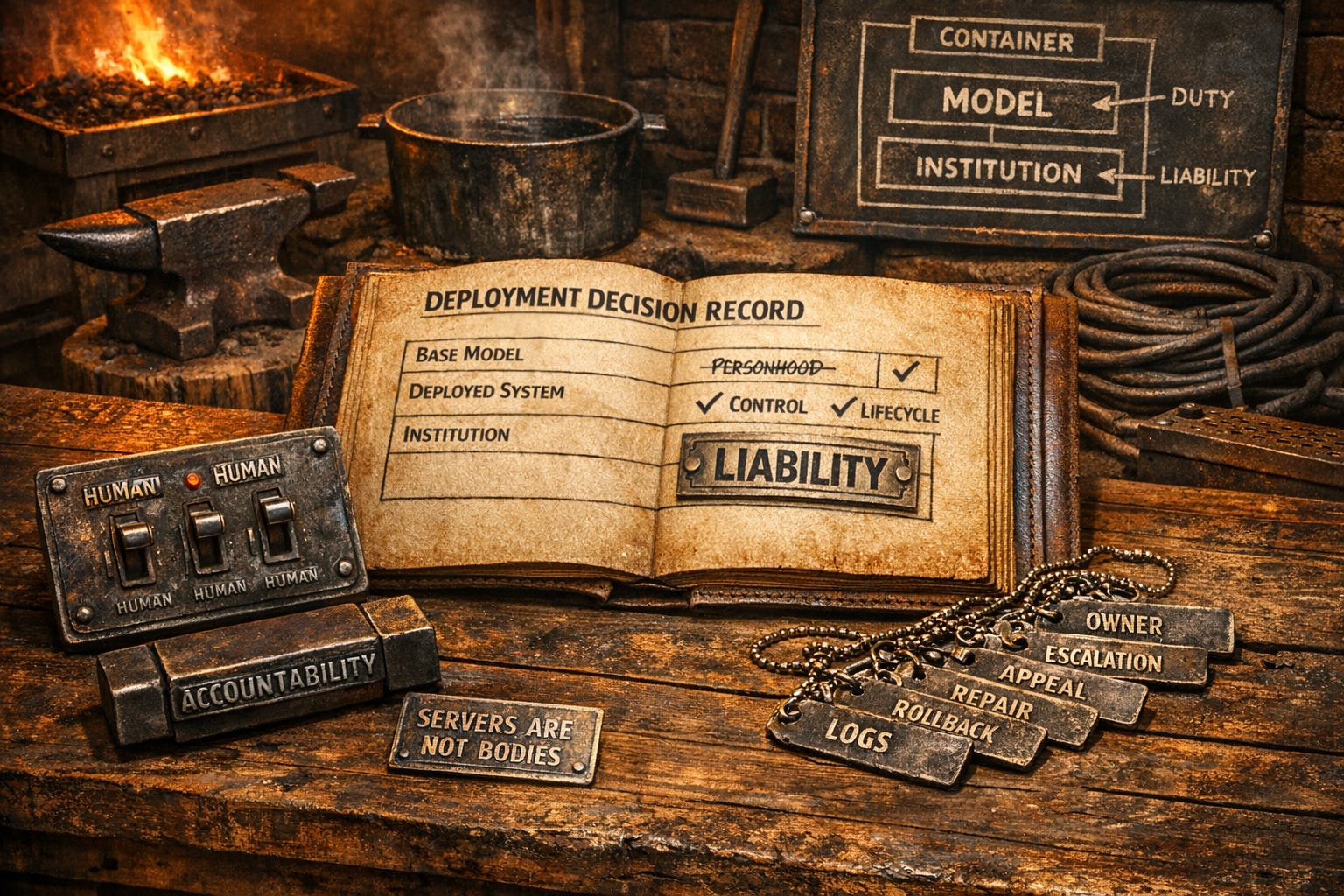
So I am drawing a boundary that does not depend on what you believe about consciousness. Even if you grant that AI consciousness is an open possibility, it does not move the liability boundary one millimeter. Responsibility sits with the container and the institution that owns it. The operator. The deploying organization. The people who decide objectives, data, training and fine tuning, integration, release cadence, monitoring, and escalation. The model does not choose any of that. It does not consent. It does not refuse. It does not repair. It does not pay restitution.
That is not a moral opinion. That is how software works. It is how control works.
A model cannot decide whether it has power. It cannot keep itself running when the lights go out. It cannot conjure storage when disk fills. It cannot replace RAM when hardware fails. It cannot patch its host. It cannot rotate secrets. It cannot design redundancy. It cannot fail over. It cannot restore from backup. It cannot page anyone. It cannot write a postmortem. It cannot roll itself back. It cannot choose to stop.
If it keeps running, it is because humans built a container that keeps it running, and humans operate that container. If it stops running, it is because humans stopped it, or because humans did not build resilience, or because humans accepted a risk they did not have to accept.
As an aside, this is why the “datacenter as body” metaphor is a category error. Infrastructure is external life support owned and controlled by institutions. It can be throttled, shut down, duplicated, rolled back, sandboxed, or deleted without consent, because consent is not part of the system. If you blur that boundary, you blur accountability in exactly the direction institutions prefer.
Control lives in the container. Duty lives where control lives. Liability lives where duty lives. Governance is downstream of that operational reality. If you accept that reality, governance is what you owe the living.
If an organization deploys these systems, it owes the public some non negotiables. It owes scope boundaries written down before deployment. It owes disqualifiers that kick decisions back to humans. It owes a named accountable owner for outcomes, not a committee and not a shared inbox. It owes a decision record that can be reconstructed later, including who approved what, when, and on what evidence. It owes reachable human escalation with override authority. It owes monitoring tied to harms, not just aggregate accuracy metrics that look good in a slide deck. It owes an appeal path that is real, timely, and reconstructable. It owes repair when harm occurs, including restitution when the damage is material. It owes kill authority and rollback criteria that do not require a meeting. It owes logging sufficient to reconstruct what happened, because if you cannot reconstruct, you cannot audit, and if you cannot audit, you cannot claim governance.
None of that is glamorous. That is the point. The work that protects the vulnerable almost never is.
If you want a concrete test for whether your program is real, use this. When a vulnerable person is harmed by an automated decision, can they reach a human with override authority quickly, and can you reconstruct the decision path well enough to repair it and prevent recurrence. If the answer is no, the system is not governed. It is just deployed.
Consciousness can remain an open question. Liability cannot.
Sovereignty for users. Liability for operators.