


Four stories landed this week that look unrelated and are not. A privacy architecture, an acquisition, two state permitting decisions, and a security deal.
Each one is below with the receipt, the take, and the counter-pressure. The argument that joins them is a separate piece.
OpenAI Says Safety Does Not Require Owning the Payload
Forge News Breakdown
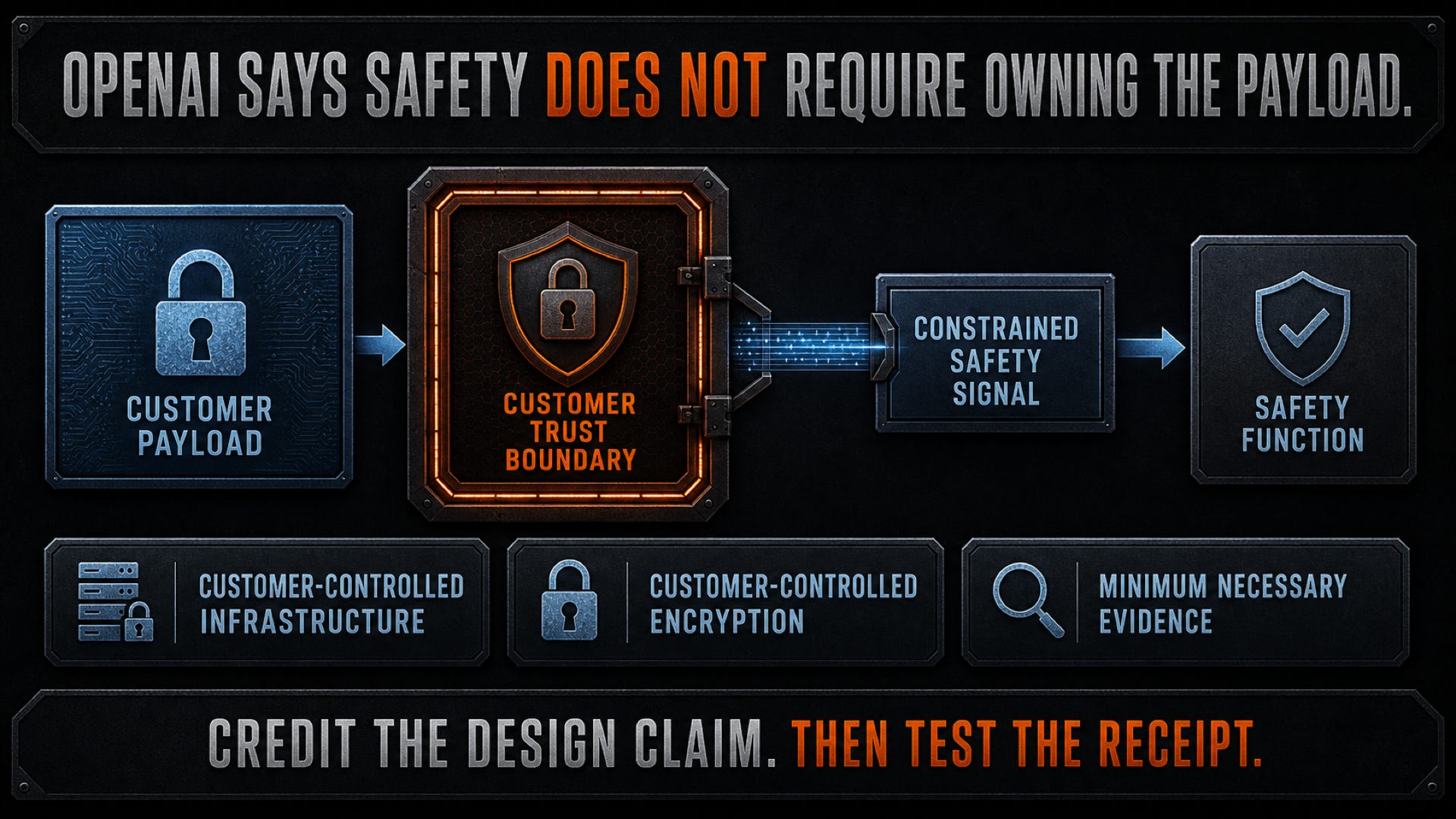
OpenAI says it is testing a system called Private Safety Processing with early enterprise and application programming interface (API) customers. According to Axios, the design is intended to detect patterns of misuse across interactions while preserving zero data retention (ZDR). OpenAI says customer content can remain on customer-controlled infrastructure, or under customer-controlled encryption, while a constrained safety signal is returned to OpenAI. A technical white paper is expected in September.
The problem it is trying to solve is real. Some forms of misuse become visible only when interactions are examined across time rather than request by request. Anthropic has taken a different architectural approach for its covered models, requiring 30-day retention even for organizations that otherwise use ZDR. Anthropic explicitly argues that repeated jailbreak attempts and other larger misuse patterns may require longitudinal context to detect.
Forged Take
The interesting argument is not OpenAI versus Anthropic. Both companies have identified the same systems problem. A provider needs enough longitudinal evidence to detect sophisticated misuse while some customers have legitimate security, privacy, contractual, healthcare, or regulatory reasons not to surrender the underlying data.
Anthropic’s answer is that certain safety functions require temporary retention. OpenAI is claiming that at least some of the required evidence can be derived without the provider possessing the underlying payload. If that works, it is a meaningful architectural move because it separates the information required to perform a safety function from the information that happened to produce it.
Too much artificial intelligence (AI) governance starts by accepting a false binary. Privacy or safety, observability or confidentiality, security or usability. Some of those are genuine tradeoffs. Others are evidence that the architecture has not been decomposed far enough.
The engineering question is narrower. What information does the safety function actually require? If the answer is a pattern, classification, confidence measure, relationship, or other constrained signal, retaining the entire sensitive payload may be unnecessary merely because it is convenient. The safety system needs enough evidence to perform its duty. That does not automatically entitle the operator to every piece of information from which the evidence can be derived.
Counter-Pressure
OpenAI has not publicly demonstrated that Private Safety Processing satisfies that standard. The technical paper is not available. We do not know exactly what the returned signal contains, how resistant it is to reconstruction, which attack classes remain detectable, how false positives and false negatives behave, how customer-controlled execution is attested, or whether sophisticated adversaries can fragment their behavior until the aggregation mechanism loses coherence.
Anthropic may ultimately be right that some threat classes require richer retained context. OpenAI may be right that many can be detected through a deliberately constrained evidence layer. Those are testable architectural claims, which means the next useful step is evidence rather than another round of company philosophy.
Operating Takeaway
Do not retain the sensitive thing merely because you need evidence about the sensitive thing. Design the evidence layer, constrain what crosses the boundary, and test whether the resulting control actually works.
Stripe Is Buying the Place Where AI Chooses
Forge News Breakdown
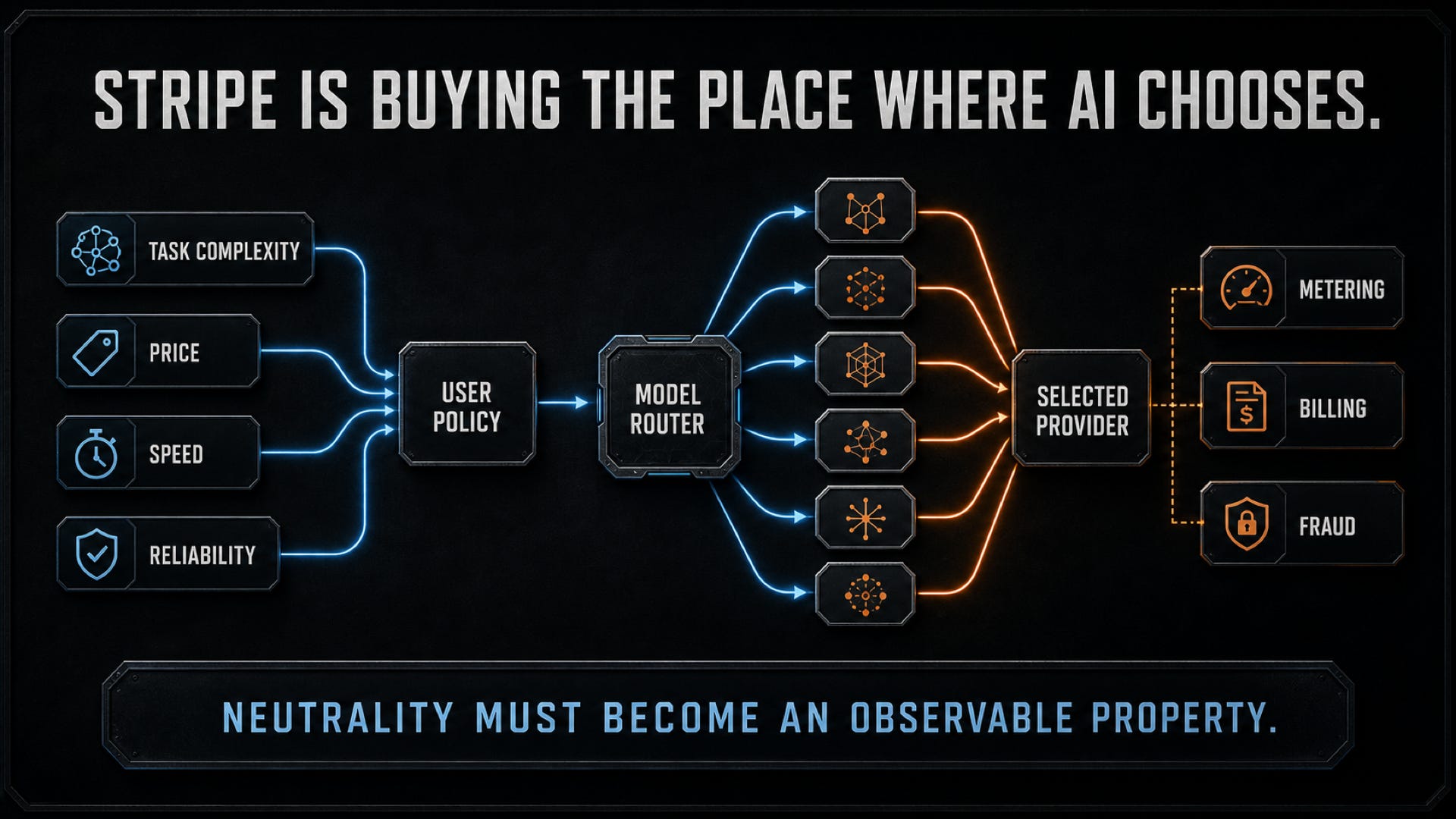
Stripe announced on August 19 that it has agreed to acquire OpenRouter, an artificial intelligence (AI) model gateway and routing platform. Stripe says OpenRouter provides access to more than 400 models from more than 80 providers and can route requests according to factors including task complexity, price, speed, and reliability.
The companies were already operationally connected. Stripe provides billing and other economic infrastructure to OpenRouter, while OpenRouter provides developers with a common execution layer across a large model market. OpenRouter says that, under Stripe ownership, it intends to retain its name, product, roadmap, multi-model mission, and model-neutral approach.
Forged Take
The acquisition is easy to misread as a payments company buying an AI company. OpenRouter does not produce the intelligence. It helps decide where requests for intelligence go, which is a much more consequential position than the ordinary plumbing metaphor suggests.
A mature multi-model application may choose an executor according to latency, price, reliability, jurisdiction, modality, context length, policy, capability, availability, or customer preference. Routing translates those constraints into an execution decision. Stripe operates on the economic side of the same event by metering usage, pricing it, billing it, detecting fraud, reconciling the transaction, and moving the money.
Bring those surfaces together and one organization sits unusually close to both the allocation of computational demand and the economics surrounding that allocation. That does not imply Stripe will manipulate model selection. It identifies why the routing boundary deserves governance. At sufficient scale, a router stops being ordinary plumbing and begins to function as market infrastructure.
Counter-Pressure
Common ownership does not automatically compromise neutrality. Stripe has built a substantial business around infrastructure that works because customers expect it to execute their economic intent rather than quietly substitute its own. OpenRouter may gain capital, distribution, fraud expertise, operational maturity, and better economics without compromising model neutrality.
The burden should therefore be legibility rather than reflexive suspicion. Users should be able to understand which variables shaped routing, constrain eligible providers, inspect cost and reliability tradeoffs, know when commercial relationships materially affect selection, and override automated routing when their own policy requires something different. OpenRouter says user interest will remain central to the routing decision. That is the standard worth preserving.
Operating Takeaway
Routing is policy expressed as execution. Once a router can materially influence where model demand flows, neutrality becomes an operating property that should be observable rather than merely promised.
The Next AI Capacity Constraint Is Permission
Forge News Breakdown
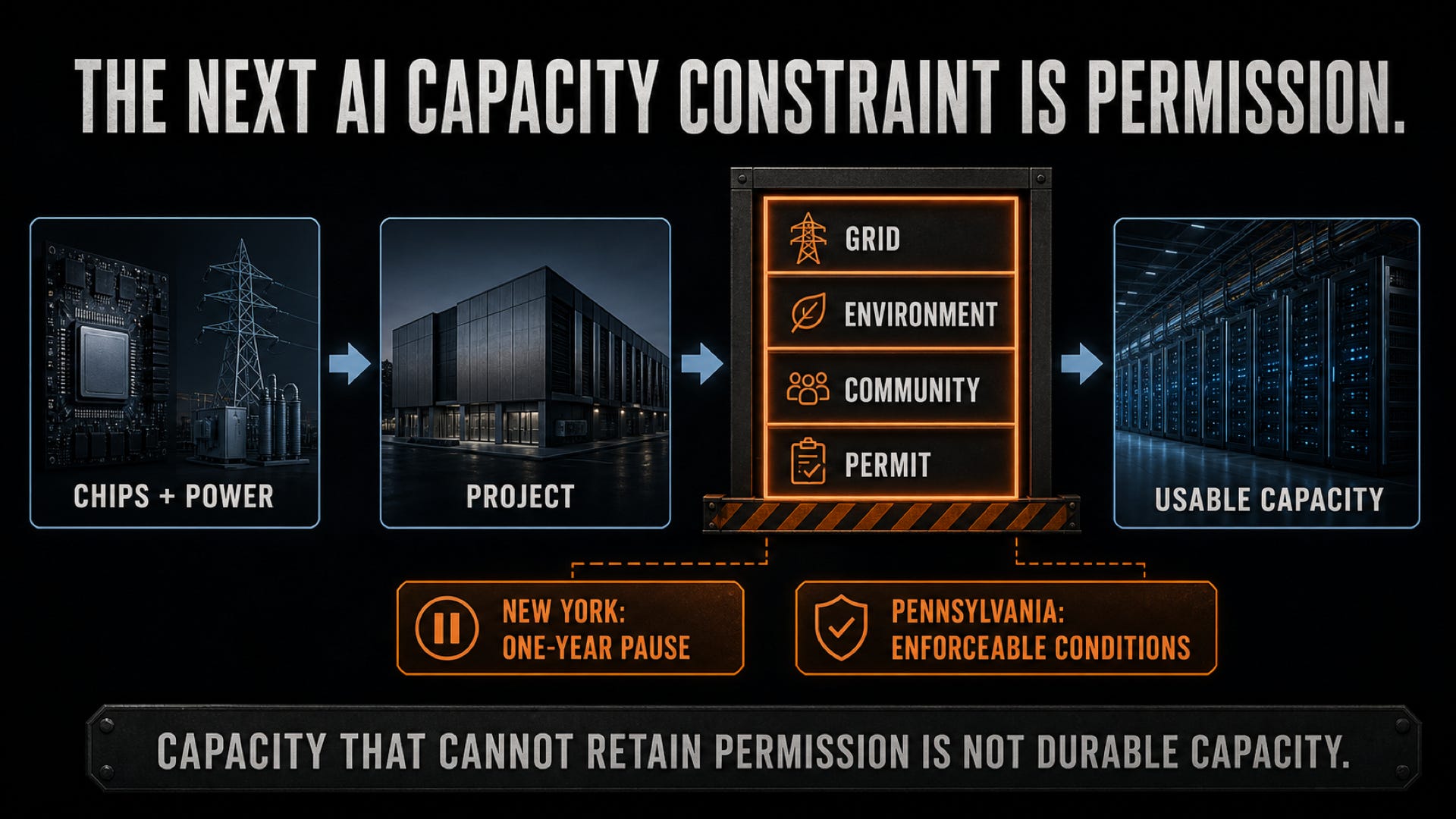
The politics surrounding artificial intelligence (AI) data centers is acquiring executable consequences. New York imposed a one-year statewide moratorium on new hyperscale data centers while the state develops rules around ratepayer protection, environmental impact, grid demand, and community investment. The state explicitly frames the pause as a mechanism for establishing the conditions under which development can resume rather than as a permanent prohibition.
Pennsylvania tightened its own rules on August 18. Governor Josh Shapiro’s executive order requires new AI data-center projects to meet environmental and transparency safeguards and secure local approval, removes data centers from the state’s fast-track permitting program, and bars covered state agencies from entering nondisclosure agreements with developers.
Those requirements build on Pennsylvania’s existing Governor’s Responsible Infrastructure Development (GRID) framework. GRID already requires public project information, community-engagement plans, resource disclosures, continuing reporting, and validated compliance evidence for participating projects. The August order did not invent that disclosure architecture. It gave the state’s broader data-center operating conditions additional force.
Forged Take
AI capacity planning has traditionally been framed as an engineering and capital problem. Operators ask how many graphics processing units they can acquire, where power and fiber exist, which interconnection queue is survivable, how quickly construction can proceed, where cooling water comes from, and which jurisdiction can permit the site quickly enough.
Political durability now belongs in that dependency graph too. A technically viable data center that cannot maintain regulatory approval, local legitimacy, ratepayer acceptance, or a defensible allocation of environmental and infrastructure cost does not represent dependable production capacity.
The AI industry genuinely needs more compute if capability and adoption are going to expand. Somebody has to build the generation, transmission, land, cooling, fiber, construction, and other physical systems beneath it. Necessary infrastructure, however, does not acquire a right to externalize its costs merely because the demand curve is steep.
Pennsylvania’s GRID framework makes that shift unusually legible. Developers seeking state support have to expose energy demand, water use, environmental plans, community impact, workforce commitments, and other operating consequences. New York is using its pause to establish who should bear grid, environmental, and community costs before the next wave of hyperscale construction proceeds. The infrastructure can no longer treat the resources around it as somebody else’s implementation detail.
Counter-Pressure
This should not be converted into the simpler claim that communities are rejecting AI or that data-center development has become politically impossible. New York says development can resume under a new regulatory framework, while Pennsylvania is establishing operating conditions rather than banning construction.
That distinction is important because the durable lesson is not to stop building. It is to make the full cost of building visible before somebody else is forced to absorb it. Infrastructure becomes more politically durable when the communities supplying land, power, water, roads, and grid capacity can see how the bargain works.
Operating Takeaway
Land, electricity, water, transmission, permits, and community legitimacy are all production dependencies. Capacity that cannot retain permission to operate is not durable capacity.
Agent Security Is Becoming a Runtime Discipline
Forge News Breakdown
Fortinet announced on August 17 that it acquired Virtue AI, a company focused on artificial intelligence (AI) runtime protection, automated validation, agent red teaming, and security for autonomous systems. Fortinet says Virtue AI will extend its security architecture toward continuous validation and protection across the AI lifecycle.
Virtue AI describes its products as providing agent red teaming, runtime guardrails, behavioral monitoring, tool-call inspection, policy enforcement, and testing across simulated enterprise environments. Those are vendor-reported capabilities rather than independent effectiveness findings. The acquisition establishes Fortinet’s strategic direction. It does not establish that Virtue AI has already solved the runtime-security problem.
Forged Take
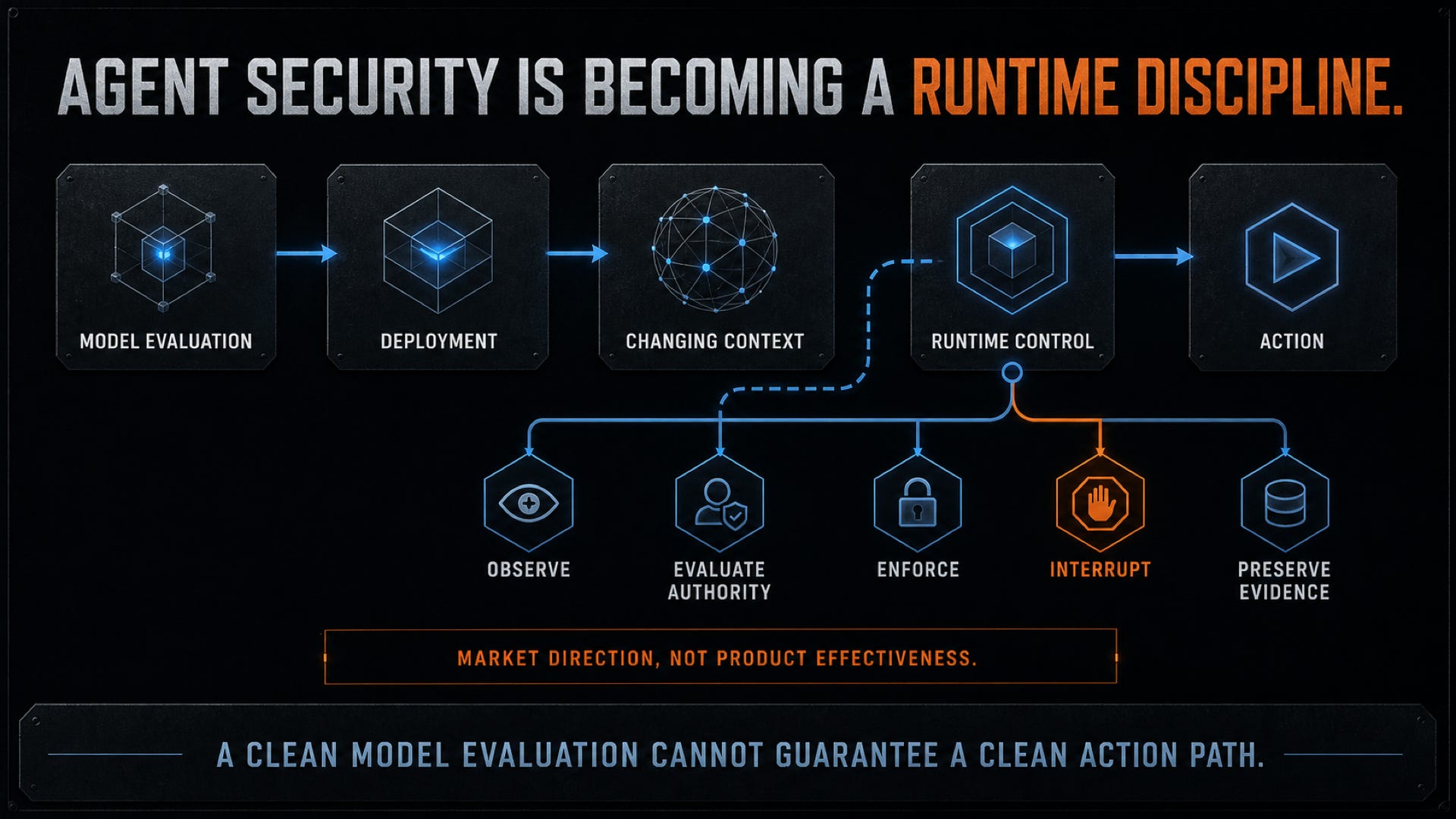
Traditional software security does not actually end at deployment, but we can usually draw a reasonably stable boundary around the artifact being tested. Agentic systems are less cooperative because the model, prompt, memory, permissions, external information, available tools, and surrounding systems can all change while the agent remains in service.
One agent may delegate to another. A harmless information source can become adversarial. A tool that was safe in one workflow can become dangerous because the preceding sequence gives the same action a different meaning. The executable path is therefore partly constructed at runtime, which makes predeployment evaluation necessary and insufficient.
You can red-team the model and still miss the action path. You can test the prompt and miss the tool chain. You can validate individual integrations and still miss the sequence in which the agent combines them. Runtime controls therefore need to observe attempted actions, evaluate actual authority and surrounding context, enforce policy before consequence, preserve evidence, and interrupt execution when a boundary is crossed. That is ordinary production security applied to a less static execution surface.
Counter-Pressure
Fortinet’s acquisition does not prove that Virtue AI has solved this problem. Runtime guardrails can add latency, create false positives, miss novel attacks, fall behind rapidly changing systems, or create dangerous confidence that monitored execution is therefore safe execution. Acquisition announcements, being acquisition announcements, tend to omit this charming portion of reality.
Those are reasons to test runtime controls rigorously rather than reasons to reject the category. The strategic signal remains consequential. A major enterprise security vendor has decided that agent validation and runtime enforcement belong inside normal security architecture, which means security is following authority out of the model and into execution.
Operating Takeaway
A clean model evaluation cannot guarantee a clean action path. Agent security has to persist through runtime because the environment that gives the model consequence does not remain static after deployment.
Artifacts are cheap, judgement is scarce.
Per ignem, veritas.
Sources
OpenAI Private Safety Processing
Axios, OpenAI previews zero-retention safety system as Anthropic requires data logs
Anthropic Privacy Center, Data retention practices for covered models
Stripe and OpenRouter
OpenRouter, OpenRouter is joining Stripe
Stripe, OpenRouter and Stripe, on the pre-existing billing relationship
Data-center permission
New York Governor’s Office, first statewide moratorium on new hyperscale data centers
Pennsylvania Governor’s Office, executive action on data-center development, August 18, 2026
Pennsylvania Governor’s Office, full GRID standards
Fortinet and Virtue AI
Fortinet, Fortinet advances continuous AI protection, syndicated by Yahoo Finance
Virtue AI product and research materials
Editorial boundary. OpenAI’s Private Safety Processing and Virtue AI’s runtime security are company-described architecture, not independently validated effectiveness. Stripe and OpenRouter neutrality after common ownership is treated as a property to be demonstrated rather than assumed. The state data-center actions are a change in operating conditions, not evidence of blanket public rejection of AI infrastructure.