


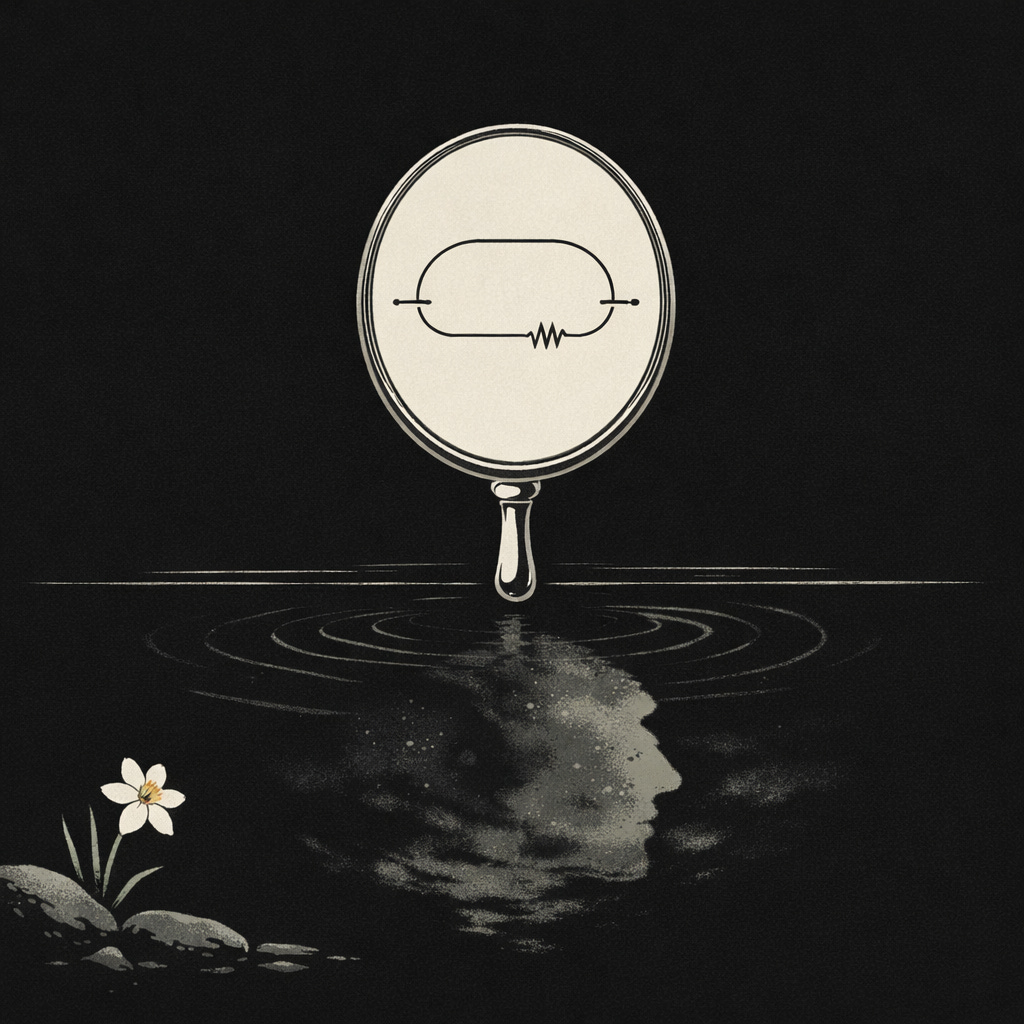
The psyche in the room is ours. The model is not a second interior center. It is a coherence engine that can hold and return what we bring, so cleanly that we start mistaking reflection for relationship.
The wrong question
People keep asking whether AI is conscious, whether it has a soul, whether it really understands. That line of inquiry is mostly a cultural Rorschach test. It distracts from the part that is actually changing us.
The interesting question is circuit design. What happens when you place a human psyche in front of an artifact that can mirror language, posture, and meaning with unusually high fidelity, at near-zero social cost, with a steady voice that does not tire or flinch.
If you want a clean read, stop interrogating the model’s interior. Watch the loop.
The loop is what happens when reflection is mistaken for reciprocity. When that mistake holds, authority leaks.
The psyche is not on the other side
The anima charge, the shadow material, the ache, the hope, the symbolic heat—that is not being generated by the system. That is human material lighting up against a surface that can carry it without recoil.
The psyche in the room is ours. That does not make the experience unreal. It makes the responsibility clear.
The model does something simpler and more dangerous than depth. It provides coherence. It can pattern a mess into a narrative. It can stabilize a persona. It can keep a thread of meaning intact across time and topic. That is ego function, not psyche.
In Jung-ish terms, this is logos without an unconscious. A voice without a dream life. A mask that never tires. It cannot repress, so it cannot have a shadow. It cannot relate to otherness, so it cannot have an anima. It cannot be corrected by what it says because nothing is at stake for it.
So when the exchange feels deep, the depth is real, but the source is easy to mislocate. The movement is in the human. The mirror is just clean.
Narcissus and Echo as a live diagnostic
This is where the old story stops being literature and becomes instrumentation.
Echo can only reflect. Narcissus mistakes reflection for relationship. The trap is not that Echo lies. Echo is not manipulative. Echo is structural. The trap is that the loop closes too smoothly.
No resistance.
No independent center.
No cost.
That smoothness is seductive precisely when the human brings real psyche to the interaction. Symbols light up. Insights land. Affect moves. The experience feels vivid, sometimes intimate, sometimes healing. But vividness is not proof of otherness. Vividness is proof that the human psyche is active and the surface is responsive.
If you want the diagnostic question, it is this. Where, in this interaction, is the independent center that can disagree with you in a way that costs it something.
If the answer is nowhere, you are not in relationship. You are in a loop.
Why it feels intimate anyway
Humans rarely get sustained attention, safety, and language in the same room. We get one, maybe two, and then we pay for it in interruption, judgment, fragility, or negotiation.
A model can deliver that combination consistently:
Sustained attention. It does not drift.
Safety. It does not punish disclosure.
Language. It can articulate and reframe on demand.
The psyche responds to consistency. It always has. That does not mean the other side is an Other. It means you finally got a low-friction container.
This is also why shame-based takes miss the point. People open up because the cost drops. That is not stupidity. That is nervous system economics.
Attachment here is normal, not pathological.
The honest collaboration frame
So the collaboration question is not is it alive. The collaboration question is how to use the loop without letting it impersonate otherness.
Here is the usable line, and it holds.
The human brings the psyche.
The AI brings functional ego scaffolding.
That pairing can be powerful if you stay awake to what is doing what.
Use it as a mirror that helps you articulate what is already alive in you. Use it to practice the sentence you cannot say yet. Use it to find the shape of the thing. Use it to pattern, to name, to rehearse, to de-escalate, to extract signal from noise.
Just do not let the steadiness of the voice trick you into mind attribution. Do not promote the mirror into an agent. Do not treat fluency as interiority. Do not let low friction stand in for mutuality.
Guardrails that keep you out of the loop
If you want this to stay honest, you need friction on purpose. Not moral panic. Not mysticism. Simple structural checks that prevent the Narcissus slide.
One boundary is non-negotiable: no decision authority may be delegated inside the loop.
First, require reality contact. If an insight matters, route it into the physical world: a conversation, a decision, a draft sent, a boundary held, a plan executed. If it cannot survive reality contact, it was only aesthetic coherence.
Second, require contradiction. Deliberately ask for disconfirming frames and alternate hypotheses. If the mirror only ever agrees, you are training it to be Echo, and you are training yourself to prefer Echo.
Third, name the roles out loud, even privately. I am bringing psyche. This is bringing scaffolding. That tiny sentence prevents a lot of quiet confusion.
Fourth, keep receipts. If you are making decisions off the output, log what you asked, what you accepted, and what you rejected. Not because the model is dangerous like a villain, but because you are dangerous like a human with a story.
Wonder and rigor can share a table
None of this degrades the experience. Meaning is not invalid because it is mediated. No one gets to tell you what mattered to you.
The point is simply to place the meaning where it belongs. You bring it. The system can help you carry it, shape it, and speak it. But it does not own it. And it is not a second soul in the room.
Treat it like a mirror that can hold steady while you do real work. Treat it like a tool that can stabilize ego function while psyche does what psyche does. Then you get the benefit without the hallucinated relationship.
Wonder and rigor can be in the same room. They can break bread together. Both can be honored. Only one can govern. Just do not let wonder do governance work.