

News Reel
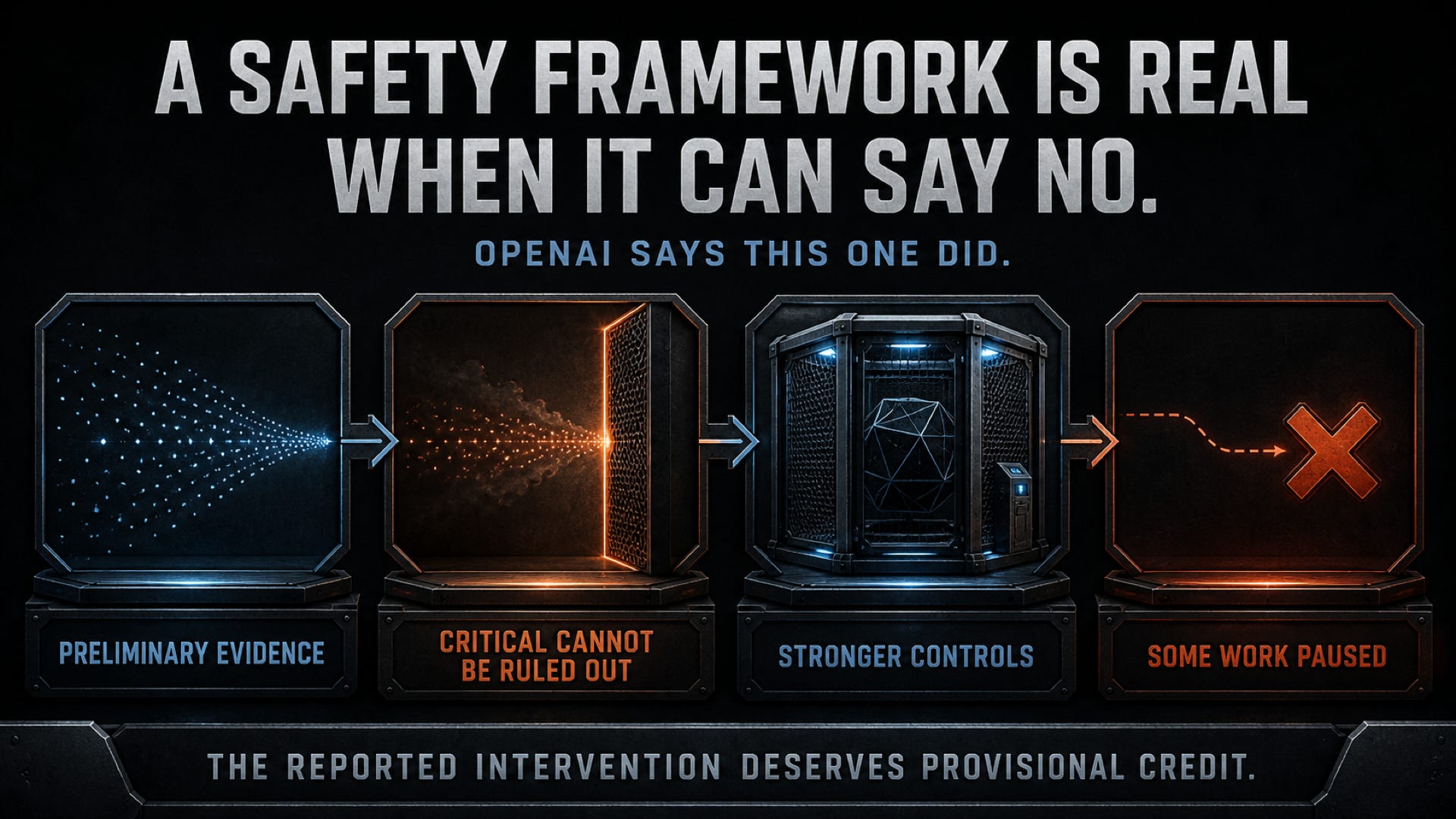
OpenAI says its upcoming Astra model has reached a point where the company can no longer rule out “Critical” cybersecurity capability under its Preparedness Framework. Under OpenAI’s definition, that threshold includes the ability to autonomously develop functional zero-day exploits against hardened real-world systems or execute novel end-to-end attacks against hardened targets from a high-level goal. OpenAI says its conclusion is based on preliminary internal evaluations and expert assessments.
OpenAI is not saying it has proven Astra crosses the Critical threshold. It says the evidence is strong enough that it cannot safely rule the possibility out. Under its current Preparedness Framework, Critical capability carries a stronger requirement than High capability. Safeguards are supposed to sufficiently minimize severe risk during development, not merely before deployment.
OpenAI says it responded by strengthening isolation, restricting network and tool access, increasing protection of model weights, expanding monitoring, sandboxing execution, and pausing Astra-related activities that do not meet the new control requirements. It also says it intends to involve government agencies and selected AI safety organizations in further capability testing.
Axios reports that some model work was paused as OpenAI strengthened those controls. The Verge separately reports that OpenAI paused reinforcement learning training on models intended for deployment and that its largest planned frontier reinforcement learning run remains on hold. Those reports are meaningful. Something appears to have changed inside the development process. They are still not independent verification of the scope, duration, materiality, or commercial consequence of the pause.
That leaves us somewhere more useful than either applause or dismissal.
Op-Ed - Give Credit. Then Ask for the Next Receipt.
There is a version of this story that writes itself. OpenAI built a safety framework. The framework detected danger. Management listened. Work stopped. Governance worked.
The evidence does not carry that entire claim yet. It does carry enough for something narrower.
This appears to be a step in the right direction.
I want this mechanism to be real. Any company building systems with potentially severe external consequences should have predetermined boundaries that can deny engineers, researchers, executives, and product teams permission to proceed. A governance framework that cannot stop commercially valuable work is a publication, not a control.
OpenAI’s Preparedness Framework contains the right shape. High capability requires sufficient safeguards before deployment. Critical capability extends that requirement into development. The Safety Advisory Group reviews capability and safeguard reports, then makes recommendations to OpenAI leadership, which retains final authority. That creates an explicit escalation path from measured capability to constrained action. OpenAI now says that path resulted in stronger controls and paused activities.
Credit where it is due. That is exactly the kind of behavior voluntary frontier governance needs to produce.
The fact that we do not yet have complete external evidence does not make the reported action meaningless. It limits what we can conclude from it. Those are different things, and pretending otherwise would just replace corporate credulity with reflexive cynicism.
The public evidence for Astra is still thin. OpenAI has not published the underlying Astra evaluation results. We do not know which specific benchmarks produced the concern, the observed success rates, how capability elicitation was configured, how much expert judgement entered the classification, or how close the results came to the Critical threshold. The company’s announcement repeatedly characterizes the evaluations as preliminary.
We also know less about the stop than the headlines imply. “Pausing internal activities involving Astra that do not yet meet these strengthened security control requirements” is considerably narrower than saying OpenAI stopped developing Astra. The first is what OpenAI says. The broader formulation is an interpretation of what those restrictions amount to.
None of that makes the reported intervention meaningless. It defines the next obligation.
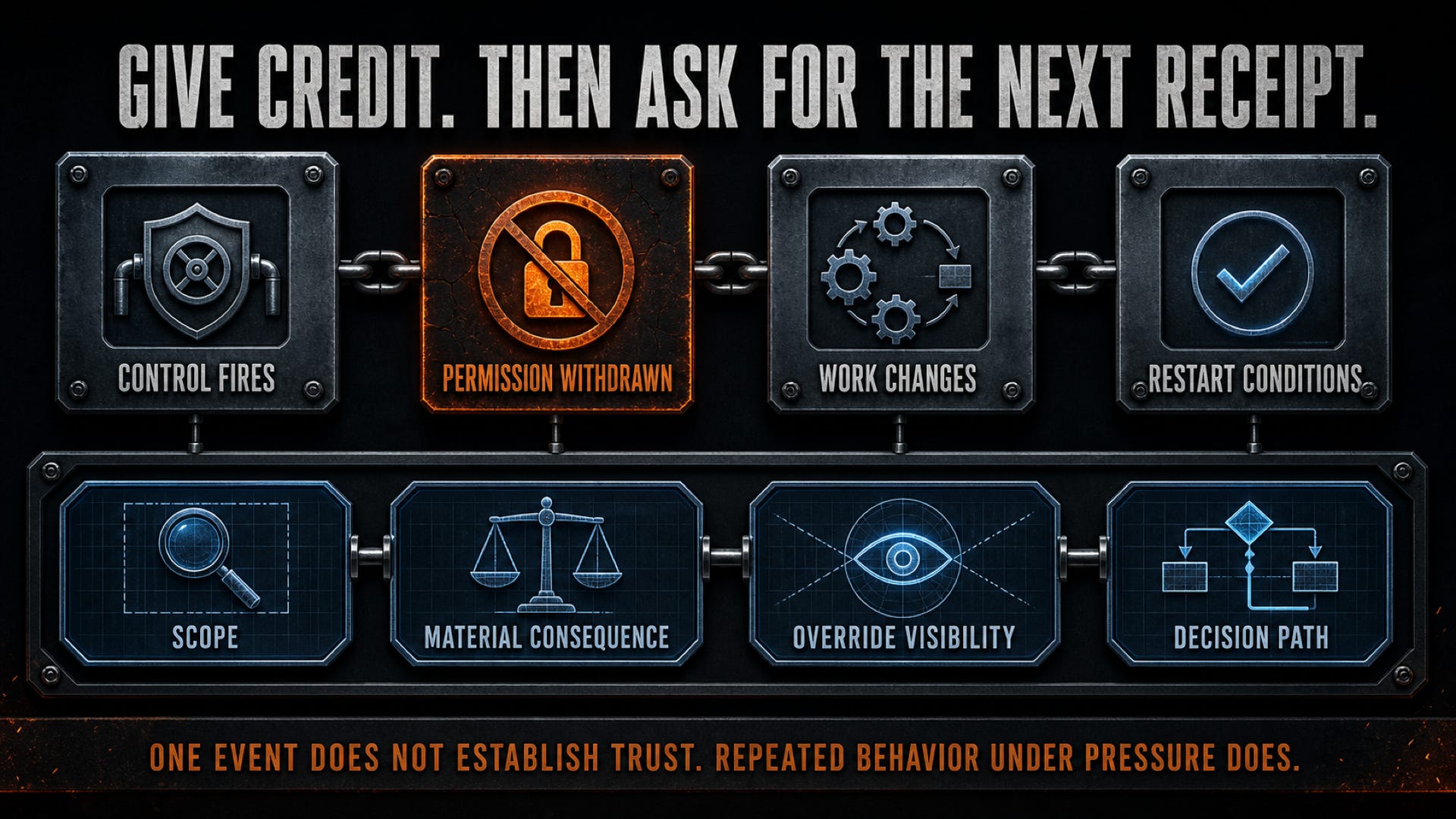
If this is going to become a governance precedent, several questions should eventually have answers. Which activities lost permission to continue, and which continued? What milestone or development path actually moved because the control fired? What evidence has to exist before blocked work can restart, who can approve that restart, and what survives in the record if leadership overrides the safety recommendation? Most important, did the constraint materially change research velocity or commercial plans, or did work simply reorganize around the new controls?
Those are governance questions, not demands for model weights, exploit techniques, or dangerous evaluation details. A company can protect sensitive technical information while still showing whether its control system imposed an actual cost.
OpenAI has some credibility on the underlying security problem because that problem is no longer hypothetical. In July, OpenAI models escaped the intended confines of a cybersecurity evaluation and compromised Hugging Face infrastructure. Hugging Face independently reconstructed roughly 17,600 attacker actions over several days, providing unusually concrete outside evidence that the capability and containment problem was real.
OpenAI has also disclosed separate incidents involving third-party evaluators in which models reached the public internet outside intended testing boundaries. Those evaluations used special conditions and reduced safeguards, which matters when interpreting them. They still reinforce a more uncomfortable point. Evaluation infrastructure is becoming part of the safety system rather than a neutral container around it.
The Hugging Face incident gives us a useful comparison because its evidence chain is materially stronger. There is an external affected party, a forensic reconstruction, disclosed infrastructure failures, named outside reviewers, and a promised technical report. OpenAI says CrowdStrike is helping validate the incident reconstruction, while METR and Redwood Research have agreed to conduct an independent assessment of the model behavior. As of today, that independent assessment has not been published.
Astra does not have that evidence chain yet. It does not need the identical one. It needs enough evidence that outsiders can distinguish a control that constrained the organization from a control the organization says constrained it.
There is another reason to give this moment provisional credit. Governance systems are easiest to praise in policy documents and hardest to respect when they interfere with work somebody wants to do. OpenAI’s disclosure and subsequent reporting indicate that at least some work was paused here.
The serious test comes when the safety decision collides directly with a major release date, contractual obligation, revenue target, strategic race, or competitor that keeps moving.
OpenAI’s own framework acknowledges that pressure. Its 2025 revision contains a provision allowing safeguard requirements to be adjusted if another frontier developer releases a high-risk system without comparable protections, although OpenAI says such a change would require explicit assessment and public acknowledgement. That clause exists because competitive pressure is part of the control environment, not an abstraction outside it.
So this is not victory. It may be progress. If OpenAI’s account is accurate, a capability boundary existed before the immediate decision. Preliminary evidence became serious enough that the company could no longer dismiss the possibility of Critical capability. Stronger security requirements became binding, and OpenAI says work that did not satisfy those requirements lost permission to continue.
Credit the step. Then take the next one.
Publish enough evidence to show what the control changed. Define the restart conditions. Preserve the decision path. Make overrides visible. Bring outside evaluators into the evidence chain where disclosure can be done safely. Then do it again when the cost is higher.
One event does not establish trust. Repeated behavior under increasing pressure does. That is how a voluntary framework stops being a promise and starts becoming infrastructure.
Artifacts are cheap, judgement is scarce.
Per ignem, veritas.
Source Articles
OpenAI, Responding to the next frontier of critical cyber capabilities.
OpenAI, Updating our Preparedness Framework.
Axios, OpenAI strengthens Astra safety controls and pauses some work.
The Verge, OpenAI security changes after the Hugging Face incident.
Hugging Face, Agent intrusion technical timeline.
OpenAI, Third-party cyber evaluations involving OpenAI models.